Top 10 Dive Sites in Wakatobi: Coral Triangle's Finest Reefs
Wakatobi's 63 named dive sites span six distinct zones across the Tukangbesi Archipelago, and the diversity of underwater topography is matched only by the marine life that inhabits it. Gentle coral gardens, vertical walls dropping to 80 meters, current-swept channels, and an eye-shaped atoll — all within a 30-minute boat radius from Tomia Island.
This guide ranks the top 10 dive sites in Wakatobi based on biodiversity, signature features, accessibility, and the quality of the underwater experience. Every site here is cross-referenced from Wakatobi Dive Resort's catalog of 54 sites plus independent operator reports.
1. House Reef
Type: Steep slope with wall, overhangs, and micro-sites | Depth: 0–40 m | Access: Shore entry or taxi boat | Skill level: Intermediate | Best season: Year-round
The House Reef at Onemobaa Island is consistently ranked among the top three house reefs in the world. It's not a single dive site — it's six interconnected micro-sites that span roughly 800 meters of coastline, accessible by walking 80 yards from your bungalow or taking a five-minute taxi boat ride to the upcurrent end for a drift drop.
The reef crest starts at ankle depth and slopes gradually to about 15 meters, where the wall begins its descent to 40 meters. The slope is covered in dense hard coral — table corals, staghorn corals, massive porites bommies — with soft coral gardens on the wall itself. Overhangs and crevices create micro-habitats for macro life, and sandy patches at 12–18 meters harbor garden eels and stingrays.
Marine life is exceptional year-round. Green turtles are seen on nearly every dive, grazing on the seagrass in the shallows. Whitetip reef sharks patrol the reef flat at 8–12 meters. Macro photographers target the overhangs for pygmy seahorses, ghost pipefish, frogfish, and nudibranchs. Night diving on the House Reef is spectacular — octopus, crustaceans, and sleeping parrotfish are reliably encountered.
Why it's #1: No other site in the world combines shore-access convenience, this level of biodiversity, and the variety of diving options. You can do six completely different dives along a single reef system without repeating terrain.
Practical tips: Use the taxi boat for drift drops — it's complimentary and adds variety. A torch is essential for peeking into overhangs. The night dive here is mandatory.
2. Cornucopia ("The Great Wall of Wakatobi")
Type: Sheer vertical wall | Depth: 0–55 m | Access: 15 min boat | Skill level: Advanced | Best season: March–November
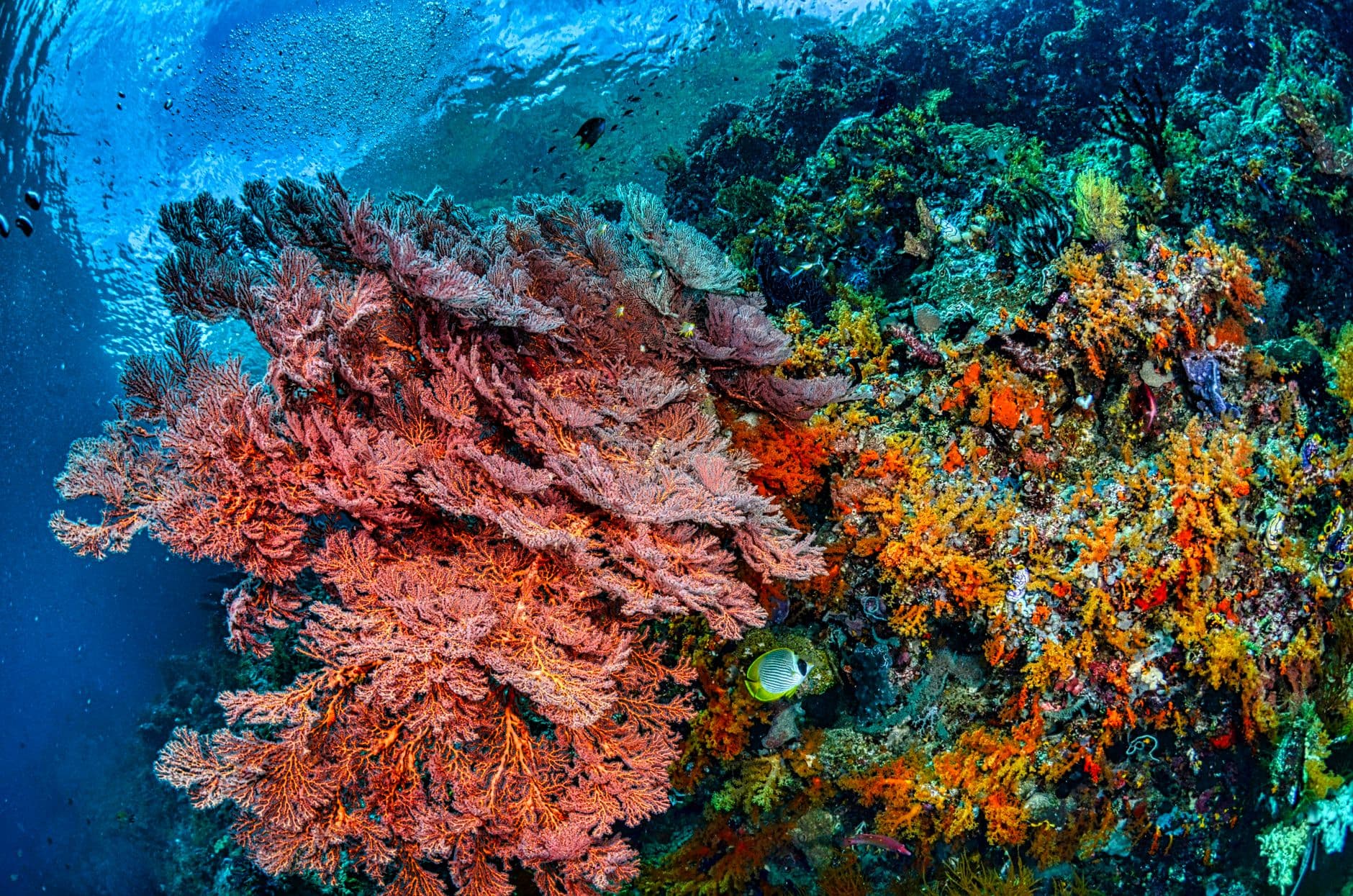
Cornucopia is Wakatobi's signature wall dive — a sheer vertical drop-off that plunges from the surface to 55 meters with no gradual slope, no ledge, and no bottom in sight once you cross the crest. The wall is densely covered in black coral trees, gorgonian sea fans, and barrel sponges, with overhangs and crevices at every depth.
The shallow section (5–18 m) is covered in soft corals — pastel pinks, purples, and yellows — with schools of anthias, fusiliers, and damsels swirling above the reef crest. Below 20 meters, the black coral forest begins, with individual trees reaching 1.5 meters in height. Macro life in the overhangs includes wire corals with pygmy seahorses, nudibranchs, and commensal shrimp.
Grey reef sharks patrol the wall during incoming tides. Turtles are common. Eagle rays occasionally glide past at depth. The sheer drama of a 55-meter drop-off with dense coral cover makes Cornucopia one of the most photographed walls in the Coral Triangle.
Why it's top-ranked: The wall is pristine — zero signs of human impact, no damaged coral, no fishing debris. It is the reef you imagine before human activity started affecting reefs everywhere.
Practical tips: This is a deep dive (40–55 m) with mandatory decompression stops. Nitrox is recommended but requires certification — Wakatobi Resort blends up to 42%. A torch is essential for the overhangs and black coral forest.
3. Fan 38 (East and West)
Type: Steep slope with wall and canyons | Depth: 3–60 m | Access: 15 min boat | Skill level: Intermediate–Advanced | Best season: Year-round
Fan 38 is named for the 38th gorgonian sea fan photographed during a site-mapping project, and it has since become one of Wakatobi's most iconic sites. The reef face is a steep slope with deep canyons, overhangs, and crevices that create a three-dimensional underwater landscape.
The signature feature is the gorgonian sea fans, many exceeding two meters across, that grow from the wall face and canyon edges. The sheer density of fans — hundreds visible on a single dive — is unmatched in Wakatobi. The canyons between 15 and 30 meters are the best spots for fan photography, with backlighting from the surface creating dramatic silhouettes.
Reef manta rays visit cleaning stations at Fan 38 during the July–August plankton season. Grey reef sharks and whitetip reef sharks are common. Eagle rays are occasionally seen gliding along the wall. The West side is more exposed and has stronger current, making it the better choice for experienced divers seeking pelagic encounters; the East side is gentler.
Why it's top-ranked: The gorgonian density alone makes Fan 38 a must-dive. No other site in Wakatobi has this concentration of giant sea fans.
Practical tips: The West side has stronger current — schedule it for incoming tide for the easiest drift. The East side is better for macro photography due to the protected overhangs. Both sides deserve a dive.
4. Roma (The Colosseum)
Type: Gentle slope with coral pinnacle | Depth: 0–30 m | Access: 10 min boat | Skill level: Beginner–Intermediate | Best season: Year-round
Roma is home to Wakatobi's most famous single coral formation: the Colosseum, a natural amphitheater-shaped potato coral pinnacle that rises from 15 meters to within 5 meters of the surface. The formation is roughly 20 meters in diameter, with a central depression surrounded by raised coral walls — exactly like a Roman amphitheater.
The site is shallow (max 30 m) and has minimal current, making it one of the most beginner-accessible signature sites in Wakatobi. The Colosseum itself is surrounded by schooling fusiliers, cardinalfish, and anthias. Banded sea snakes are commonly seen weaving through the coral. Ribbon eels (both blue and black varieties) are reliably found in the sandy patches around the pinnacle. Scorpion leaf fish and stonefish are masterfully camouflaged in the coral heads.
Turtles frequently cruise the perimeter. Whitetip reef sharks rest under the coral ledges. The reef flat above the Colosseum (5–12 m) is covered in pristine hard coral tables and plates.
Why it's top-ranked: The Colosseum is unique in Wakatobi — there is no other coral formation like it in the park. It is also one of the safest, most accessible sites for beginners while remaining visually rewarding for experienced divers.
Practical tips: Perfect for a second dive after a deeper first dive. Good for snorkelers too — the Colosseum crest is at 5 meters. Bring a wide-angle lens for the amphitheater shot.
5. Magnifica
Type: Steep slope with extreme depth wall | Depth: 0–80 m | Access: 15 min boat | Skill level: Advanced–Technical | Best season: March–November
Magnifica is widely considered Wakatobi's best depth dive. The site features a shallow shelf at 5–18 meters with dense macro life, followed by a steep slope that drops into a vertical wall at 30 meters continuing to 80 meters.
The shallow shelf is a macro photographer's dream — cuttlefish, mandarin fish, nudibranchs, and pygmy seahorses are reliably found. The wall below 30 meters attracts schooling pelagics — snappers, skipjacks, barracudas — and occasionally dogtooth tuna and sharks. The deep drop creates upwelling that concentrates nutrients, attracting larger predators.
Why it's top-ranked: Magnifica offers the rare combination of world-class macro on the shelf and pelagic action on the deep wall in a single dive profile. Trimix divers get a genuine 60–80 meter wall experience.
Practical tips: This is a technical dive below 40 meters. For recreational divers, the shallow shelf (18–30 m) is the sweet spot. Nitrox or trimix required for the full experience. Surface interval needs to be long given the depth profile.
6. Spiral Corner
Type: Gentle slope with coral garden | Depth: 2–40 m | Access: 10 min boat | Skill level: Beginner | Best season: Year-round
Spiral Corner is famous for a single claim to fame: it is the only known dive site in the world where schooling pufferfish are reliably observed. The pufferfish here are not the solitary, slow-moving individuals you see elsewhere — they form loose aggregations of 10–20 individuals, swimming together in the current like a school of jacks.
The site itself is a gentle slope with a shallow coral garden at 2–8 meters and a sandy bay at 12–18 meters. Spiral corals — the site's namesake — are abundant in the mid-depth range. Nudibranchs are prolific. Pygmy seahorses are reliably found in the wire corals along the slope.
Why it's top-ranked: The schooling pufferfish phenomenon is unique. You will not find this behavior documented at any other dive site in the world. For that reason alone, Spiral Corner earns a spot on every Wakatobi itinerary.
Practical tips: Best visited mid-morning when the pufferfish are most active. Easy enough for a check-out dive. Pufferfish behavior is seasonal — October to April is the peak window for the aggregations.
7. Karang Gurita (Octopus Reef / "The Eye")
Type: Coral atoll with walls, gardens, and slopes | Depth: 0–35 m | Access: 30 min boat | Skill level: Intermediate | Best season: March–November
Karang Gurita, meaning "Octopus Reef," is an eye-shaped coral atoll located about 30 minutes by boat from Tomia. The atoll is roughly 200 meters long and 100 meters wide, with a central sandy lagoon and coral-covered walls on all sides. From above, it looks like a giant eye in the ocean.
The atoll's walls are covered in pristine corals — both hard and soft — and attract a wide range of marine life. Reef sharks (grey reef, whitetip, blacktip) patrol the outer walls. Barracuda and trevallies hunt in the channel between the atoll's north and south rims. Turtles are common. Eagle rays are occasionally sighted.
The highlight of Karang Gurita is the occasional hammerhead shark sighting — scalloped hammerheads are known to visit the atoll, particularly during the July–September window. They are not guaranteed but are seen often enough that local guides mention the possibility on every briefing.
Why it's top-ranked: The eye-shaped atoll is visually stunning from above, and the combination of shark patrols, pelagic activity, and pristine coral cover makes every dive here feel like an expedition. The hammerhead possibility adds an edge.
Practical tips: Best visited on a calm day — the atoll is exposed and can be choppy in wind. Bring a wide-angle lens for the atoll wall shots. The current through the channel can be moderate on outgoing tides.
8. The Zoo
Type: Slope with sandy bays | Depth: 0–30 m | Access: 5 min boat | Skill level: Beginner | Best season: Year-round
The Zoo is Wakatobi's premier macro photography site, located just five minutes by boat from the resort. The site is a gentle slope with sandy patches and scattered coral bommies, creating a variety of micro-habitats.
The macro life here is extraordinary. Mushroom pipefish, pygmy seahorses, ghost pipefish, leaf fish, and frogfish are all reliably present. The sandy patches harbor garden eels, stingrays, and flounders. Nudibranch abundance is among the highest in the park — experienced macro photographers routinely find 10–15 species in a single dive.
Why it's top-ranked: For macro photographers, The Zoo is the best single site in Wakatobi. The density of critters and the variety of macro habitats (sand, rubble, coral bommies, overhangs) make it a destination unto itself.
Practical tips: Bring a dedicated macro lens or diopter. Move slowly and check every coral bommie. Night dives at The Zoo are excellent for finding octopus, crab, and lobster activity.
9. Black Forest
Type: Wall with steep slope | Depth: 0–80 m | Access: 20 min boat | Skill level: Advanced–Technical | Best season: March–November
Black Forest is named for its dense forest of black coral trees that cover the steep wall from 30 to 80 meters. The black corals here are among the largest in Wakatobi, with individual trees reaching two meters in height, creating an underwater forest.
The wall is steep but not vertical, allowing divers to descend along the slope and explore the black coral groves at different depths. The black corals are inhabited by delicate crinoids, commensal shrimp, and juvenile fish seeking shelter. The deeper sections (50–80 m) are technical-diving territory and attract experienced trimix divers.
Why it's top-ranked: The scale of the black coral forest is unique in Wakatobi. Nowhere else in the park do black corals grow this large or this densely. The site is also one of the best in Wakatobi for deep-wall photography.
Practical tips: Requires Nitrox or trimix for recreational deep diving (40 m+). A bright torch is essential to see the color of the black corals — they appear black in ambient light but show green and gold bioluminescence under a torch beam.
10. Liabale (East and West)
Type: Wall with overhangs and caverns | Depth: 0–85 m | Access: 10 min boat | Skill level: Intermediate–Technical | Best season: Year-round
Liabale consists of two sites on either side of a small peninsula near Tomia. Liabale East features a wall with strong channel currents that attract pelagics — giant trevally, Napoleon wrasse, turtles, and occasional sharks. Liabale West has a central ravine with caverns, deep overhangs, and dense wire coral colonies.
The West side is particularly notable for its macro life — tube sponges, wire corals, whip corals — and the caverns at 15–25 meters create dramatic light effects for photography. The East side is better for large-animal encounters.
Why it's top-ranked: Liabale East offers some of the best pelagic encounters in the Tomia area, while Liabale West is a top-tier macro and cavern-diving site. Together, they represent the full spectrum of Wakatobi diving in two adjacent sites.
Practical tips: Dive Liabale East on incoming tide for the best current-driven pelagic action. Dive Liabale West on a calm day for the cavern photography. A torch is essential for the overhangs on both sides.
Honorable Mentions
Table Coral City (0–20 m) is a shallow plateau with extensive table coral formations, perfect for snorkeling and beginners. Turkey Beach (0–40 m) is a fringing reef with turtles, rays, and excellent macro life. Sombu Dive (0–40 m) near Wangi-Wangi offers wall diving with good coral cover and is accessible from the budget dive operators. Kollo-Soha Beach (0–15 m) is a beach-entry training site perfect for check-out dives.
The outer atolls — Koromaha and Koka — are accessible primarily by liveaboard and offer pristine, rarely-dived walls with exceptional fish density. These are the sites for experienced divers who want untouched reef.