Wakatobi Diving: The Complete Guide to the Coral Triangle's Epicenter
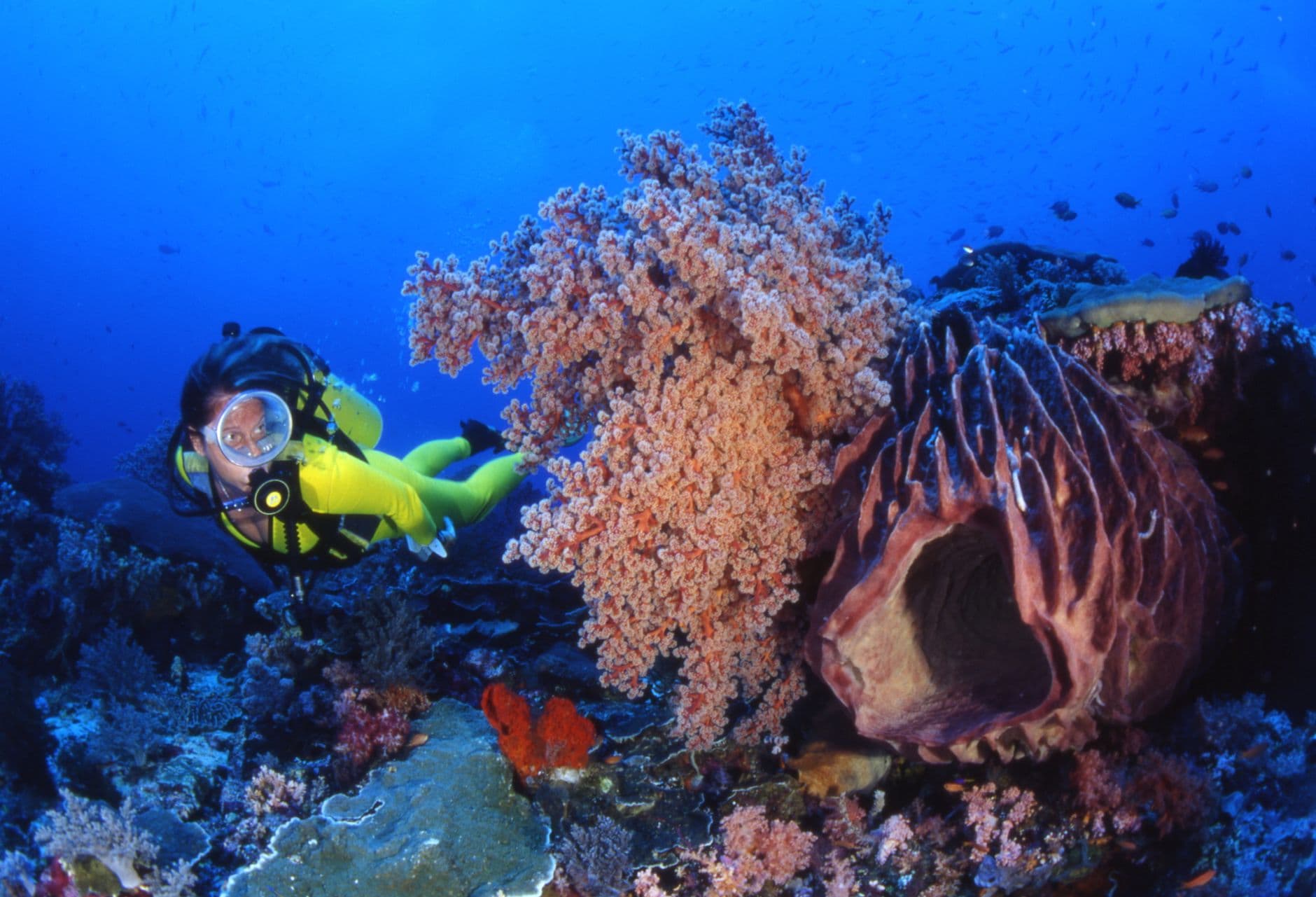
Wakatobi is not a gradual introduction to tropical diving. It is an archipelago in Southeast Sulawesi, Indonesia, sitting at the dead center of the Coral Triangle — the global bullseye of marine biodiversity. Its national park covers 1.39 million hectares, making it Indonesia's third-largest marine protected area, and inside that water lies 88 percent of the world's known reef-building coral species.
This isn't a destination you stumble into. You fly to Makassar, transfer to a 50-seat turboprop, and land on Wangi-Wangi, the northernmost of the four main islands that give Wakatobi its name. But the logistics are worth it, because what you find underwater is unlike anywhere else on the planet.
Why Wakatobi
750 coral species. That is the headline number. To put it in perspective, the entire Caribbean reef system — stretching from Florida to Brazil — hosts about 50 species of reef-building corals. Wakatobi has fifteen times that. A single dive here can pass through more coral diversity than most divers see in a lifetime.
942 fish species have been documented within the park, including a world-record 40 species of butterflyfish — the benchmark marine biologists use to measure reef health. Most healthy reefs have 10 to 15 butterflyfish species. Forty means this ecosystem is functioning at full capacity.
Zero rivers. There are no rivers on any of Wakatobi's islands. Zero sediment runoff, zero agricultural pollution washing onto the reef, zero murky water days after a rainstorm. When a diver tells you they had 40-meter visibility at Wakatobi, they are not exaggerating a good day — they are describing the baseline.
Zero bleaching. The archipelago sits far enough south that cooler currents sweep through in July and August, naturally preventing the thermal stress that bleaches coral elsewhere. While reefs across the globe bleached catastrophically in 2016 and 2024, Wakatobi's corals remained healthy.
Who Wakatobi Is For
Wakatobi is one of the most versatile dive destinations in Southeast Asia. It works for three distinct types of diver.
The resort diver. Wakatobi Dive Resort on Onemobaa Island is a dedicated dive resort with a purpose-built dive center, three day boats, Nitrox up to 42 percent, rebreather support, and a house reef that consistently ranks among the top three in the world. You step off your bungalow deck, walk 80 yards across the sand, and you are at the drop-off. There is no boat commute, no gear hauling, and no surface interval wasted on transit.
The macro photographer. The Zoo, House Reef, and Trailblazer consistently produce pygmy seahorses, ghost pipefish, frogfish, leaf fish, nudibranchs, and mimic octopus. The sandy patches at Tanjung Lintea harbor garden eels and stingrays. Spiral Corner is the only site in the world where schooling pufferfish are reliably observed. Wakatobi is a serious macro destination.
The budget traveler. Wakatobi Dive Resort is expensive, but it is not the only option. Tomia Fun Dive runs two-tank dives from IDR 500,000 (about $32) and offers simple homestay accommodation. Village homestays on Tomia and Kaledupa go for $15 to $30 a night. The marine park entrance fee is IDR 200,000 — about $13 — and the daily diving fee is IDR 25,000 ($1.60). For those willing to stay outside the resort, Wakatobi is surprisingly affordable.
The Four Islands
Wakatobi is an acronym — Wangi-Wangi, Kaledupa, Tomia, Binongko — and each island has a different character.
Wangi-Wangi is the gateway. Matahora Airport (WNI) lands here, the regency capital sits on its coast, and the bulk of budget dive operators and homestays are concentrated here. Dive sites on this side include Waha Wall, Sombu Dive, and Eel Valley, plus the famous night dive at Pasar Wajo pier.
Tomia is the diving heart. Wakatobi Dive Resort occupies Onemobaa Island off Tomia's coast, and most of the 54 resort-mapped dive sites lie within a 30-minute boat radius. Tomia Fun Dive and Tomia Scuba Dive operate here. The topography ranges from gentle coral slopes like Table Coral City to vertical walls like Cornucopia and extreme depth dives like Magnifica.
Kaledupa is the cultural island — Bajo sea gypsy villages, Hoga Island research station, and the channel dive at Numana Gate. It is quieter, less visited, and rewarding for divers who want uncrowded reefs.
Binongko is known as the Island of Blacksmiths, famous throughout Indonesia for its hand-forged parang machetes. Diving here is minimal, but the culture is worth a visit if you have time.
The 63 Dive Sites
Dive operations in Wakatobi are concentrated enough that most divers access 30 to 40 sites during a week-long stay, but the total catalog exceeds 60 named sites plus several outer atolls reachable by liveaboard. The sites break into clear categories.
House Reef and its satellites. The House Reef itself is a 0-to-40-meter steep slope with six interconnected micro-sites, accessible both by beach entry and taxi boat. Adjacent sites like The Zoo, Barracuda, and Conchita extend the shore-dive experience. The House Reef alone could occupy a diver for three days of exploration.
The wall sites. Cornucopia is a sheer vertical drop-off called "The Great Wall of Wakatobi," dropping from 0 to 55 meters with dense black coral and macro life on every overhang. Fan 38 East and West feature gorgonian sea fans up to two meters across. Black Forest descends to 80 meters with huge black coral trees.
The signature sites. Roma (Colosseum) features a natural amphitheater-shaped potato coral pinnacle. Karang Gurita is an eye-shaped coral atoll where reef sharks, turtles, and occasional hammerheads patrol. Magnifica drops to 80 meters and is widely considered the best depth dive in the park, with macro life on the shallow shelf and schooling pelagics on the deep wall.
The current-dependent sites. Channel, Kapota Gate, Wandoka Pinnacle, and Pintu Timur require advanced certification and comfort with moderate to strong currents. These are the sites where pelagic encounters — giant trevally, dogtooth tuna, sharks — are most likely.
Practical Overview
Wakatobi sits in UTC+8 (Central Indonesia Time, same as Bali and Singapore). The currency is Indonesian Rupiah (IDR), though Wakatobi Dive Resort quotes in USD. English is widely spoken at the resort and at Tomia Fun Dive; Indonesian is the lingua franca everywhere else.
The nearest hyperbaric chamber is in Makassar, roughly five hours by flight. DAN insurance is mandatory — no exceptions.
The best time to visit is March through May or September through November, when visibility peaks at 30 to 50 meters and seas are calm. July and August bring plankton blooms that drop visibility to 20 to 28 meters but attract manta rays and occasional whale sharks. Diving is possible year-round — the resort has cancelled only four dives in ten years due to weather.
Bottom Line
Wakatobi is the densest concentration of marine biodiversity on Earth that is accessible to recreational divers. The coral counts are world records, the visibility is exceptional, and the range of diving — from shore dives to deep walls to current-swept channels — is remarkable for a single park. It is not a quick trip from Bali, but the payoff is the most biodiverse reef diving in the Coral Triangle.