Raja Ampat Dive Guide: 40 Sites, Manta Rays & Coral Triangle
Raja Ampat — the "Four Kings" of Indonesian Papua — sits at the epicenter of the Coral Triangle, Earth's undisputed capital of tropical marine biodiversity. With 600+ hard coral species (75% of the world's total), 1,700+ reef fish species, and a single dive site that holds the world record for fish species counted on one dive (374 at Cape Kri), this is not another destination on the list. It's the one divers measure everything against.
But Raja Ampat is not a casual trip. It's remote, expensive to reach, demands strong diving skills at many sites, and operates without a hyperbaric chamber on any of its 1,500 islands. This guide covers the real logistics, the best sites, what to expect underwater, and who this destination is actually for.
Where Is Raja Ampat and How Do You Get There?
Raja Ampat is an archipelago off the northwest tip of Bird's Head Peninsula, Southwest Papua province, Indonesia. The four main islands — Misool, Salawati, Batanta, and Waigeo — give the region its name. Center coordinates: 0.23°S, 130.51°E.
Getting there is a multi-leg journey:
- Fly into Jakarta (CGK) or Bali (DPS) — the nearest international gateways to eastern Indonesia
- Connect to Sorong (SOQ) — ~4–5 hours from Jakarta, ~3 hours from Bali
- Take the ferry from Sorong to Waisai — 2–3 hours by express speedboat (~$10–16)
- Your resort or liveaboard handles the last leg from Waisai
The most time-efficient approach for dedicated divers is a liveaboard that departs directly from Sorong. Seven- to fourteen-day itineraries cover Misool, Dampier Strait, and Wayag — the three core dive areas — in a single trip.
Who Should Dive Raja Ampat?
Ideal for: Advanced Open Water and above, particularly divers comfortable with drift diving and moderate to strong currents. Macro photographers will find some of the best muck diving in the world at Kabui Bay. Liveaboard enthusiasts who value biodiversity over resort amenities.
Not ideal for: Newly certified Open Water divers who haven't done drift dives. Divers on a tight budget — this is a $4,000–8,000/week destination when you factor in flights, liveaboard or resort, and park fees. Anyone uncomfortable with remote conditions and limited medical infrastructure.
Beginner-friendly options exist: Boo Windows, Yenbuba Jetty, Arborek Jetty, Candy Store, and the jetty dives at Sauwandarek are all calm, shallow (3–20 m) sites with mild current. Several eco-resorts offer PADI courses from Open Water through Divemaster.
What You'll See Underwater
Raja Ampat packs more marine life into a square kilometer than any other region on Earth. The key categories:
Manta Rays — Both reef (Mobula alfredi) and oceanic (Mobula birostris) mantas use Dampier Strait cleaning stations year-round. Manta Sandy and Manta Ridge are the most reliable spots, where mantas queue up for cleaner wrasse service at 12–25 m. Peak manta season runs October–April for reef mantas and June–October for oceanics.
Sharks — Grey reef, whitetip reef, and blacktip reef sharks are common year-round at any outer reef site. Scalloped hammerheads school in 20–50+ individuals at Cape Kri and Blue Magic during tidal changes. Zebra sharks — subject of a pioneering reintroduction program — are occasional but increasingly common since 2024.
Pelagics — Dogtooth tuna, giant trevally, barracuda, rainbow runners, and schools of jacks hunt the current-swept channels. Whale sharks — almost exclusively juveniles 3–6 m — appear June–September when plankton blooms are thickest.
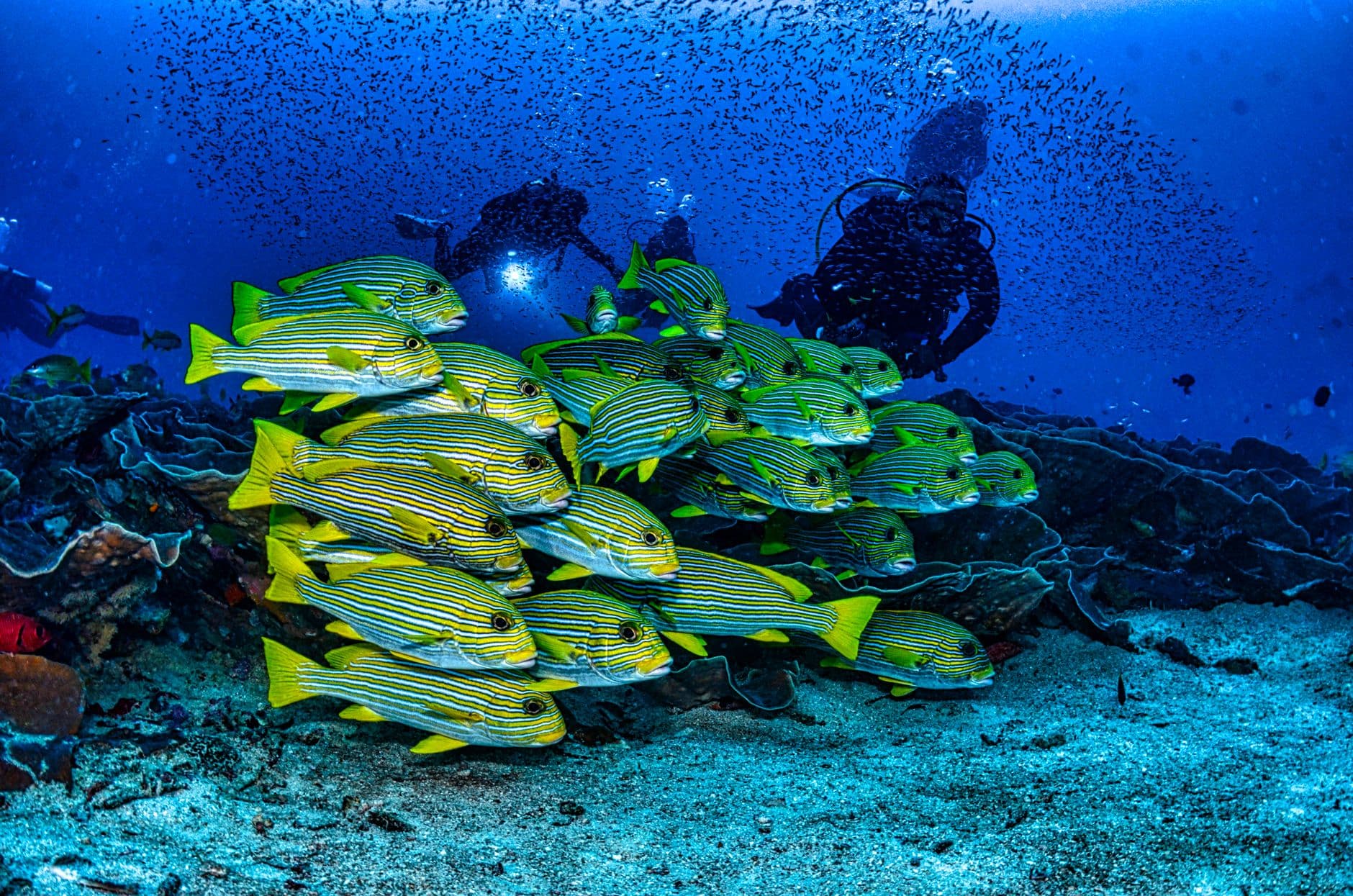
Reef Life — The coral diversity alone is worth the trip. 600+ hard coral species in every shape, color, and growth form. Napoleon wrasse, bumphead parrotfish (schools of 10–50+), barramundi cod, and ornate ghost pipefish are regular sightings.
Macro Life — Kabui Bay (also called Secret Bay) near Waisai is a world-class muck diving site with wonderpus, mimic octopus, flamboyant cuttlefish, frogfish, pygmy seahorses, and rhinopias. Nudi Rock in Misool has 50+ nudibranch species.
Liveaboard vs Land-Based
| Option | Best For | Typical Cost | Coverage |
|---|---|---|---|
| Liveaboard (7–14 days) | Maximum site access, all three areas | $4,000–8,000/week | Misool, Dampier Strait, Wayag, Kofiau |
| Eco-resort (per night) | Relaxed pace, single area focus | $150–500/night incl. diving | One resort area (Misool, Batanta, or Waigeo) |
Most first-time visitors to Raja Ampat choose a liveaboard for coverage. The top operators include Raja Ampat Aggressor, The Seven Seas, Arenui, Pindito, and Damai I & II. If you prefer land-based, Misool Eco Resort, Meridian Adventure, Papua Paradise, and Sorido Bay are the established options.
Marine Park Fees and Conservation
Every diver pays an IDR 1,000,000 (~$65 USD) marine park fee per year. This fee funds the Raja Ampat Marine Recreation Park, a community-managed MPA system that is one of the most successful conservation models in the Coral Triangle. Raja Ampat was designated a UNESCO Biosphere Reserve in 2025.
The zebra shark reintroduction program (2022–2032) has been releasing captive-bred individuals with increasing success — 500 sharks is the target. Crown-of-Thorns starfish outbreaks are managed by local divers using vinegar injections. Mooring buoys at all major sites prevent anchor damage.
Safety: The Chamber Problem
There is no hyperbaric chamber in Raja Ampat. The nearest confirmed operational chamber is in Manado, North Sulawesi — a medevac flight 3–5 hours away. DAN (Divers Alert Network) evacuation insurance is mandatory. Every diver should carry DAN coverage and an emergency contact card.
General safety: Malaria prophylaxis is recommended — Raja Ampat is a malaria zone. Mobile coverage is limited to Waisai and resort areas. Most resorts and all liveaboards carry satellite communications for emergencies.
Practical Quick Reference
| Item | Detail |
|---|---|
| Best diving months | October–April |
| Best manta/whale shark | June–September (plankton season) |
| Water temperature | 26–30°C (North: 28–30°C, Misool: 26–28°C) |
| Visibility | 10–35 m (peak 25–35 m Oct–Apr) |
| Current | Mild to strong; drift diving standard |
| Depth range | 1–50 m+ (typical 10–35 m) |
| Visa | Visa on Arrival for most nationalities (IDR 500,000, 30 days) |
| Currency | Indonesian Rupiah (IDR); bring cash from Sorong |
| Wetsuit | 3 mm full suit year-round; 5 mm for thermocline-sensitive divers |
Raja Ampat asks for your best diving, your attention to safety, and your respect for its reefs. In return, it delivers underwater experiences that redefine what's possible. Plan ahead, dive conservatively, and book early — the best liveaboards fill months in advance.