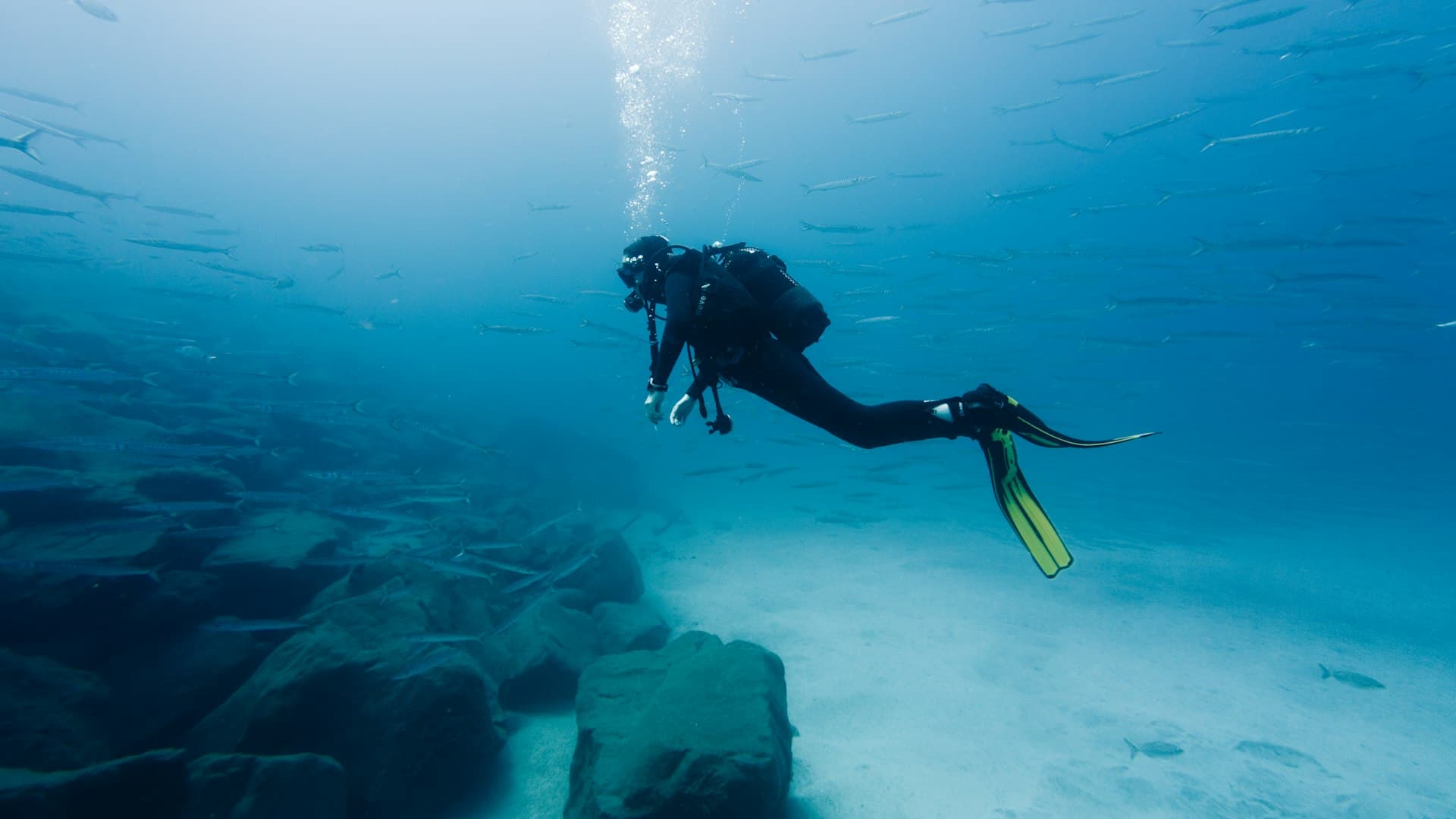
Poor Knights Islands Diving: New Zealand's Volcanic Marine Reserve
Twenty-two kilometers off the Tutukaka Coast, the Poor Knights Islands rise from the Pacific as the eroded remains of a four-million-year-old rhyolitic volcano. Above water, the islands are protected nature reserves where landing is prohibited. Below water, they form one of the Southern Hemisphere's most distinctive dive landscapes: sea arches, sheer walls, sponge gardens, kelp-lined boulder slopes, and the huge echoing chamber of Rikoriko Cave.
Jacques Cousteau famously rated the Poor Knights among his top dive sites in the world, and the reputation is not just marketing. The reserve sits at a subtropical-temperate meeting point warmed by the East Auckland Current. That creates an unusual mix: blue maomao (Scorpis violacea) and kingfish schooling through archways, red moki (Cheilodactylus spectabilis) and butterfish on temperate reef, jewel anemones and sponges covering shaded walls, and summer gatherings of short-tail stingrays (Dasyatis brevicaudata) and New Zealand eagle rays (Myliobatis tenuicaudatus).
Why the Poor Knights Are Different
The Poor Knights Islands Marine Reserve protects 1,890 hectares around Tawhiti Rahi, Aorangi, and the surrounding rocks. The no-take rules are strict: no fishing, no collecting shells or rocks, no landing on the islands, and careful anchoring only where permitted. Those rules have made the reserve a conservation success story. Snapper biomass increased dramatically after full protection, and the fish behavior feels different from heavily fished coastlines: schools are dense, larger fish are common, and the reserve's food web looks intact.
Topography is the other signature. Many tropical destinations are built around coral reefs; the Poor Knights are built around volcanic architecture. You dive through arches, along buttresses, through tunnels, and into sea caves where surge, light, and schooling fish create the drama. Even shallow sites feel three-dimensional. A 12-meter swim through Blue Maomao Arch can be more memorable than a 30-meter wall elsewhere because the whole arch may be filled with fish.
The Main Diving Areas
Most trips leave from Tutukaka Marina and take 30-45 minutes to reach the islands. Operators choose sites based on wind, swell, current, and diver experience.
Tawhiti Rahi, the larger northern island, holds many of the classic arch and wall dives: Northern Arch, Blue Maomao Arch, Magic Wall, Barren Wall, The Tunnel, The Gap, The Gut, Cleanerfish, and Maomao Arch. These sites are ideal for divers who want dramatic swim-throughs, blue maomao schools, walls, and pelagic fly-bys from kingfish (Seriola lalandi) or bronze whalers (Carcharhinus brachyurus) in summer.
Aorangi, the southern main island, offers Southern Arch, The Gardens, The Pinnacles, Tie Dye, Nursery Cove, Aorangi Point, Landing Bay Pinnacle, Jan's Crack, and Nudibranch Rock. This side is especially good for sponge gardens, macro life, and summer ray encounters. The Gardens and Tie Dye are named honestly: the walls can be packed with color.
The channel and offshore rocks include Rikoriko Cave, Middle Arch, Treasure Chest, Sugarloaf Rock, and High Peak Rocks. Rikoriko Cave is the headline: one of the world's largest sea caves by volume, with a ceiling around 30 meters high and a chamber that extends deep into the island. Divers often visit the entrance zone or combine cave light effects with nearby reef diving.
Marine Life Highlights
Poor Knights marine life is not about a single animal; it is about layers. Blue maomao often form dense clouds in arches. Pink maomao, trevally, kingfish, demoiselles, red moki, and snapper fill midwater and reef edges. On the sand and lower reef, look for short-tail stingrays, eagle rays, and long-tail stingrays. Macro divers search for nudibranchs, jewel anemones, morays, crayfish, and scorpionfish. Winter and spring can be excellent for nudibranchs as hydroids bloom.
Large animals are possible but seasonal or unpredictable. Bronze whalers are more often seen in warmer months. Common dolphins (Delphinus delphis) may ride the boat wake. Humpback whales (Megaptera novaeangliae) migrate past Northland from June to October, and orca (Orcinus orca) are possible year-round in coastal waters. Leatherback turtles (Dermochelys coriacea) occur in New Zealand waters but should be treated as a rare bonus, not an expectation.
When to Dive
| Season | Months | Water | Visibility | Best for |
|---|---|---|---|---|
| Summer peak | Dec-Apr | 19-23°C | 20-30 m | Warmest water, best access, ray schools |
| Shoulder | May and Nov | 16-19°C | 15-25 m | Fewer divers, still strong conditions |
| Winter | Jun-Aug | 14-17°C | 10-20 m | Macro life, sponge gardens, quiet boats |
| Spring | Sep-Oct | 15-18°C | 12-25 m | Improving weather, feeding fish, value trips |
December through April is the easiest recommendation for visiting divers: warmer water, calmer seas, and the best chance of reaching exposed sites. Winter is colder and swellier, but it is not a write-off. Bring the right exposure protection and you may get quieter boats, dramatic visibility windows, and exceptional macro.
Skill Level and Equipment
The Poor Knights can suit beginners when operators choose sheltered sites like Nursery Cove or protected arch entrances, but it is not a guaranteed easy-water destination. Surge, current, boat pickup procedures, and overhead-adjacent environments make buoyancy and situational awareness important. Intermediate divers get the most from the destination. Advanced divers can add deeper walls, stronger-current points, and more ambitious swim-through profiles.
A 7 mm wetsuit is common in winter, while many divers use 5 mm or 7 mm in summer depending on tolerance. A hood helps outside peak season. Carry an SMB, use a dive computer conservatively, and listen carefully to site-specific current instructions. There is no hyperbaric chamber in Northland; the nearest chambers are in Auckland, roughly 2.5-3 hours by road from Tutukaka, or around one hour by air ambulance in an emergency.
Getting There and Practical Planning
Tutukaka Marina is the gateway. Auckland Airport is the main international arrival point, followed by a 2.5-3 hour drive north via Whangarei. Whangarei Airport is closer, about 30 minutes from Tutukaka, with domestic flights from Auckland. Most divers either rent a car or arrange transfers; having a car makes accommodation and food logistics easier.
Trips are normally two-dive boat days from Tutukaka, with the ride to the islands taking 30-45 minutes. Peak summer and holiday periods book out early, especially around Christmas and New Year. New Zealand uses the New Zealand Dollar, cards are widely accepted, and tipping is not customary. Bring seasickness medication if you are prone to motion sickness; the coastline is exposed and the trip crosses open water.
Bottom Line
The Poor Knights are not tropical reef diving transplanted into New Zealand. They are their own thing: volcanic, fish-filled, protected, sometimes cold, often dramatic, and deeply rewarding. Come for the Cousteau reputation, but remember the details that make the place work: no-take protection, the East Auckland Current, archways carved by old volcanoes, and the discipline of Tutukaka operators who know when to choose shelter and when to go big. For divers visiting New Zealand, this is the North Island's must-dive marine reserve.