Playa del Carmen Diving Guide
Playa del Carmen is more than a convenient base for cenotes and the ferry to Cozumel. Directly offshore, the mainland shelf holds its own collection of coral ridges, sandy channels, walls, arches, a wreck, and a regulated winter bull shark observation area. Local dives begin with a boat ride rather than a ferry or road transfer, and they cover a useful range from 6 m coral gardens to advanced profiles near 40 m.
That range is the reason Playa works for mixed-experience groups. A recently certified diver can spend a morning at Jardines or Cueva del Pargo, while an experienced buddy can plan Mama Viña, Los Arcos, or Pared Verde on another day. Most dives include some current, but its strength varies sharply by site and weather. The right question is not simply, “Is there current?” It is, “What is this site doing today?”
This guide focuses on Playa del Carmen’s local marine dives. Cozumel’s reefs are across the channel and require a separate day-trip plan. The inland cenotes are freshwater cavern or cave environments reached by road. Both are worth considering, but neither should be confused with the reefs immediately offshore from Playa.
Playa Diving at a Glance
Local marine sites span a normal depth range of about 6–40 m. Every one is reached by boat. Shallow platforms such as Jardines, Shangri-La, Chun Zumbul, and Cueva del Pargo usually offer gentler profiles, sand patches, ledges, and plenty of time to look for small reef life. Deeper reefs and walls—including Tortugas, Los Arcos, Pared Verde, and Moc-Che Deep—bring stronger flow, shorter bottom times, and more demanding buoyancy control.
Water temperature runs from roughly 25.1°C in January to 29.2°C in September. Destination-wide visibility ranges from 15–40 m, with 20–40 m commonly reported during the November–April dry season. Rain, wind, swell, and runoff can lower visibility, especially during the wetter months. These are planning ranges, not promises.
The usual seasonal split is straightforward:
- November–April: drier weather, cooler water, often clearer visibility, and the regulated bull shark tourism window from November 1 through March 31.
- May: a warm transition month with increasing rain.
- June–October: warmer water, wetter weather, and greater exposure to tropical systems and port closures.
Reef diving continues year-round. Weather and the Port Captain, however, always have the final say. A closure overrides the day’s booking, even if conditions looked acceptable when you went to bed.
What the Local Reefs Feel Like
Playa’s reefs tend to form elongated ridges running near the coast, with sand channels between coral structure. Many dives are conducted as drifts: the boat drops the group, follows bubbles, and retrieves divers down-current. On a mild day, that may feel like a slow moving walkway. At Sábalos, Barracuda, Tortugas, or the deeper walls, the pace can be much faster.
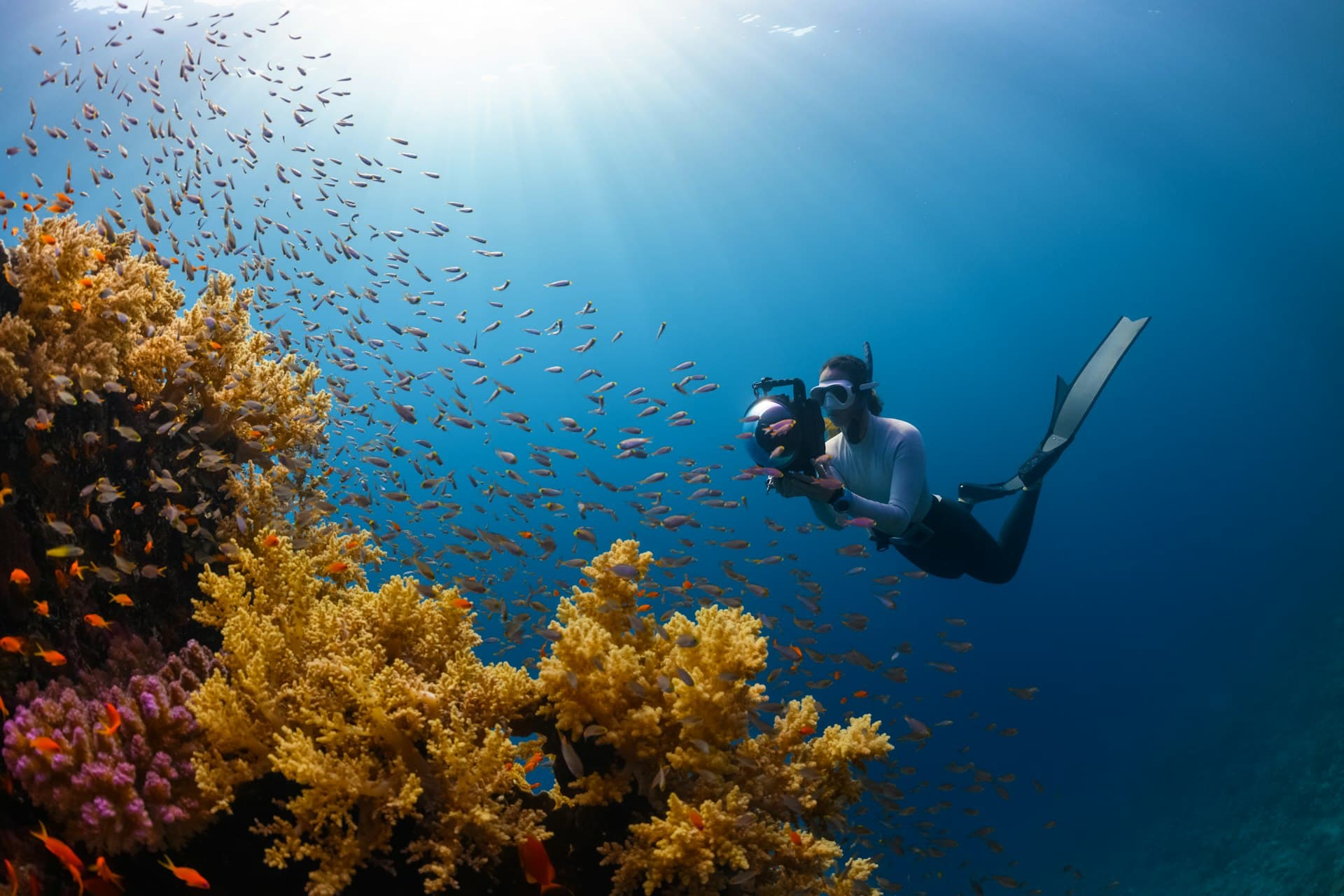
The shallow sites reward close observation. Look beneath ledges for Caribbean spiny lobster and green morays, across sand for southern stingrays, and above coral heads for grunts, snappers, angelfish, parrotfish, and barracuda. Green turtles and hawksbill turtles can appear throughout the year, although no individual sighting is guaranteed. Nearby beach nesting follows a separate seasonal calendar and should not be used to predict what any one dive will produce.
Deeper profiles shift the emphasis toward wall scenery, sea fans, barrel sponges, schooling fish, and passing animals in open water. Eagle rays have a stronger seasonal signal from November through March, but may appear outside those months. Nurse sharks and larger groupers are possible rather than routine. Treat every encounter as a wild event, not an item on a checklist.
Five Sites That Explain Playa
Jardines: the easy introduction
Jardines sits in the 6–13 m range on a shallow coral platform with sand pockets, a small wall, and overhangs. Current is often weaker than on the deeper drift reefs, which is why the site is frequently used for check dives, training, and first local immersions. Morays, angelfish, lobster, crabs, trumpetfish, and small snails reward a slow pace, while jacks or barracuda may pass overhead.
This is a sensible first dive if you have been out of the water for a while. It gives you room to check weighting and buoyancy before committing to a deeper wall or fast drift.
Cueva del Pargo: structure in shallow water
Also around 6–13 m, Cueva del Pargo combines a circular overhang, ledges, coral garden, sand, and seagrass. Its varied habitat makes it a strong site for both new divers and experienced photographers. Pargo, morays, lobster, shrimp, turtles, stingrays, squid, and occasional seahorses may be found here.
The name can sound like an invitation to enter a cave, but the day’s route and any overhead section must be discussed during the briefing. Stay within your training and follow the guide’s chosen line. Boat traffic is another reason to listen carefully to ascent and surface-marker instructions.
Tortugas: the classic turtle drift
Tortugas covers a broad reef plateau and slope with barrel sponges. Published profiles range from 10–40 m, though many dives are conducted between 15 and 30 m. Green and hawksbill turtles are the signature attraction, joined by barracuda, groupers, tarpon, and rays.
The site is best understood as a flexible family of profiles rather than a single fixed route. Current, group experience, gas use, and the chosen section determine how deep and fast the dive becomes. Its name reflects frequent turtle encounters, not a guarantee.
Mama Viña: Playa’s wreck dive
Mama Viña was a shrimp and crab boat intentionally sunk in 1995. The structure now supports coral and attracts spadefish, jacks, barracuda, morays, and groupers. The wreck usually rests around 28–30 m, and the dive often begins with a blue-water descent before continuing as a current-exposed drift.
Depth and flow limit bottom time, so this is not a casual extension of a shallow reef dive. Agree on descent procedure, maximum depth, turn pressure, separation protocol, and ascent plan before entering. The wreck is compelling from the outside; any penetration decision belongs within formal training, site conditions, and the operator’s plan.
Shark Point: controlled winter observation
Shark Point is an open sand-and-stone plateau around 20–25 m, not a colorful reef drift. Adult female bull sharks aggregate offshore in winter, and tourism is managed within a regulated window from November 1 to March 31. Many operators describe December through March as the core season, but arrival and departure vary and sightings are never guaranteed.
This is a controlled wildlife observation dive. Operator protocols and participation requirements vary, and moderate to strong current is possible. Choose an authorized, experienced operator, listen to the complete shark briefing, hold the assigned position, and never chase or block an animal. The objective is quiet observation on the sharks’ terms.
Who Playa del Carmen Is For
New and returning divers
Playa has several shallow choices between 6 and 15 m, including Jardines, Shangri-La, Chun Zumbul, Cueva del Pargo, Moc-Che Shallow, and Cerebros. That does not make every day beginner-friendly. Surface conditions and current can change, so the operator should choose the site after assessing the group and the morning weather.
If you are rusty, say so before boarding. A shallow check dive is a smart reset, not a penalty. It gives the guide useful information about your weighting, air consumption, trim, and comfort in moving water.
Drift divers and intermediate divers
Sábalos, Barracuda, and Tortugas offer the transition from gentle local reefs to more active current. Sábalos is shallow but can move quickly over coral walls, ridges, sand pockets, and caves. Late-summer tarpon schools are reported there, especially around August and September, but encounters vary.
Playa’s Barracuda is a local mainland reef at 6–15 m with finger-like outcrops and sand channels. It is not Cozumel’s expert-level Barracuda Reef. Confirm which destination and site your booking names before assuming the profile.
Experienced divers
Los Arcos, Pared Verde, Moc-Che Deep, Punta Venado, and Mama Viña add depth, walls, arches, stronger current, and tighter gas planning. Los Arcos sits around 21–35 m and includes two arches, caverns, and swim-through formations. Pared Verde runs roughly 20–30.5 m along a near-vertical face with ledges and sea fans. Punta Venado is a more remote southern option, with swell exposure and potentially very strong current.
Cantil is different again: its upper edge begins around 40 m and the wall continues deeper. It is a special-request, technical-fringe profile rather than part of the standard local two-tank circuit. Direct operator confirmation is necessary before treating it as a realistic trip option.
Choosing the Right Season
Choose December through March if bull sharks are your priority and you prefer cooler water with generally good visibility. January averages about 25.1°C, February 25.3°C, and March 25.6°C. Cold fronts can still bring wind, swell, stronger current, or closures.
Choose April or May for warming water and a transition away from the main winter wildlife season. April averages 26.6°C and is often clear; May reaches about 27.4°C as rain becomes more frequent.
Choose June through August if you favor warm water. Monthly averages rise from 28.3°C in June to 29.1°C in August. Showers and storm risk increase, and visibility becomes more weather-sensitive. July through October is also the reported window for Atlantic tarpon at Sábalos, with the strongest signal in late summer.
Choose September or October only with flexibility. September averages 29.2°C, the annual high, but carries the greatest tropical-weather risk. October remains warm at about 28.4°C and can have variable visibility. The regulated bull shark season has not opened in October.
Practical Planning and Safety
Ask what the booking includes and which launch point is used. Local reefs are boat dives, and beach or marina procedures vary. Keep valuables minimal, bring sun protection and water, and confirm whether rental gear, conservation charges, transport, and taxes are included rather than assuming.
On the boat, pay attention to five parts of the briefing: expected current, maximum depth, group formation, ascent method, and pickup procedure. Carry the surface signaling equipment required by the operator and know how to deploy it. Do not fight a drift to hold one photo angle; protect your gas, stay with the group, and let the guide choose the route.
Good buoyancy matters on every profile. It protects coral, keeps sand out of the water column, and prevents uncontrolled depth changes near walls. Do not touch coral or wildlife, stand on the reef, enter an overhead area beyond your training, or crowd turtles, rays, or sharks.
Finally, accept substitutions and cancellations as part of Caribbean boat diving. The operator sees the sea state, current, group ability, and port instructions that morning. A safer shallow reef can be the correct replacement for a planned wall, and a closed port means no local boat dive at all.
The Bottom Line
Playa del Carmen rewards divers who treat it as a destination in its own right. Its local reefs offer shallow coral structure, lively drifts, turtle habitat, deep walls, arches, and a coral-covered wreck, with a carefully managed bull shark experience in winter. Pick sites by current and depth rather than name recognition, keep Cozumel and cenotes as separate dive days, and leave room for the operator to change the plan. That flexibility is how you get the best of Playa without asking the sea to follow an itinerary.