The Complete Palau Diving Guide: Sites, Wrecks & Wildlife
In 2020, Palau became the first nation on Earth to close 80 percent of its ocean territory to fishing — creating a marine protected area the size of France. The result is one of the most biodiverse and predator-dense diving experiences on the planet.
This archipelago of roughly 340 islands in the western Pacific sits between the Philippines and Guam, and it occupies a class of its own among dive destinations. The numbers tell you why: over 1,400 species of reef fish, 500+ species of hard and soft corals, seven of the nine known giant clam species, and thirteen species of shark commonly sighted on a single week of diving. The currents that sweep through Palau's passages are strong by design — they bring nutrients, they bring action, and they create the drift dives that have made this place legendary.
What Makes Palau Unique
Blue Corner — The World's Most Famous Wall Dive
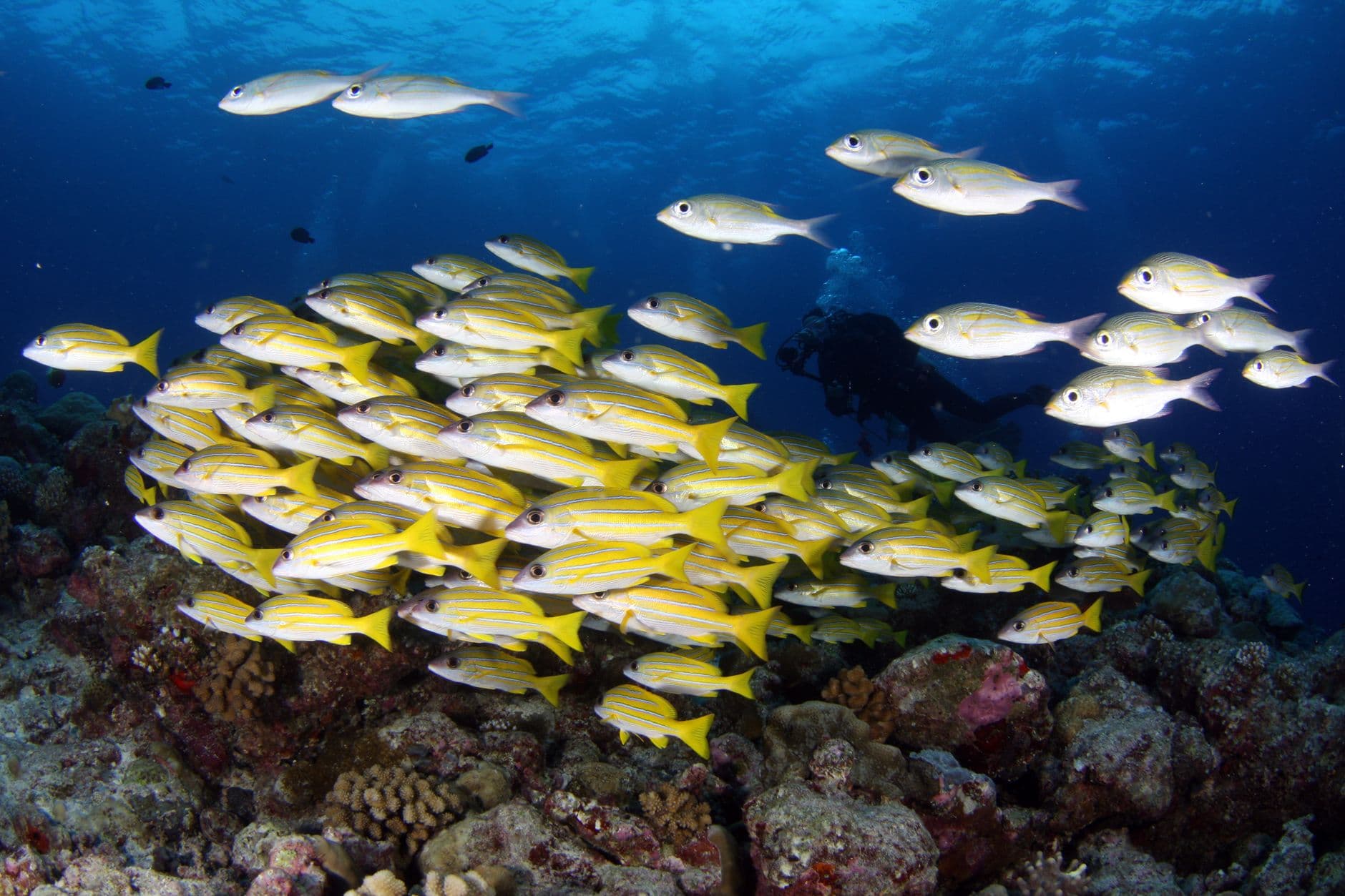
Blue Corner is the reason divers book a flight to Micronesia. It is a triangular coral plateau at the northwest point of Ngemelis Island where the reef drops vertically on three sides into open ocean. You descend to about 20 meters, hook into the reef with a stainless steel reef hook, and hang in the current while nature unfolds around you. Scores of grey reef sharks cruise the edge in lazy circles, barracuda spin in dense columns overhead, bigeye trevally sweep through like a wall of silver, and Napoleon wrasse swim right up to inspect your camera. Manta rays, eagle rays, and the occasional whale shark glide through when conditions align. The current runs strong — 2 to 3 knots is standard — and a reef hook is mandatory, but the show is worth every second of hang time.
German Channel — Manta Central
German Channel is a man-made passage blasted through the reef by German colonial administrators in the early 1900s to ship phosphate from the islands. Today it is Palau's premier manta ray cleaning station. On an incoming tide, manta rays — some with wingspans exceeding 5 meters — queue up at cleaning stations along the channel floor, where cleaner wrasse remove parasites from their gills and skin. Divers kneel on the sandy bottom at 10 to 18 meters and watch these giants hover in place, often for the entire dive. The best manta action runs January through April, but mantas are present year-round.
Jellyfish Lake — A 12,000-Year-Old Phenomenon
A short boat ride through the Rock Islands brings you to Ongeim'l Tketau, better known as Jellyfish Lake. This marine lake was cut off from the ocean roughly 12,000 years ago by rising sea levels, and the golden jellyfish trapped inside evolved in isolation — losing their stinging ability because there were no predators to defend against. Today millions of golden jellyfish pulse through the lake on a daily migration that tracks the sun. Snorkeling here feels like floating through a living constellation. The lake is a protected site: no scuba is allowed, only snorkel, and you pay a ranger fee at the dock.
WWII Wrecks — History Beneath the Reef
Operation Desecrate One, on March 30–31, 1944, was one of the largest carrier-based air raids of World War II. American planes sank over sixty Japanese ships in Palau's lagoon in a single 48-hour period. Today those wrecks form one of the richest WWII wreck-diving collections in the Pacific. The Iro Maru, a 143-meter freighter sitting upright at 30 meters, is the most popular — its holds are still filled with depth charges and a tank. The Amatsu Maru, at 40 meters, is covered in a forest of black coral that has earned it the nickname "Black Coral Wreck." A Zero fighter plane in shallow water (10–15 meters) is one of the few intact Japanese fighters accessible to recreational divers anywhere in the world.
Who Palau Is For
Palau is for divers who want the complete Pacific experience in one trip. The range of conditions means every skill level has a place:
- Open Water divers focusing on shallow walls, coral gardens (Ngedbus, Ngerchong Inside), and channel dives on calm days.
- Advanced divers who want Blue Corner, Peleliu Express, Siaes Tunnel, and deep wrecks.
- Macro enthusiasts who spend entire dives hunting nudibranchs, frogfish, and mandarin fish at sites like Barnum's Wall and Short Drop-Off.
- Wreck divers who appreciate intact WWII history on wrecks accessible within recreational limits.
- Shark lovers who want to see grey reef sharks, whitetip and blacktip reef sharks, silvertips, scalloped hammerheads, and the occasional tiger shark in a single week.
The Palau National Marine Sanctuary — 80 percent of the country's EEZ, closed to all fishing since 2020 — is the reason the apex predators are still here in numbers that feel like a wildlife documentary.
Practical Overview
Getting there: Fly into Roman Tmetuchl International Airport (ROR) on Babeldaob Island. Direct flights from Tokyo (4.5 hours), Seoul (5 hours), Taipei (3.5 hours), Manila (3.5 hours), and Guam (2 hours). Most visitors arrive via Taipei or Manila.
Permits: The Palau Pristine Paradise Environmental Fee (PPEF) of $100 is included in your airfare. Koror State permits cost $50 for 5 days. The Palau Pledge is a mandatory environmental oath stamped into your passport on arrival.
Dive operations: Over 18 operators serve the islands. Land-based dive centers are concentrated in Koror (Sam's Tours, Fish 'n Fins, Splash, Neco Marine). Six liveaboards operate regularly including Palau Aggressor II, Rock Islands Aggressor, Ocean Hunter III, and Palau Siren.
Best season: November through April offers the best combination of calm seas, peak visibility (25–30 meters), and strongest pelagic action. May through October brings warmer water, more rain (often at night), and manta feeding season.
Water temperature: 27–30°C (81–86°F) year-round. A 3 mm wetsuit is standard. No wetsuit is possible in summer for some divers, though a thin shorty is recommended for repeated dives.
Experience level: Open Water certification is enough for most sites on a calm day. Advanced Open Water with drift-diving experience is recommended for Blue Corner, Peleliu Express, and deep wrecks. Every diver should be comfortable with boat entry and strong-current hook-in techniques.
Palau delivers the Pacific at its most vibrant — uncompromised by overfishing, protected by national law, and accessible to any diver willing to ride the current.