Osprey Reef Diving Guide: Sharks, Walls, and the Coral Sea
Osprey Reef is what happens when a tropical reef grows on the summit of an underwater mountain in the open Coral Sea. There is no island to step onto, no harbor, and no shore-based dive center. The reef lies more than 300 km from Cairns, and every dive begins from a liveaboard or its tender. That isolation is the point: clear oceanic water washes walls that fall beyond 1,000 m, reef sharks patrol the edges, and large pelagic fish appear from blue water with little warning.
Osprey is inside Coral Sea Marine Park, not Great Barrier Reef Marine Park. Its shape is roughly oval, about 25 by 12 km, with a lagoon near 30 m deep and an outer reef rising from an underwater mountain approximately 2,000 m above the ocean floor. The scale becomes obvious when a wall disappears beneath your fins while the reef top remains bright and shallow behind you.
Why Divers Make the Crossing
North Horn is the headline dive. At the reef's northern tip, an underwater amphitheater around 12 m gives divers a controlled vantage point for grey reef sharks (Carcharhinus amblyrhynchos), whitetip reef sharks (Triaenodon obesus), and occasional silvertip sharks (Carcharhinus albimarginatus). Operators may conduct carefully briefed shark-attraction or observation dives here. Follow the crew's position, ascent, and camera rules exactly; this is not a free-swim wildlife encounter.
The rest of Osprey is more varied than its shark reputation suggests. Western Wall carries divers past overhangs, sea fans, and soft corals. Admiralty threads through bommies, sandy gullies, caves, and an old anchor lodged in a tunnel. Castles is a maze of coral towers and trenches. Around the Bend combines a sheer wall with a cleaning-station bommie near 32 m, where reef manta rays (Mobula alfredi) may visit. Mantas and scalloped hammerheads (Sphyrna lewini) are possibilities, not scheduled performances.
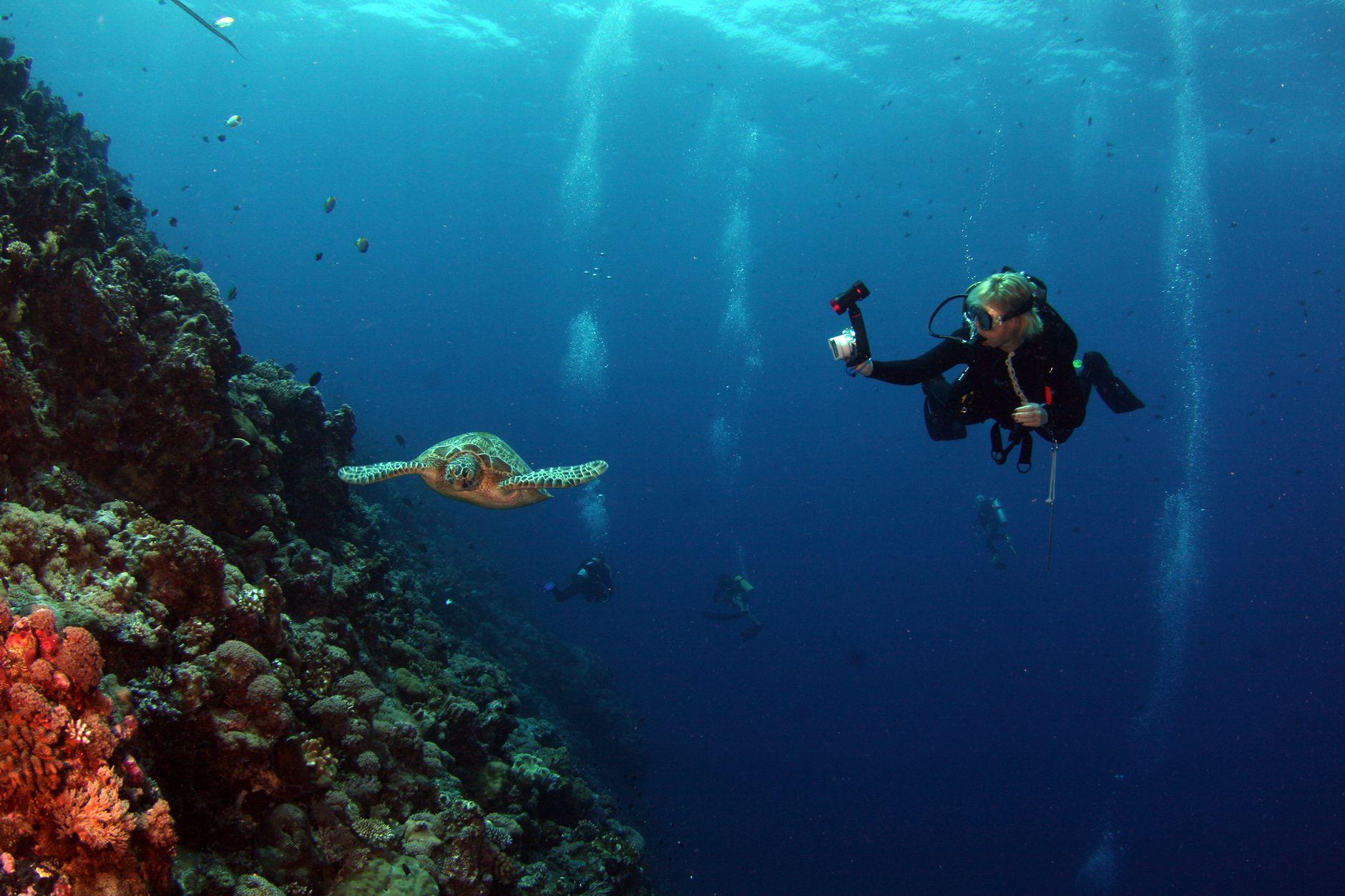
Large reef fish fill the gap between shark encounters. Potato cod (Epinephelus tukula) cruise around bommies, dogtooth tuna (Gymnosarda unicolor) hunt off the edge, and giant trevally (Caranx ignobilis) use current lines as feeding lanes. Look under ledges for giant morays and whitetip sharks, and scan coral-rich sections for humphead wrasse, green turtles, and tortugas carey—hawksbill turtles (Eretmochelys imbricata).
Osprey also has animals most recreational divers will never see. Its geographically isolated chambered nautilus population lives in deep water, and the tiny stout infantfish was collected from the lagoon. These are part of the reef's natural history, not realistic items for a dive checklist.
The Main Diving Zones
North Horn and the Northern Wall
North Horn, North Horn Wall, and Half Way Wall deliver the strongest combination of sharks, pelagic fish, and abyssal scenery. Common recreational profiles run from 10 to 30 m, while advanced wall dives may reach 40 m. Current can accelerate around the horn, so entries, descents, and pickups are planned around the vessel's live assessment.
Lagoon Entrances and Western Maze
Admiralty, Secret Caves, Castles, and Silver City mix walls with more protected terrain. Expect coral bommies, swim-throughs, sandy channels, and caves rather than one continuous drop-off. These sites can provide afternoon or night dives when the exposed points are unsuitable, although “protected” is relative this far offshore.
Exposed Southern and Outer Sites
False Entrance, Rapid Horn, Western Wall, Fairy Grotto, and Coral Canyons are selected according to wind, sea state, and current. Rapid Horn is principally a summer opportunity when northerly winds permit access. Coral Canyons reaches 30–40 m in places, making gas planning and no-decompression limits central to the dive rather than an afterthought.
Conditions at a Glance
Water temperatures range from about 24°C in July to roughly 29°C in January and February. Visibility commonly falls between 30 and 60 m, with the clearest planning window generally from May through October. These are climatological ranges; Osprey has no convenient local weather station, and live conditions can differ from the regional averages.
A 5 mm full suit is a practical choice from June through August, especially during repetitive diving. A 3 mm suit usually works in the warmer months. Currents vary from mild to strong and may change sharply around horns, channels, and wall corners. A computer, DSMB, audible signaling device, and a securely attached electronic locator are sensible essentials. Use the equipment and procedures required by your vessel.
September through January is often presented by operators as the most reliable access window. May through August can bring cooler, very clear water but also exposed southeast trade-wind seas. November through April is warmer and wetter, with tropical-cyclone risk that can alter crossings or cancel a trip. There is no month when a remote Coral Sea itinerary becomes weather-proof.
Who Osprey Reef Is For
Osprey suits advanced divers with recent ocean experience, stable buoyancy beside deep walls, and comfort making tender entries in current. Spirit of Freedom publishes a recommendation for Advanced certification, at least 20 ocean dives, and five dives within the previous 12 months. Requirements vary, so check the exact standard before paying a deposit.
A newly certified diver may find the combination of repetitive profiles, current, blue-water separation risk, and remote evacuation too demanding. Even experienced divers should schedule a tune-up before departure if they have been out of the water. The reef is not the place to discover that a mask, computer, or DSMB setup does not work under pressure.
Getting There and Life Aboard
Current four-night itineraries operate through the Cairns and Lizard Island corridor. One pattern crosses from Cairns and returns by an approximately one-hour flight from Lizard Island; another flies to Lizard Island first, boards there, and returns to Cairns by sea. The Lizard Island–Osprey vessel leg is about 100 km and may take around 10 hours. Trips commonly offer up to 14 or 15 dives, including a night dive, but every number is weather-dependent.
Your vessel is the hotel, restaurant, compressor station, dive center, and emergency platform. Confirm what the fare includes: marine levies, equipment, nitrox, transfers, and guided service differ by operator. Also confirm the required no-fly interval. A published itinerary that uses a flight after diving may impose a full 24-hour surface interval.
Safety Changes the Way You Dive
There is no local clinic, runway, or recompression chamber. Cairns Hospital is the likely mainland receiving facility, while the nearest confirmed public hyperbaric unit is at Townsville University Hospital. Transfer depends on vessel position, sea state, aircraft availability, daylight, and acceptance by the receiving service; a helicopter should never be assumed.
Before departure, verify that the vessel carries enough emergency oxygen for a prolonged transfer, satellite communications, VHF/HF/DSC capability, a registered beacon, diver-location devices, an AED, and written missing-diver and evacuation plans. Carry insurance that explicitly covers scuba treatment, evacuation, vessel diversion, and repatriation. Underwater, keep conservative depth and gas margins, make controlled ascents, and report symptoms immediately rather than waiting to see whether they pass.
The Bottom Line
Choose Osprey Reef for its open-ocean character, not for a guaranteed species list. The reward is a sequence of wall dives where 30–60 m visibility can reveal sharks, tuna, trevally, and manta rays against a blue drop that seems bottomless. The cost is real remoteness, weather uncertainty, and less room for sloppy diving. Arrive current, listen to the crew, and let the skipper choose the site—the best Osprey itinerary is the one that responds to the Coral Sea rather than fighting it.