Nusa Penida Diving: The Complete Guide to Bali's Pelagic Playground
Nusa Penida is where Bali goes big.
The largest of three islands off Bali's southeastern coast (alongside Nusa Lembongan and Nusa Ceningan), this rugged limestone island sits at the mouth of the Lombok Strait, where the Indonesian Throughflow Current forces nutrient-rich deep water toward the surface. The result is one of the few places on Earth where you can see both manta rays and mola mola (oceanic sunfish) on the same dive trip — a combination that draws divers from every corner of the globe.
The Nusa Penida Marine Protected Area, designated in 2010 and covering roughly 200 square kilometers, protects this extraordinary ecosystem. In 2024 it was recognized as a Mission Blue Hope Spot and became Indonesia's first IMO Particularly Sensitive Sea Area — a testament to its global ecological significance.
What Makes Nusa Penida Unique
Year-Round Manta Encounters
Manta Point on the southwest coast features three primary cleaning stations where reef manta rays (Mobula alfredi) queue up for parasite removal like clockwork. Over 200 individual mantas have been identified in the MPA through photo-ID tracking on MantaMatcher.org. Unlike many manta destinations where encounters are seasonal, Nusa Penida delivers year-round. Peak conditions run March through June when seas are calmest, but even in the rainy season the mantas keep coming.
The cleaning stations sit on a shallow plateau at 5–15 meters, making them accessible to all skill levels. On a good morning — before the day-tripper boats arrive around 9 AM — you can have the site largely to yourself, watching rays barrel-roll at the cleaning stations while smaller fish dart around the rocky terrain.
The Mola Mola Season
From July through October, cold-water upwellings that originate in the deep Lombok Strait bring something extraordinary to recreational depths: the mola mola, or oceanic sunfish. These are the heaviest bony fish in the world, reaching up to 1,000 kilograms. At Nusa Penida they ascend from deep cold water to cleaning stations at 25–35 meters, where cleaner fish remove parasites from their enormous bodies.
Crystal Bay is ground zero for mola encounters. The site has a shallow sandy bay that transitions into a steep outer drop-off reaching 40 meters. Divers who brave the cold (16–20°C at depth), the strong currents, and the thermocline drama are rewarded with one of the most sought-after sights in tropical diving. August and September offer the highest probability of sightings, with some operators offering a "Mola Money Back Guarantee" during those months.
World-Class Drift Diving
The north coast of Nusa Penida is lined with fringing coral reefs that deliver some of the healthiest coral dives in Bali. Sites like SD Point, PED, and Sental offer gentle to moderate unidirectional currents — ideal drift dives where you barely need to kick. The coral heads here are massive: 200-year-old brain corals that were already growing when Napoleon was still in power.
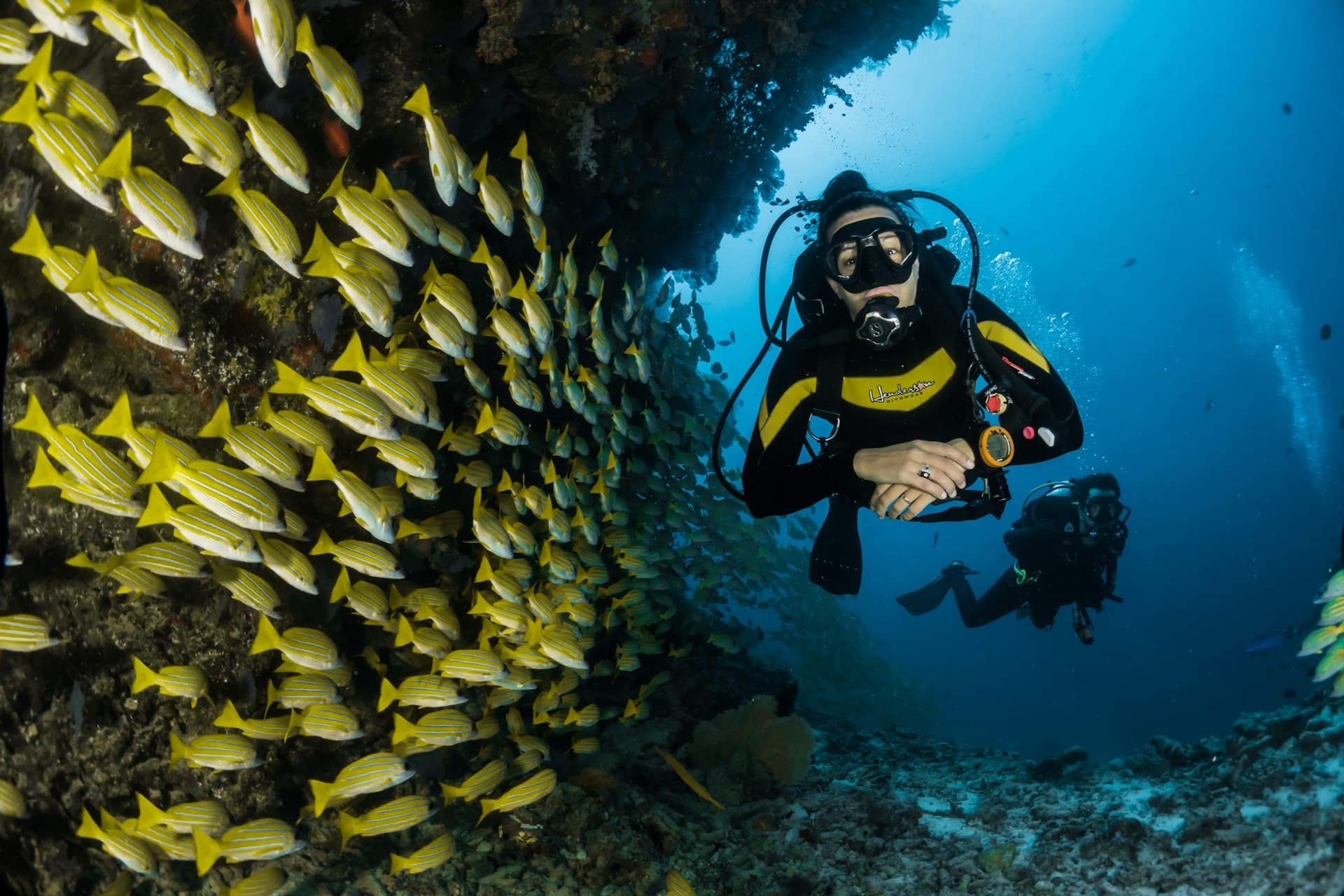
These north coast sites are the Bali that most divers don't see anymore: thriving soft corals, large sea fans, schools of fusiliers and trevallies, and turtles at nearly every turn. The visibility on the north coast regularly hits 25–30 meters during the dry season (May–October), and the currents are mild enough that Open Water divers can handle most sites.
Who Nusa Penida Is For
Nusa Penida has something for every level, but it rewards planning and skill matching:
-
Beginners can explore Manta Bay (5–15 m, calm conditions), the shallow parts of Crystal Bay, and gentle north coast drift dives like SD Point and Buyuk. All major dive shops offer guided dives with max 4 divers per guide.
-
Intermediate divers with Advanced Open Water certification should target the full north coast experience — SD Point to PED drift runs, Gamat Bay's caves and overhangs, and Toyapakeh's terraced coral slopes. The drift dives are manageable with proper briefing.
-
Advanced divers chasing mola mola need to handle strong currents, cold thermoclines, and depths of 30–40 meters at Crystal Bay's outer slope and Blue Corner on Lembongan. Ceningan Wall drops to 180 meters with fast, unpredictable currents — 100+ logged dives recommended.
-
Macro enthusiasts will love Lembongan Bay (3–12 m), Gamat Bay's overhangs, and the muck-diving potential at Ped's house reef. Frogfish, leaf fish, nudibranchs, and pygmy seahorses are regular finds.
The 18 Dive Shops
Diving in Nusa Penida is well-organized, with roughly 18 verified dive shops based on the island plus 7 more on the neighboring island of Nusa Lembongan that run Penida dives. The best-known operators include Scuba Junkie Penida (the only shop running three dives per day), Purple Dive Penida (PADI Eco Center, conservation-focused), Dune Penida (luxury resort integrated), and Legend Diving Penida (Green Fins Gold Member with an in-house marine biologist). Most shops run two-tank morning trips departing at 7:30–8 AM and returning by 1 PM, with a third afternoon dive available through Scuba Junkie.
Prices run roughly IDR 800,000–1,500,000 (USD 50–100) for a two-dive day including gear rental. Many operators offer three-dive packages or liveaboard-style day trips covering both north and south coast sites.
Practical Overview
Nusa Penida sits in the Central Indonesia Time zone (UTC+8, same as Bali mainland). The currency is IDR — bring sufficient cash from Bali, as ATMs are scarce outside Toyapakeh town. English is widely spoken across dive shops and tourist areas. Entry is via a 30–45 minute fast boat from Sanur Harbor on Bali mainland, costing IDR 150,000–250,000 per person each way.
The Nusa Penida Marine Protected Area requires a conservation levy of IDR 100,000 per person. A 5 mm wetsuit is essential from June through October when water drops to 16–18°C at depth; a 3 mm shorty works November through May.
Critical diver safety note: There is no hyperbaric chamber on Nusa Penida Island. The nearest chambers are on the Bali mainland — Sanglah General Hospital in Denpasar or Kasih Ibu Hospital in Gianyar — approximately 1.5 to 3 hours away by boat and ambulance. DAN insurance is mandatory.
Bottom Line
Nusa Penida is Bali's most accessible world-class pelagic destination. Year-round manta rays at cleaning stations, the heaviest bony fish on the planet from July through October, and some of the healthiest coral reefs left in Bali — all reachable via a 30-minute ferry from Sanur. It's not for the faint of current, but for divers who bring the right gear and the right attitude, Nusa Penida delivers encounters that rival liveaboard destinations without the multi-day commitment.