Great Barrier Reef Diving: The Definitive Guide to Australia's Underwater Universe
The Great Barrier Reef is the world's largest coral reef system — 2,300 kilometers of living wonder stretching along Australia's tropical northeast coast. It comprises 2,900 individual reef systems, 900 islands, 400 species of coral, and over 1,500 fish species across 344,400 square kilometers of the Coral Sea. This is the largest single structure built by living organisms on Earth — bigger than Italy, visible from space, and home to six of the world's seven sea turtle species.
But the GBR isn't just one destination. It's ten completely distinct dive regions spanning 15 degrees of latitude, from the turtle-packed southern cays where over 1,200 individual manta rays have been catalogued, to the remote Coral Sea atolls where near-vertical walls drop 2,000 meters into the abyss. From the world-famous Cod Hole where potato cod grow to 100 kg+, to the SS Yongala — one of the top ten wreck dives on Earth — the Great Barrier Reef packs more bucket-list dives per square kilometer than any reef on the planet.
What Makes the Great Barrier Reef Unique
Cod Hole: Where Fish Forget Their Fear
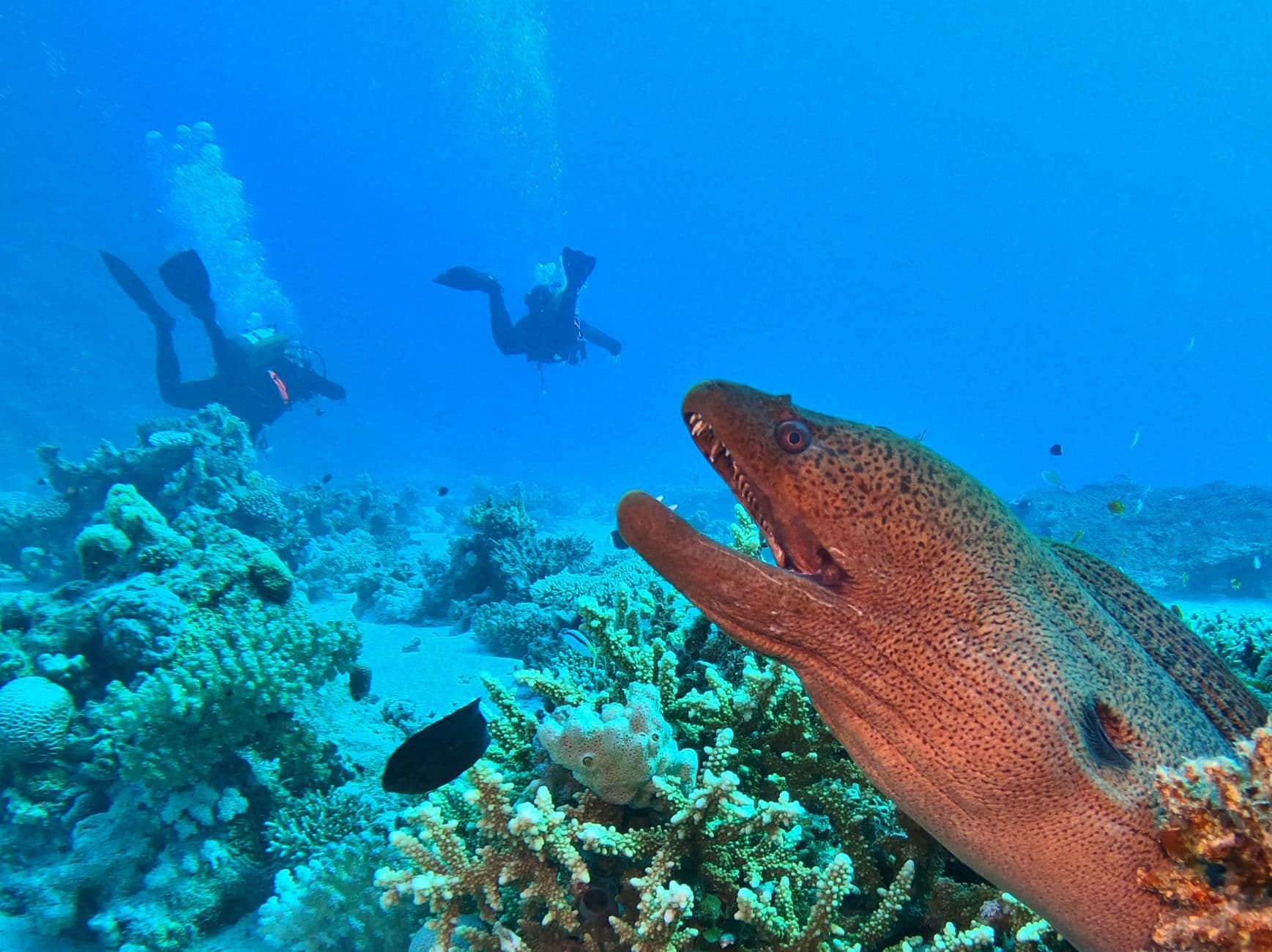
The Ribbon Reefs between Cooktown and Lizard Island are the crown jewels of GBR diving, and Cod Hole is their most famous site. At Ribbon Reef #10, enormous potato cod (Epinephelus tukula) — some weighing over 100 kg and reaching 2 meters in length — swim right up to divers, completely unafraid. It's a feeding site within the GBR Marine Protected Area, strictly regulated, and remains one of the most iconic wildlife encounters on Earth. Nearby Lighthouse Bommie, an isolated coral tower rising 20 meters from the seabed, offers swirling schools of snapper, trevally, mackerel, and eagle rays at cleaning stations.
The SS Yongala: Australia's Legendary Wreck
One hundred twenty kilometers east of Townsville lies the SS Yongala, a 110-meter passenger ship that sank in a 1911 cyclone, killing all 122 people on board. Resting on its side and carpeted with hard and soft corals, the Yongala is Australia's largest intact historic shipwreck and consistently ranks among the world's top ten wreck dives. Queensland groupers, Napoleon wrasse, trevally, rays, and sharks are all common — the wreck acts as a marine magnet in open water with no other reef formation for miles. A special permit is required, and access is only through licensed operators.
Osprey Reef: The Shark Amphitheatre
Osprey Reef is an isolated submerged atoll in the Coral Sea, 200 kilometers east of the outer barrier, where near-vertical walls rise from 2,000 meters. At North Horn, the northernmost tip, a famous shark feed amphitheatre at approximately 12 meters draws grey reef sharks, whitetip reef sharks, and silky sharks — conducted under strict Queensland government protocols. Around the Bend offers drift dives past manta ray cleaning stations. Osprey is accessible only by liveaboard (Mike Ball's Spoilsport or the Spirit of Freedom) and delivers some of the most intense shark diving in the world.
Dwarf Minke Whale Season
The Ribbon Reefs are the only place on Earth where you can reliably encounter dwarf minke whales (25 feet) in the water — and only for two months, June and July. These gentle whales, drawn to the nutrient-rich currents of the continental shelf edge, swim alongside divers in a truly exclusive encounter. Lighthouse Bommie is the primary site for these encounters.
Coral Spawning: Nature's Greatest Spectacle
Between October and November, following the full moon, hundreds of coral species across the GBR release eggs and sperm simultaneously — the world's largest synchronized coral spawning event. It's a natural phenomenon that transforms the water column and is best witnessed from the outer reefs, particularly the Ribbon Reefs and Coral Sea sites.
Living Art: MOUA at John Brewer Reef
Near Townsville, the Museum of Underwater Art (MOUA) at John Brewer Reef is the world's first underwater art museum on a living reef. The Coral Greenhouse — a 9-meter stainless steel structure housing approximately 20 sculptures by marine science students — and the Ocean Sentinels, larger-than-life figures blending marine scientists with underwater forms, sit on the reef to highlight conservation and restoration.
Who the Great Barrier Reef Is For
The Great Barrier Reef is the ultimate reef-diving destination for divers at every level:
- Beginners — Inshore and outer-reef day trips from Cairns and Port Douglas feature calm lagoons, gentle slopes, and depths of 5–15 meters. Sites like Flynn Reef's Ski Slope, Upolu Reef's protected lagoon, and the pontoon reefs at Moore Reef are ideal for Open Water divers and first-time divers.
- Intermediate divers — The Cairns and Port Douglas outer reefs (Agincourt #3 with visibility up to 50 meters, Thetford Reef, Norman Reef) offer wall dives, swim-throughs, and bommie exploration. The SS Yongala and Ribbon Reefs (Cod Hole, Steve's Bommie) challenge and reward intermediate certified divers.
- Advanced divers — Osprey Reef's North Horn shark feed, Bougainville's Dungeons and Dragons, the Swain Reefs with heavy currents and pelagic action, and the remote Coral Sea atolls (Flinders, Holmes, Diane Bank) deliver advanced-level diving at its most dramatic.
- Adventure seekers and liveaboard divers — Multi-day liveaboard expeditions to the Ribbon Reefs, Coral Sea, and Swain Reefs (Mike Ball, Spirit of Freedom, Coral Expeditions) open access to pristine, remote reefs unreachable by day boats — 50-meter visibility, 2,000-meter walls, and encounters with sharks, mantas, and pelagics that define world-class diving.
The GBR is also for conservation-minded travelers. The Great Barrier Reef Marine Park dedicates 33% of its area to fully protected Green Zones (no-take), and the Environmental Management Charge of AUD 8.50 per person per day on all commercial trips directly funds reef research, management, and conservation. Every dive supports the reef's protection.
The Dive Operators
Diving the Great Barrier Reef is served by a mature, well-organized network of operators across all gateway cities:
Cairns (Central GBR): Silverswift, Passions of Paradise, Pro Dive Cairns, Sunlover Cruises, Reef Magic, Great Adventures, Divers Den, and Ocean Quest operate daily to the outer reefs — Flynn, Milln, Moore, Thetford, Norman, and Upolu. Day dive trips with two dives run AUD 200–350. Liveaboard access to the Ribbon Reefs is available through Pro Dive's Spirit of Freedom.
Port Douglas (Agincourt & Outer Reefs): Quicksilver and Silversonic run daily trips to the world-famous Agincourt Reef system (depths to 40m, visibility to 50m at the outer wall) and Opal Reef. Wavelength offers smaller-boat experiences. Day trips run AUD 200–350.
Ribbon Reefs & Lizard Island (Liveaboard): Mike Ball's Spoilsport and the Spirit of Freedom run multi-day liveaboards from Cairns and Port Douglas to Ribbon Reefs #1–#10, Lizard Island, and Escape Reef — the least-visited site in the GBR. Itineraries range from 3 to 5 nights.
Coral Sea (Osprey, Bougainville, Flinders): Mike Ball's Spoilsport and the Spirit of Freedom offer 4–11 day liveaboard expeditions to the remote Coral Sea atolls. Osprey Reef (North Horn), Bougainville (Dungeons and Dragons), Flinders, and Holmes Reef are some of the most dramatic diving on Earth.
Townsville (SS Yongala & MOUA): Operators run daily speedboat trips from Townsville and Alva Beach (Ayr) to the SS Yongala and John Brewer Reef (MOUA).
Southern GBR (Lady Elliot, Heron, Great Keppel): Island resorts on Lady Elliot, Heron, Wilson, and Great Keppel offer on-site diving. Lady Elliot Island, reached by flight from Bundaberg or Gold Coast, is the southernmost coral cay of the GBR and the "Home of the Manta Ray" with over 1,200 catalogued individuals.
Practical Overview
Getting there: Cairns Airport (CNS) is the primary gateway, with direct international flights from Auckland, Tokyo, Hong Kong, Singapore, and Manila. From Europe or the Americas, connect via Brisbane, Sydney, or Melbourne. Port Douglas is a 1-hour drive north of Cairns. Townsville (TSV) is the gateway to the SS Yongala and MOUA. Bundaberg (BDB) serves the Southern GBR, and Hamilton Island (HTI) serves the Whitsundays.
Best time to dive: June–November is the dry season and peak diving season — cooler water (22–26°C), excellent visibility (15–30m, up to 50m on outer reefs), mild seas, and whale encounters. Dwarf minke whales: June–July. Humpback whales: June–September. Coral spawning: October–November. Manta rays at Lady Elliot: May–October. Sea turtle nesting: November–February.
Water temperature: Ranges from 22–26°C in winter (June–August) to 28–30°C in summer (January–February). Northern Ribbon Reefs remain warmer year-round (26–28°C). Southern GBR runs 2–3°C cooler in winter.
Costs (2026): Day dive trip (2 dives): AUD 200–350. Introductory dive: AUD 150–250. Liveaboard (3 nights): AUD 995–2,295. PADI Open Water course: AUD 550–850. Environmental Management Charge: AUD 8.50/person/day (included in commercial tour prices). Accommodation (mid-range): AUD 150–300/night.
Currency & language: Australian Dollar (AUD). English is the official language; Japanese, Mandarin, Korean, and German are widely spoken at major operators. Tipping is not customary.
Safety: The only hyperbaric chamber along the entire 2,300 km reef is at Townsville University Hospital. Remote sites at Osprey Reef and the far northern Ribbon Reefs require 4–12+ hours for evacuation. Stinger season (November–May) requires stinger suits in inshore waters. Australia has extreme UV — reef-safe sunscreen is essential.
Regulations: No touching or standing on coral — fines up to AUD 110,000. No collection of shells or marine life. No feeding of marine life. The GBRMPA zones the reef into Green (33%, no-take), Yellow (limited), and Orange (open) zones. Most dive sites are in or near Green Zones.
Bottom Line
The Great Barrier Reef is the greatest reef-diving destination on Earth. It offers more iconic dive sites, more wildlife variety, and more diving experiences per square kilometer than any other reef system on the planet. Whether you're a beginner diving the calm lagoons of Cairns' outer reefs, an advanced diver chasing sharks at Osprey Reef's North Horn, or a liveaboard explorer seeking the remote Coral Sea atolls, the GBR delivers. The dive infrastructure is world-class, the conservation protections are real, and the underwater world here — from 100 kg potato cod to 2,000-meter walls — is unlike anywhere else. It is, simply, the best reef diving in the world.