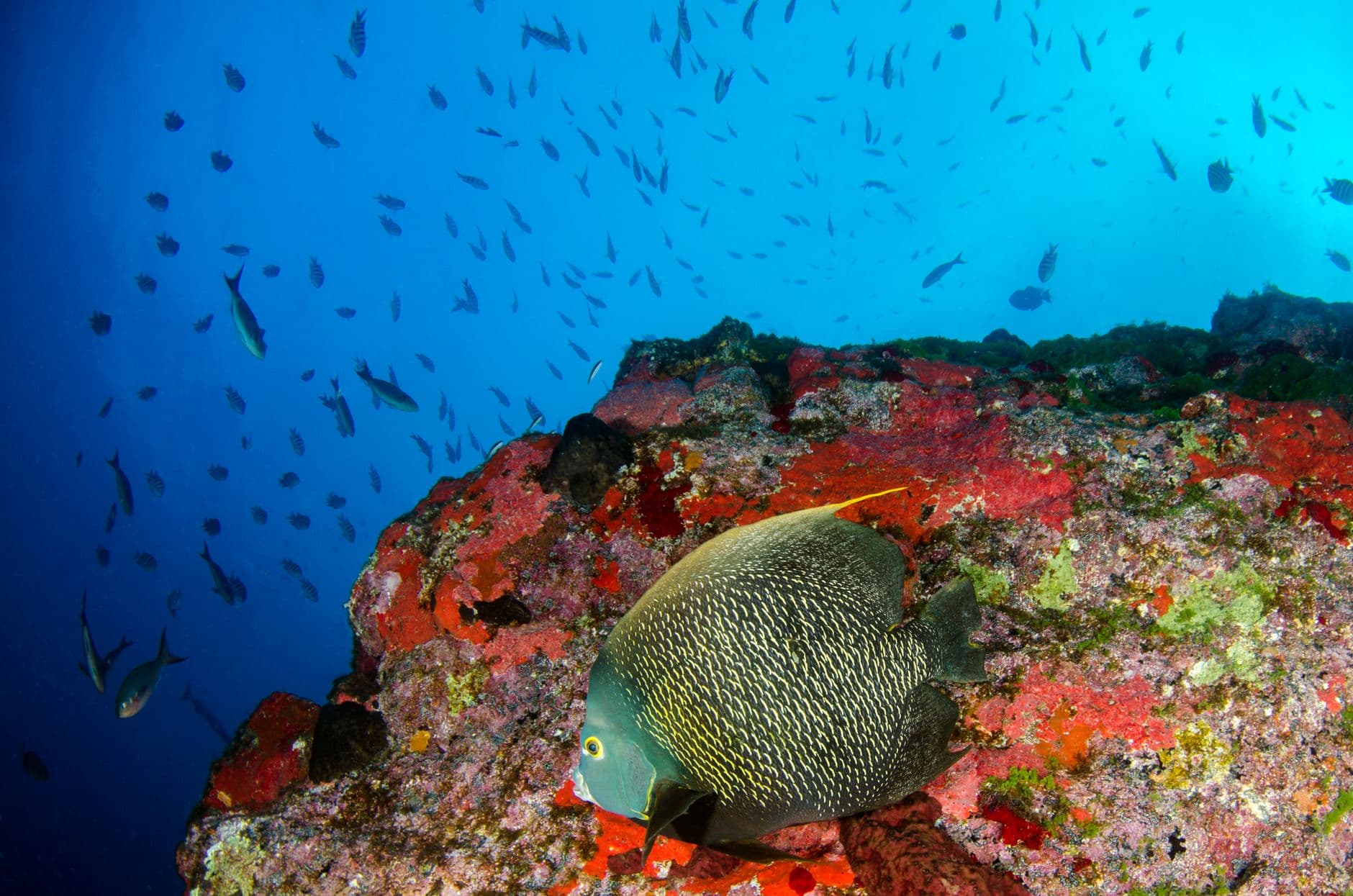
Top 10 Dive Sites in Galápagos: A Complete Guide
The Galápagos archipelago stretches across 138,000 km² of protected marine reserve, and its dive sites span everything from sheltered volcanic calderas suitable for beginner divers to open-ocean seamount expeditions where 300 hammerheads parade past in formation.
This guide ranks the top 10 dive sites so you can match your skill level and interests to the right experience. Every site listed here is verified by local operators and supported by field reports from the 2024–2026 seasons.
1. Shark Bay (Wolf Island)
Type: Reef hook / shark wall | Depth: 10–30 m | Distance from shore: 12+ hours by boat from Santa Cruz | Difficulty: Advanced (AOWD + 50 dives) | Best season: December–June
Shark Bay is the single most concentrated shark dive on the planet. You arrive at a submerged wall on the eastern side of Wolf Island, drop into a negative-entry descent from a Zodiac, hook into volcanic rock at 20–25 meters, and watch.
What you watch is a parade of scalloped hammerheads — 200 to 300+ individuals — streaming past in a continuous wall of grey and white. The cleaning station at Shark Bay draws them year-round, but the densest aggregations happen in the warm season (December–June) when the water is clearest and the currents are manageable. Silky sharks weave through the hammerhead schools. Galápagos sharks patrol the deeper blue. Eagle rays glide along the wall. And if it's July through November, whale sharks pass through the channel between Wolf and Darwin.
Target species: Scalloped hammerheads (200–300+), silky sharks, Galápagos sharks, eagle rays, whale sharks (Jul–Nov), dolphins, sea lions, Galápagos garden eels.
Dive profile: Negative entry from Zodiac, descend to 20–25 m, hook into rock using reef hook, hold position for 30–45 minutes watching the wall. Ascend along the wall — the drift can carry you 200–500 meters from your entry point.
Why it's #1: No other dive site on earth delivers this density of large shark encounters in a single dive. The hammerhead numbers at Shark Bay are not a seasonal anomaly — they are the most reliable large-shark aggregation in global recreational diving.
Practical tips: Practice your reef hook technique before this dive. The hooking point is critical — you need to find volcanic rock (not live coral) in the right position relative to the current. Most liveaboards do a check dive at North Seymour where you can practice. Bring your own reef hook if you have a preference; the boat hooks work fine but fit varies. A 5mm wetsuit is adequate in warm season; 7mm with hood is recommended June–November — the thermocline at depth can drop below 20°C even in good conditions.
2. Darwin's Arch / Darwin's Columns
Type: Offshore platform / cleaning station | Depth: 8–30 m | Distance from shore: Adjacent to Darwin Island | Difficulty: Advanced | Best season: June–November (whale sharks), December–June (hammerheads)
Darwin's Arch was the most photographed dive site in the Galápagos before the iconic arch collapsed in May 2021. The arch itself is gone — natural erosion finally brought it down — but the dive site was unaffected. Two massive pillars remain, and the volcanic platform at 18 meters continues to function as the archipelago's premier cleaning station for whale sharks, hammerheads, and giant mantas.
The site sits on the northern tip of Darwin Island, at the edge of the Darwin volcanic caldera where the Cromwell Current pushes nutrient-rich water over the platform. From June through November, gravid female whale sharks — almost all measuring 8–15 meters — arrive in numbers that can reach 5–15 individuals per dive. They swim slow, wide circuits around the pillars, filtering plankton through their gills, completely indifferent to the divers hovering in the current.
When the whale sharks are absent (December–May), the platform belongs to scalloped hammerheads — 100–200 individuals working the cleaning station — plus silky sharks, Galápagos sharks, and massive schools of creolefish that cloud the water silver.
Target species: Whale sharks (Jun–Nov, 5–15 per dive at peak), scalloped hammerheads (100–200 year-round), silky sharks, Galápagos sharks, creolefish, eagle rays, dolphins.
Dive profile: Negative entry, descend to the platform at 18 m, hook into the volcanic rock on the down-current side. Hold for 30–50 minutes. The current is consistently strong — 1.5–2.5 knots — and the reef hook is not optional.
Why it's great: Darwin is the most reliable place on earth to encounter gravid female whale sharks — a phenomenon that scientists still do not fully understand. The combination of whale sharks, hammerhead walls, and pelagic activity in a single dive is unmatched.
Practical tips: The 12-hour overnight sail from Santa Cruz to Darwin is no joke — strong seasickness medication is strongly recommended. Book this liveaboard 1–2 years in advance for whale shark season (July–November slots sell out within days of opening). A 7mm wetsuit with hood is mandatory in the cool season; 5mm with hood works in warm season.
3. Gordon Rocks
Type: Extinct volcanic crater | Depth: 8–35 m | Distance from shore: 40 min by boat from Puerto Ayora | Difficulty: Advanced (AOWD + 25 dives minimum) | Best season: Year-round
Gordon Rocks is the best day-trip dive in the Galápagos — and pound for pound, one of the best shark dives on the planet accessible without a liveaboard. This extinct volcanic crater has three exposed rocks at the surface and four submerged pinnacles underwater. The central pinnacle at 21 meters is the cleaning station, and morning dives (7–8 AM) produce the biggest hammerhead numbers.
The site gets its nickname — "the washing machine" — from the surging currents that pour through the crater opening. On an active current day, you descend through an aggressive surge that pushes and pulls you through the pinnacles. The trick is to find a sheltered lee behind one of the pinnacles and hold position. The hammerheads come to you.
When the current settles, Gordon Rocks becomes a relaxed drift around the crater walls at 8–12 meters, where whitetip reef sharks, sea turtles, and sea lions are constant companions. The crater rim sits at 8 meters, the central pinnacle at 21, and the outer wall drops beyond 65 — meaning the site offers something for every depth preference.
Target species: Scalloped hammerheads (30–100 at cleaning station), whitetip reef sharks, blacktip reef sharks, Galápagos sharks, green sea turtles, sea lions, stingrays, spotted eagle rays, barracuda, creolefish, snapper, occasional manta rays and Mola mola.
Dive profile: Giant stride entry from the boat into the crater, descend to 18–21 m for the cleaning station (30–40 min), then ascend along the crater wall to 8–12 m for the drift portion. Multi-level profile standard.
Why it's great: Gordon Rocks is the only site in the world where hammerhead schools of this size (30–100+) are accessible on a day trip without a liveaboard. If you're land-based in Puerto Ayora for a week, you can dive Gordon Rocks multiple times — and the conditions and hammerhead numbers vary enough that no two dives are the same.
Practical tips: Morning dives produce the best hammerhead numbers. The surge inside the crater can be intense — if you're prone to seasickness, take medication before the 40-minute boat ride. A 5mm wetsuit works year-round; hood recommended in cool season (June–November). Bring your reef hook — operators provide them, but knowing your own equipment helps.
4. Kicker Rock (León Dormido)
Type: Volcanic tuff cone pillars | Depth: 10–25 m | Distance from shore: 40 min by boat from Puerto Baquerizo Moreno | Difficulty: Intermediate to advanced | Best season: Year-round
Kicker Rock — known locally as León Dormido (Sleeping Lion) — is the most iconic dive site in San Cristóbal and the second most photographed landmark in the Galápagos after the now-collapsed Darwin's Arch. Two massive volcanic tuff cone pillars rise 150 meters above the water, separated by a narrow channel that divers can swim through.
The channel between the pillars concentrates marine life. Galápagos sharks are numerous here — expect to see 5–15 on most dives, cruising the channel walls with the current. Scalloped hammerheads pass through, though not in the numbers seen at Wolf. Eagle rays, golden rays, and massive schools of creolefish and salema fill the water column. Green sea turtles are constant companions.
The channel swim-through is the highlight. You enter at one end and drift through at 10–18 meters, the vertical rock walls on both sides covered with filter feeders and reef fish. The exit opens into Gardner Bay, where sea lions often join the safety stop.
Target species: Galápagos sharks (5–15+), scalloped hammerheads, eagle rays, golden rays, green sea turtles, whitetip reef sharks, barracuda, enormous schools of salema and creolefish.
Dive profile: Boat entry, descend to 15–20 m at the channel entrance, drift through the channel at 10–18 m (15–20 min), exit into Gardner Bay for a shallow drift. Usually combined with a second dive at a nearby site.
Why it's great: Kicker Rock is San Cristóbal's defining dive — the channel swim-through between the pillars is a genuinely unique underwater experience, and the Galápagos shark density here rivals any site in the central archipelago.
Practical tips: Book through Planet Ocean Galapagos, Wreck Bay Diving, or Aquaventures Dive Center in Puerto Baquerizo Moreno. The channel current can be strong — the swim-through is best attempted on an incoming tide when current is manageable. A 5mm wetsuit works year-round.
5. Cabo Marshall (Isabela Island)
Type: Manta ray cleaning station | Depth: 12–25 m | Distance from shore: Off Isabela's southeast coast | Difficulty: Advanced (strong currents) | Best season: September–December
Cabo Marshall on the southeastern coast of Isabela is the Galápagos' premier manta ray cleaning station. The site features a rocky reef at approximately 18 meters where giant oceanic manta rays (Manta birostris) gather to be cleaned by smaller fish. The mantas here have wingspans up to 5 meters — among the largest manta aggregations in the eastern Pacific.
The mantas arrive in greatest numbers from September through December, overlapping the tail end of whale shark season. On a good dive, you can see 5–10+ mantas circling the cleaning station in a slow, deliberate rotation. They are completely unbothered by divers — you can hover at 3–4 meters distance and watch them for the entire dive.
Hammerheads also pass through Cabo Marshall, especially in the warm season. Mola mola appear from June through October. The site is less trafficked than Gordon Rocks — you'll often have the cleaning station to yourself.
Target species: Giant oceanic manta rays (5–10+ at peak), scalloped hammerheads, Mola mola (Jun–Oct), Pacific seahorses, sea turtles.
Dive profile: Negative entry, descend to 18 m, find a position on the reef edge, and observe the cleaning station. Currents can be strong — reef hook recommended.
Why it's great: Cabo Marshall offers the best manta ray diving in the Galápagos with less traffic than Gordon Rocks. The mantas here are reliably large and approachable.
Practical tips: Only accessible by liveaboard or extended day trip from Isabela. The mantas are most active in the morning — schedule accordingly.
6. Punta Vicente Roca (Isabela Island)
Type: Sheltered bay / macro dive | Depth: 5–20 m | Distance from shore: North tip of Isabela | Difficulty: Intermediate | Best season: June–October (Mola mola), year-round (iguanas)
Punta Vicente Roca is the most biologically unique dive site in the Galápagos. This sheltered bay at the northern tip of Isabela is where the cold Cromwell Current wells up against the volcanic coastline, creating the perfect conditions for marine iguanas — the world's only truly marine lizard — to feed on algae. You can watch them dive to 10+ meters, cling to the rocks with their claws, and graze on algae while you hover alongside.
The same nutrient-rich water that draws the iguanas also attracts Pacific seahorses — the site is reliably the best place in the archipelago for seahorse photography — and Mola mola from June through October. Galápagos penguins are frequently spotted in the bay. Frogfish, red-lipped batfish, and nudibranchs make this the top macro site in the archipelago.
The bay is sheltered, so it's often diveable when the exposed sites are blown out — making it a reliable backup option on liveaboard itineraries.
Target species: Marine iguanas (unique underwater feeding behavior), Pacific seahorses, Mola mola (Jun–Oct), Galápagos penguins, frogfish, red-lipped batfish, nudibranchs, flightless cormorants.
Dive profile: Zodiac entry into the sheltered bay, descend to 10–15 m, explore the rocky wall and algae beds. Gentle currents — the most relaxed dive in the western islands.
Why it's great: There is no other place on earth where you can watch marine iguanas dive and feed underwater. Combined with seahorses, penguins, Mola mola, and frogfish, Punta Vicente Roca delivers the kind of endemic encounters that make Galápagos singular.
Practical tips: Water is cold — 16–23°C year-round. A 7mm wetsuit with hood and gloves is recommended even in the warm season. Bring a macro lens for seahorses and a mid-range zoom for the iguanas. Best visited as part of a western itinerary.
7. North Seymour
Type: Gentle drift dive / reef | Depth: 5–20 m | Distance from shore: 30 min by boat from Puerto Ayora | Difficulty: Beginner to intermediate (Open Water accepted) | Best season: Year-round
North Seymour is the Galápagos' most accessible reef dive and the standard check dive for liveaboards and day boats alike. The site features a gentle sandy bottom with rocky steps and garden eels covering the sand flats in dense colonies — thousands of them stretching their heads into the current.
Whitetip and blacktip reef sharks rest on the sandy patches between rocks, giving the site its signature laid-back feel. Schools of razor surgeonfish and king angelfish graze the rocky steps. Spotted eagle rays glide across the sand. And the topside bird colony — blue-footed boobies and frigatebirds — makes the surface interval as interesting as the dive.
Currents are mild (0.5–1 knot), making this the best site in the Galápagos for Open Water divers building experience.
Target species: Whitetip and blacktip reef sharks (resting on sand), Galápagos garden eels (thousands), green sea turtles, spotted eagle rays, devil and manta rays, barracuda, snapper, octopus, scorpionfish.
Dive profile: Drift dive from the boat — drop in up-current and drift with the flow over the sand flats and rocky steps. Max depth 20 m, typical dive time 45–60 minutes. Combined with Mosquera or a second Seymour dive.
Why it's great: The garden eel colonies alone make this worth the trip. The combination of resting sharks, playful sea lions, and easy conditions makes North Seymour the perfect introduction to Galápagos diving.
Practical tips: This is the ideal first dive of your trip. Use it to dial in your weight and check your buoyancy. The garden eels retract into the sand as you approach — move slowly and they'll stay visible.
8. Cousins Rock
Type: Wall dive / black coral forest | Depth: 5–35 m | Distance from shore: North of Santiago | Difficulty: Intermediate to advanced | Best season: Year-round
Cousins Rock is a terraced volcanic wall north of Santiago Island that features one of the best-preserved black coral colonies in the Galápagos. At 20–25 meters, the rock steps are covered in black coral trees (Antipathes galapagensis) — a species that takes decades to grow and is increasingly rare across the Pacific.
The site is equally famous for its playful juvenile sea lions — the colony at Cousins is reliably friendly, and young sea lions will swim directly at your mask, stop inches away, and dart off in a game that can last the entire dive. Pacific seahorses cling to the black coral branches. Whitetip reef sharks rest in the crevices. Manta rays pass through the channel.
Photographers love Cousins for its diversity: wide-angle for the black coral and sea lions, macro for the seahorses and nudibranchs.
Target species: Black coral trees (protected colony), Pacific seahorses, juvenile sea lions (very playful), whitetip reef sharks, green sea turtles, large moray eels, octopus, barracuda, manta rays, hammerheads (off the steps), frogfish, nudibranchs.
Dive profile: Descend the terraced wall from 5 m to 25 m. Explore the black coral steps. On the shallow return, the sea lions will find you. Moderate current — drift diving standard.
Why it's great: The black coral forest at Cousins is the best-preserved accessible colony in the archipelago, and the sea lion interactions are consistently the most playful anywhere in the central islands.
Practical tips: The black coral is protected — look but do not touch. A macro lens is worth bringing for the seahorses and nudibranchs. The site is a 60-minute boat ride from Puerto Ayora.
9. Devil's Crown (Floreana)
Type: Submerged volcanic crater | Depth: 5–22 m | Distance from shore: 20 min by boat from Floreana | Difficulty: Beginner to intermediate | Best season: December–May
Devil's Crown is the tip of a submerged volcanic crater ring that protrudes from the water like a crown — hence the name. The crater ring is open on one side, and divers swim through the opening to explore the interior. The interior walls are covered with dense filter feeders — the most vibrant coral coverage in the archipelago — and the relatively sheltered position makes this one of the most beginner-friendly sites in the Galápagos.
The water inside the crown is typically 22–26°C — the warmest consistently available water in the archipelago — and visibility runs 15–25 meters. Schools of black-striped salema fish, creolefish, king angelfish, and parrotfish fill the interior. Whitetip and blacktip reef sharks cruise the perimeter. Green sea turtles are constant companions.
Target species: Black-striped salema (massive schools), creolefish, king angelfish, parrotfish, whitetip and blacktip reef sharks, green sea turtles, stingrays, eagle rays, occasional hammerheads outside the crown.
Dive profile: Boat entry at the crown opening, swim into the interior crater, explore the walls at 5–15 m, exit through the opening. Very gentle current inside — excellent for photography.
Why it's great: Devil's Crown offers the warmest, clearest diving in the Galápagos in a genuinely unique geological feature. It's the best site in the archipelago for Open Water divers and underwater photographers.
Practical tips: Accessible as a day trip from Santa Cruz (1.5-hour boat ride). Best visited in the warm season (December–May) when visibility peaks. The surge at the crown openings can be strong — enter on a slack current.
10. Bartolomé Island
Type: Lava formations / penguin dive | Depth: 5–18 m | Distance from shore: Shore access from the beach | Difficulty: Beginner | Best season: Year-round
Bartolomé is the most famous island in the Galápagos for its iconic Pinnacle Rock — the postcard image of the archipelago. But the diving here is equally distinctive: Bartolomé offers the most reliable Galápagos penguin sightings in the entire archipelago. The only penguin species north of the equator (Spheniscus mendiculus) congregates along the lava rock shorelines and underwater lava tube formations, and on most dives you'll see them rocket past at close range.
The underwater terrain is a mix of lava tubes, rock steps, and sandy patches. Whitetip reef sharks rest in the crevices. Green turtles graze the algae. The currents are gentle, and the site is suitable for Open Water divers and even strong snorkelers. The combined dive-and-land tour — climbing to the Pinnacle Rock viewpoint after the dive — makes Bartolomé one of the best half-day trips in the archipelago.
Target species: Galápagos penguins (guaranteed sightings), whitetip reef sharks, green sea turtles, moray eels, parrotfish, seahorses.
Dive profile: Shore-entry or boat-entry dive at the base of Pinnacle Rock. Explore the lava tube formations at 5–15 m. Gentle currents — the easiest dive in the Galápagos. Combined with the Pinnacle Rock summit hike.
Why it's great: Bartolomé is the only dive site in the world where Galápagos penguins are a guaranteed encounter. The lava tube formations and Pinnacle Rock make for extraordinary backdrops.
Practical tips: Combine the dive with the Pinnacle Rock hike for the full experience. The penguins are most active in the cool season (June–November) when the water is coldest. A 5mm wetsuit is adequate year-round.
Summary Table: Galápagos Top Sites
| Rank | Site | Type | Max Depth | Difficulty | Best Season | Key Species |
|---|---|---|---|---|---|---|
| 1 | Shark Bay (Wolf) | Shark wall | 30 m | Advanced | Dec–Jun | Hammerheads (300+), silky sharks |
| 2 | Darwin's Arch | Cleaning station | 30 m | Advanced | Jun–Nov (whale sharks) | Whale sharks, hammerheads (100–200) |
| 3 | Gordon Rocks | Volcanic crater | 35 m | Advanced | Year-round | Hammerheads (30–100), reef sharks |
| 4 | Kicker Rock | Tuff pillars | 25 m | Int–Adv | Year-round | Galápagos sharks (5–15+), rays |
| 5 | Cabo Marshall | Manta cleaning station | 25 m | Advanced | Sep–Dec | Giant mantas (5–10+), Mola mola |
| 6 | Punta Vicente Roca | Sheltered bay / macro | 20 m | Intermediate | Jun–Oct | Marine iguanas, seahorses, Mola mola |
| 7 | North Seymour | Drift reef | 20 m | Open Water | Year-round | Garden eels, reef sharks, turtles |
| 8 | Cousins Rock | Black coral wall | 35 m | Int–Adv | Year-round | Black coral, seahorses, sea lions |
| 9 | Devil's Crown | Submerged crater | 22 m | Beginner–Int | Dec–May | Salema schools, reef sharks |
| 10 | Bartolomé | Lava / penguin dive | 18 m | Beginner | Year-round | Galápagos penguins, lava tubes |
Choosing Your Galápagos Dive Adventure
- Open Water (12+ dives): North Seymour, Devil's Crown, Bartolomé, Santa Fe. These sites are gentle, with mild currents and abundant life.
- Advanced Open Water (25–50 dives): Add Gordon Rocks for day-trip hammerheads, Kicker Rock for the channel swim-through, and Cousins Rock for black coral and sea lions.
- 50+ logged dives: Join a liveaboard for Wolf and Darwin — Shark Bay and Darwin's Arch require decent experience, comfort with strong currents, and reef hook technique.
- 100+ logged dives: Full Galápagos itinerary combining all regions. Consider an extended 10-night liveaboard covering the northern, western, and southern islands.
Bottom Line
The Galápagos offers dive experiences that range from beginner-friendly garden eel dives to the most intense shark encounters on the planet. The top 10 sites listed here cover the full spectrum, and every single one of them delivers something you cannot find anywhere else. Plan your itinerary around the priority — hammerhead schools, whale sharks, mantas, or endemic encounters — and book early. The best Galápagos dive trips are the ones that leave you planning the next before the first one is over.