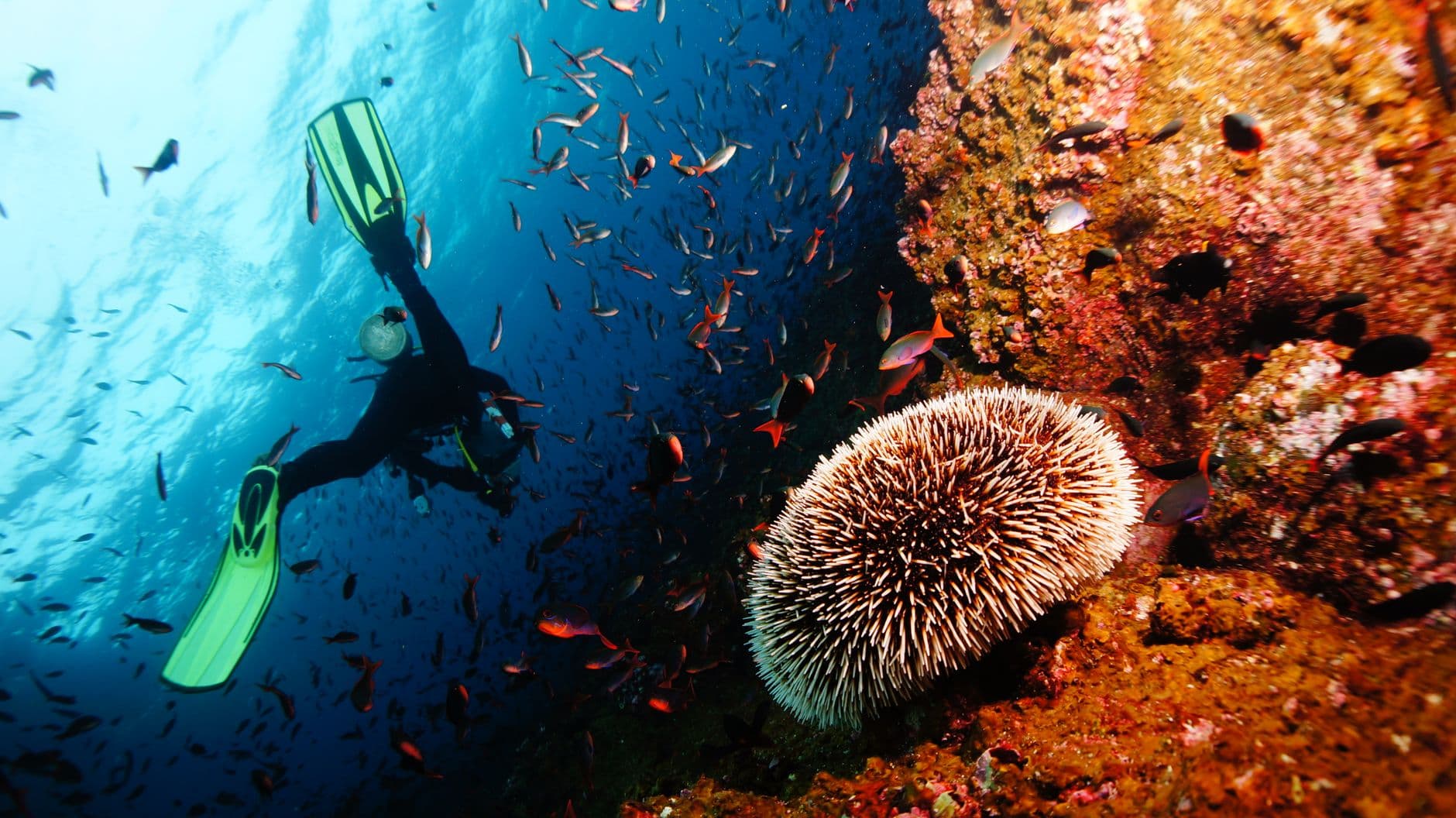
Galápagos Diving: The Ultimate Guide to the Planet's Best Big-Animal Dives
The Galápagos Islands are where bucket-list dive experiences become your Tuesday morning.
This volcanic archipelago 1,000 kilometers (620 miles) west of mainland Ecuador sits at the convergence of three major ocean currents — the cold Humboldt, the warm Panama, and the subsurface Cromwell. That collision creates a nutrient vortex that sustains the highest shark biomass on the planet. You don't just dive the Galápagos. You earn it.
What Makes Galápagos Unique
The Shark Capital of the World
No destination on earth offers the sheer density of large shark encounters that the Galápagos delivers. At Wolf Island's Shark Bay, it's routine to see 200–300+ scalloped hammerheads schooling in a single dive — you hook into the volcanic rock at 20–25 meters with a reef hook and watch them parade past like a formation of fighter jets. Silky sharks, Galápagos sharks, whitetip and blacktip reef sharks are ever-present. Tiger sharks patrol the deeper blue. And from June through November, gravid female whale sharks — the world's largest fish — filter plankton at Darwin Island while you hover alongside.
Liveaboard-Only Legends
The two most famous dive sites in the archipelago — Darwin's Arch (which collapsed in May 2021, leaving two pillars — the diving was unaffected) and Wolf Island — are accessible only by 7- to 10-night liveaboards that sail 12+ hours overnight from Santa Cruz. This is not a casual day trip. The water at Wolf sits at 18–26°C, currents run strong, and you do negative-entry giant strides from Zodiacs into open ocean. The reward is the kind of diving that makes other destinations feel like the pool session.
Gordon Rocks: The Day-Trip That Rivals the Liveaboards
Forty minutes from Puerto Ayora by boat, an extinct volcanic crater called Gordon Rocks delivers hammerhead encounters that would justify a liveaboard anywhere else. The "washing machine" — named for the surging currents inside the crater — is the best day-trip dive in the eastern Pacific. Morning dives at 7–8 AM produce the biggest hammerhead numbers at the cleaning station on the central pinnacle at 20 meters. If you only have one day in the Galápagos, this is the dive.
Endemic Encounters Nowhere Else on Earth
The Galápagos is the only place on the planet where you can see all of these on a single trip:
- Marine iguanas (Amblyrhynchus cristatus) — the only truly marine lizard on earth, diving to 10+ meters to graze on algae. Watch them at Punta Vicente Roca on Isabela.
- Galápagos penguins (Spheniscus mendiculus) — the only penguin species north of the equator. Guaranteed sightings at Bartolomé Island.
- Red-lipped batfish (Ogcocephalus darwini) — an endemic fish that "walks" on modified fins across the seafloor. Found on sandy bottoms at Wolf's Anchorage.
- Flightless cormorants — a bird that lost the ability to fly and instead dives underwater for eels and fish. Seen off Fernandina and western Isabela.
The Galápagos also has 41 endemic fish species, and the opportunity to see Mola mola (ocean sunfish) from June through October, giant oceanic manta rays with wingspans up to 5 meters at Cabo Marshall, and Galápagos garden eels covering entire sandy slopes at North Seymour.
Who Galápagos Is For
The Galápagos is not a beginner destination for most of its signature experiences. Here's the reality:
- Wolf & Darwin (liveaboard-only): Requires Advanced Open Water certification with a minimum of 50 logged dives. Strong currents, negative entries, reef hook technique, and open-ocean conditions are non-negotiable. Some operators require 100+ logged dives.
- Gordon Rocks: Advanced Open Water with 25+ logged dives minimum. Surge currents inside the crater can be challenging.
- Central sites (North Seymour, Mosquera, Bartolomé, Cousins): Open Water divers welcome. These are gentle drift dives over sandy bottoms and rocky reefs with mild currents. Perfect for building experience.
- Southern sites (Devil's Crown, Champion Island): Beginner-friendly with warm water, moderate depths, and abundant reef life.
If you're an Open Water diver with fewer than 25 dives, you can still have an excellent Galápagos trip — you just need to stick to the central, southern, and eastern day-trip sites. Book with Academy Bay Diving or Scuba Iguana in Puerto Ayora, tell them your level, and they'll set the right itinerary.
The Infrastructure
There are 27 verified dive operators across the archipelago: 12 land-based centers on Santa Cruz (Puerto Ayora), 3 on San Cristóbal, 1 on Isabela, and 11 liveaboard vessels. Santa Cruz is the hub — Charles Darwin Avenue in Puerto Ayora is lined with dive shops. Two operators are PADI 5-Star IDC centers (Scuba Iguana and Academy Bay Diving), meaning you can do full instructor training on the island.
Liveaboard prices range from $532/night (budget) to $831/night (premium). Day trips run $180–250 for two tanks. A full week land-based including flights from mainland Ecuador, accommodation, meals, and diving runs $3,500–5,300.
Practical Overview
The Galápagos runs on Galápagos Time (UTC-6, no DST). US Dollar is the currency — Ecuador is fully dollarized, and crisp USD cash is king. The TCT ($20, cash only) must be purchased at your mainland departure airport before flying. The National Park entrance fee ($200, crisp USD cash) is paid on arrival. English is widely spoken by dive operators. The two airports are Seymour Airport on Baltra (GPS) — serving Santa Cruz — and San Cristóbal Airport (SCY). Flights depart from Quito or Guayaquil, roughly 2–2.5 hours.
Safety
The Galápagos has a functioning hyperbaric chamber — the SSS Network facility in Puerto Ayora — contrary to some outdated guides. It's 24/7 emergency on-call, multiplace capacity, and has treated over 1,000 patients since 2001. However, it's only on Santa Cruz: the chamber is 12+ hours from Wolf & Darwin by boat, and 2–3 hours from San Cristóbal and Isabela. DAN insurance with evacuation coverage is mandatory. Night diving is prohibited across nearly all of the Galápagos Marine Reserve.
Bottom Line
The Galápagos is the benchmark for big-animal diving worldwide. No other destination combines hammerhead schools in the hundreds, whale sharks, endemic marine iguanas and penguins, and a 138,000 km² marine reserve in a single trip. It requires preparation, fitness, and respect for the conditions — but every diver who has hung on a reef hook at Wolf Island watching 300 hammerheads pass in formation will tell you it's worth the journey.