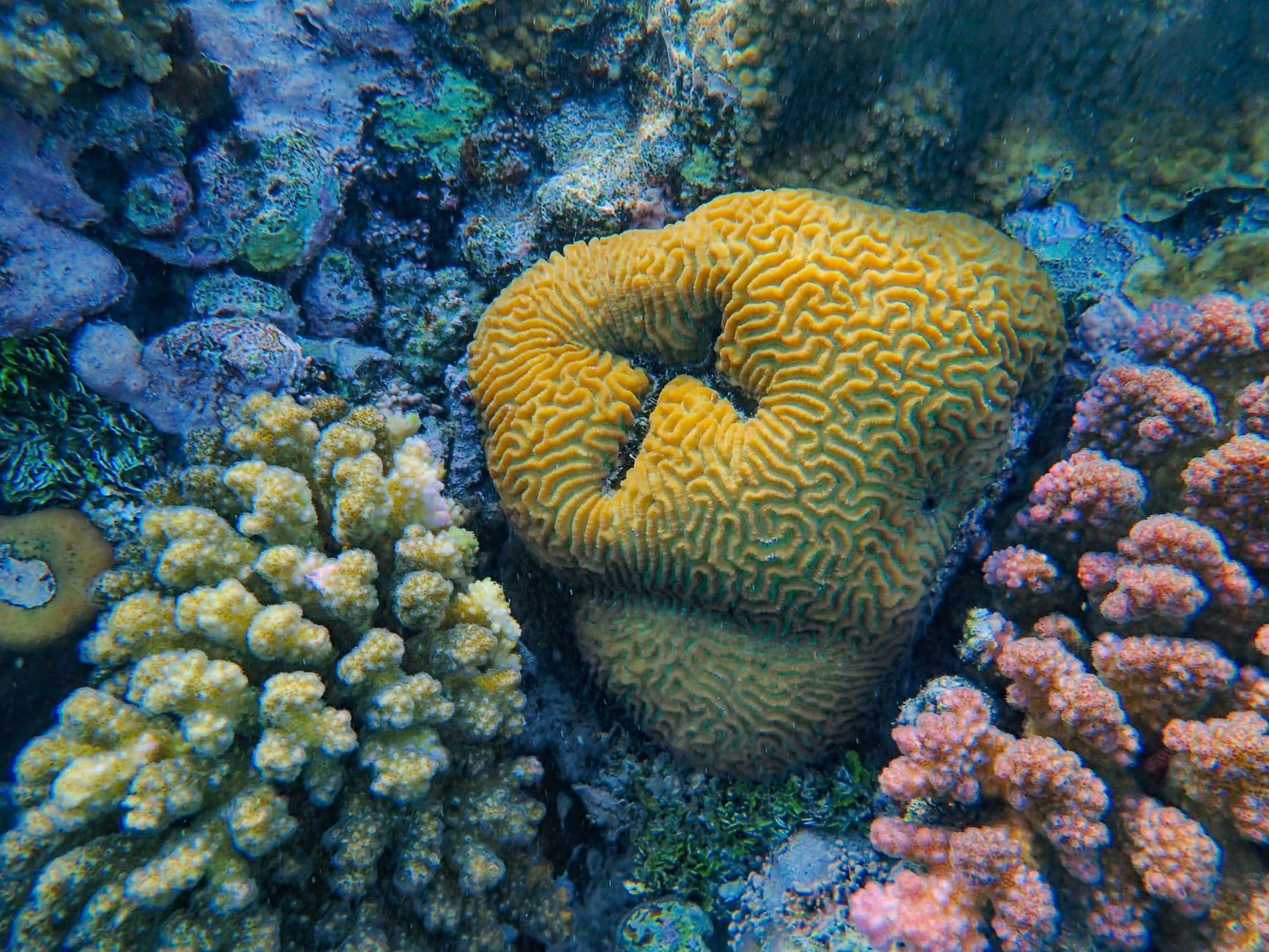
The Farasan Banks span 560 km of pristine Red Sea reef system with 42 documented dive sites across 9 geographic zones. Most of these sites see a dive boat once a week or less. Some see one per season. A few — the remote southern atolls — may go an entire year between visits. In a world where every dive site in Egypt has been photographed, GPS-tagged, and reviewed on TripAdvisor, the Farasan Banks feel like stepping back four decades.
We ranked the top eight sites by overall experience — marine life density, visibility, uniqueness, and diver reward. These are the dives you do not want to miss.
1. Dohra Nord (Turtle Island)
Zone: 2 — Dohra-Jadir-Malathu Group Depth: 20–40 m Difficulty: Advanced Access: Liveaboard Best season: November–May, peak December–February Current: Moderate to strong — drift dive
Dohra Nord is the Farasan Banks' most reliable hammerhead site. The island is a flat, scrub-covered sand cay where turtles lay eggs — you will see the crawl tracks on the beach at sunrise. What matters for divers is underwater: two massive coral blocks separated by narrow, current-swept valleys where scalloped hammerheads patrol regularly from November through May.
The standard profile is a drift along the main coral block, descending to 30–35 m where the wall levels to a plateau. The hammerheads cruise the outer edge of this plateau, typically 32–40 m, moving in groups of 5–15 on a normal day and 20–80 on a good one. They are comfortable with diver presence and will circle back for repeated passes.
Grey reef sharks occupy the mid-water column at 20–30 m. Trevally and tuna streak through the valleys. On the plateau itself, whip corals and gorgonians create a lunar landscape effect.
The hammerhead factor: This is the site you choose when hammerheads are your priority. The sharks are not guaranteed but the probability on a December–February visit is the highest in the Banks.
Current notes: The narrow valleys between the coral blocks accelerate current significantly. Plan a drift dive and deploy your SMB before ascending from the plateau. The crew will track you from the surface and pick you up downcurrent.
Diver level: Advanced. The combination of depth (30–40 m engagement with hammerheads), current, and remote access means this is not a first-dive site. 50+ dives recommended.
2. Shib Habil Reef
Zone: 7 — Al Lith Local Sites Depth: 5–20 m Difficulty: Open Water / Snorkeling Access: Day boat from Al Lith or liveaboard Best season: December–May, peak March–May Current: Mild
Shib Habil is the Farasan Banks' most famous single reef — and for good reason. This shallow platform, 4 km offshore Al Lith, is one of the only confirmed whale shark nursery habitats in the Indian Ocean basin. Over 100 juvenile whale sharks (2.5–7 m) aggregate here annually from December through May, feeding on plankton blooms that concentrate at the northern end of the reef.
The scientific significance is substantial. KAUST (King Abdullah University of Science and Technology) tracked 47 individual whale sharks at Shib Habil from 2009–2014, publishing their findings in PLOS ONE. The study revealed that the sharks make regular dives to 400 m, with three individuals exceeding 1,000 m — the deepest recorded dives for this species.
For divers, the experience is straightforward: the reef tops out at 5–8 m, the sharks cruise just above the reef platform, and visibility ranges from 15–25 m (the plankton that attracts the sharks also reduces clarity). The encounter is intimate — the sharks are juveniles, curious, and accustomed to the presence of snorkelers and divers. You can swim alongside a 5 m animal in 7 m of water. It is accessible to Open Water divers and even snorkelers.
What to know: Timing is everything. December–February offers cooler temperatures and better visibility but fewer sharks. March–May delivers peak shark numbers but visibility drops as the plankton bloom intensifies. Either way, you will see sharks.
Diver level: All levels. Open Water certified is sufficient. Snorkelers can participate on surface-level encounters.
3. Long Reef — North & South
Zone: 1 — Northern Banks (Mar Mar Group) Depth: 15–45 m Difficulty: Advanced Access: Liveaboard Best season: November–May, peak December–March Current: Strong — drift dive
Long Reef is the shark and barracuda site of the northern Banks. This elongated reef structure features an extensive plateau sloping from 15 m to 40 m, covered in hard coral formations that create a "lunar landscape" effect. What makes Long Reef exceptional is the density and consistency of its pelagic life.
A large sedentary barracuda school — hundreds of individuals — holds in the water column above the plateau. The barracudas do not drift; they hold position, their silver bodies catching the light, creating a curtain of metal that parts as you swim through. Grey reef sharks and hammerheads patrol the outer edge of the plateau. Trevally and tuna hunt in coordinated packs.
The current at Long Reef is typically strong — 1.5–2.5 knots — and the dive is a drift profile along the reef axis. The crew drops you at the upcurrent end and picks you up downcurrent. The north and south ends of the reef offer slightly different profiles: the north end drops to 45 m with stronger current, the south end is shallower at 15–35 m.
Diver level: Advanced. Strong currents and depth require solid buoyancy control and drift diving experience. A delayed SMB is mandatory.
Pro tip: Descend immediately on entry — the current can sweep you past the plateau edge before you reach depth if you linger at the surface.
4. Sha'ab Ammar — North
Zone: 3 — Sha'ab Ammar Atoll Depth: 15–40 m Difficulty: Intermediate–Advanced Access: Liveaboard (night anchorage available) Best season: November–May Current: Moderate to strong on outer walls
Sha'ab Ammar is one of the largest atoll systems in the Farasan Banks and a favorite among liveaboard operators for its sheltered anchorage, excellent night diving, and consistent pelagic action. The atoll is horseshoe-shaped, roughly 2 km across, with a shallow central lagoon and outer walls that drop to 40+ meters.
The north end of the atoll features coral plateaus at 15–25 m covered in healthy hard coral and sea fans. Above the plateau, barracuda and trevally form large aggregations. Hammerheads visit the outer wall regularly during winter months, and grey reef sharks are present year-round.
The night dive at Sha'ab Ammar is a highlight of most liveaboard itineraries — the sheltered lagoon means calm conditions even when the outer walls are running current. Sleepy parrotfish in mucus cocoons, hunting moray eels, hunting octopus, and the occasional shark cruising through the torch beam.
Diver level: Intermediate for the plateau dive (15–25 m, moderate current). Advanced for the outer wall drift where current picks up.
Why it's ranked here: Sha'ab Ammar is versatile — it works for a mixed-skill group, offers reliable shark encounters, and the night dive option adds a second experience. It is not as extreme as Long Reef or as specialized as Shib Habil, but it is the most consistently rewarding all-rounder.
5. Gorgonia Reef (Shabrur)
Zone: 1 — Northern Banks Depth: 25–40 m Difficulty: Advanced Access: Liveaboard Best season: November–May Current: Moderate to strong
Gorgonia Reef is an isolated submerged reef with a unique biological signature. The reef is elongated north–south, with a plateau sloping from 25 m to 38 m and a second plateau at 45–50 m. That deeper plateau is within technical diving range, but the primary attraction lies at 25–35 m.
The reef gets its name from the dense gorgonian sea fans that cover its upper slopes. These are massive specimens — the largest fans stand over 2 m tall — in red, purple, and orange. Mixed in with the gorgonians are grape coral formations and whip madrepores that create a garden-like effect. This is one of the most photogenic sites in the Banks.
Barracuda schools and jacks use the reef as a hunting ground. Grey reef sharks patrol the drop-off at the plateau edge. The reef's isolated position — surrounded by deep water — attracts transient pelagics that the inner reefs do not see.
Diver level: Advanced. The depth profile (25–40 m) means bottom time is limited. Good air consumption and gas management are essential.
Current notes: Moderate currents average to strong. The best window for visibility is the morning dive, before wind builds.
6. Choppy Reef
Zone: 4 — Danak-Jabbara-Mudarr Group (Southern Atolls) Depth: 27–45 m Difficulty: Advanced Access: Liveaboard Best season: November–May Current: Strong
Choppy Reef is the biological outlier of the Farasan Banks. This isolated elongated reef features an internal lagoon and a small sandy island, but the underwater highlight is the black coral bushes with colored sponges and sea squirts — a biological community that appears to be unique to the Farasan Banks. The black coral stands 1–2 m tall, and the associated sponge community creates vivid splashes of red, yellow, and blue against the dark coral branches.
The reef has two plateaus: one at 25 m and another at 45 m. The deeper plateau is where the reef sharks — primarily grey and silvertip — patrol during the day. Hawkfish perch on the black coral branches, using them as ambush points for passing prey.
Diver level: Advanced. Strong currents are the norm. The 27–45 m depth range demands excellent gas management. This is a remote site — emergency response time is extended.
When to dive: Morning dives offer the best visibility (25–30 m when conditions align). Afternoon dives are wind-affected on most days.
7. Jabbara Island — North & South
Zone: 4 — Southern Atolls Depth: 20–45 m Difficulty: Advanced Access: Liveaboard Best season: November–May Current: Strong
Jabbara is the southernmost established atoll in the Farasan Banks catalog and represents expedition diving at its most authentic. The island is remote, infrequently visited, and surrounded by deep water that attracts the Banks' largest pelagic species.
The north site features a wall dropping from 20 m to 40 m with large gorgonian fans and sponge-encrusted overhangs. Silky sharks and grey reef sharks patrol this wall in numbers that exceed the northern Banks. Hammerheads are sighted regularly — November through February — and oceanic whitetip sharks are occasional but memorable visitors.
The south site has a steeper profile and stronger currents. The wall here is where the largest pelagic encounters happen — silky sharks in the 2 m range, large trevally, and tuna.
Diver level: Advanced. This is the most remote established site in the Banks. Emergency response to Jeddah exceeds 6 hours. Only dive here with experience and a competent crew.
8. Five Sisters (Five Corals)
Zone: 8 — Pinnacles & Wreck Sites Depth: 10–40 m Difficulty: Intermediate–Advanced Access: Liveaboard Best season: November–May, mantas October–April Current: Moderate
Five Sisters is the Banks' pinnacle signature dive — five coral towers rising from deep water, their walls dropping 300+ meters to the sea floor. Each pinnacle is covered in colorful hard and soft corals, and the currents that sweep between them create a nutrient-rich environment that attracts marine life at every level.
The key draw at Five Sisters is manta rays. From October through April, mantas visit the pinnacles for cleaning — the pinnacle tops at 10–15 m are cleaning stations where cleaner wrasse work on the mantas' gills and skin. Watching a 3–4 m manta hover over a coral pinnacle while cleaner fish work inside its mouth is one of those dives that stops time.
Hammerheads are sighted at Five Sisters during winter months, typically cruising the deep water between pinnacles. The pinnacle walls at 20–35 m are covered in gorgonian fans and soft corals that create a vertical garden effect. Tuna and barracuda hunt in the channels.
Diver level: Intermediate for the pinnacle tops (10–20 m, manageable current). Advanced for the wall dives and current-swept channels between pinnacles.
Pro tip: The second pinnacle from the north has the most reliable cleaning station. Your DM will know which one is active on the day.
Dive Planning Summary
| Site | Depth | Level | Key Attraction | Best Season |
|---|---|---|---|---|
| Dohra Nord | 20–40 m | Advanced | Hammerhead schools | Dec–Feb |
| Shib Habil | 5–20 m | All levels | Whale sharks | Mar–May |
| Long Reef | 15–45 m | Advanced | Barracuda, sharks | Dec–Mar |
| Sha'ab Ammar | 15–40 m | Int–Adv | Atoll, night dive | Nov–May |
| Gorgonia Reef | 25–40 m | Advanced | Gorgonian fans | Nov–May |
| Choppy Reef | 27–45 m | Advanced | Black coral community | Nov–May |
| Jabbara Island | 20–45 m | Advanced | Pelagics, silky sharks | Nov–Feb |
| Five Sisters | 10–40 m | Int–Adv | Manta cleaning | Oct–Apr |
Practical Notes
Liveaboard logistics: All eight sites except Shib Habil require a liveaboard. A standard 7–10 night Farasan Banks itinerary typically covers 3–4 zones, with daily double dives on the walls and a night dive at the anchorage atoll.
Photography: Wide-angle is the lens of choice in the Banks — the visibility, the walls, and the pelagic distances all reward a 14–24 mm equivalent. Macro is less rewarding here than in muck-diving destinations; the macro life exists but is not the draw. Bring a fisheye for the mantas and hammerheads.
Safety: Carry your own dive computer, SMB, and reef-safe sunscreen. Confirm DAN insurance coverage for Saudi Arabia and remote evacuation before boarding. The Banks are stunning, but they are also extremely remote — respect that.