The Last Frontier of Red Sea Diving
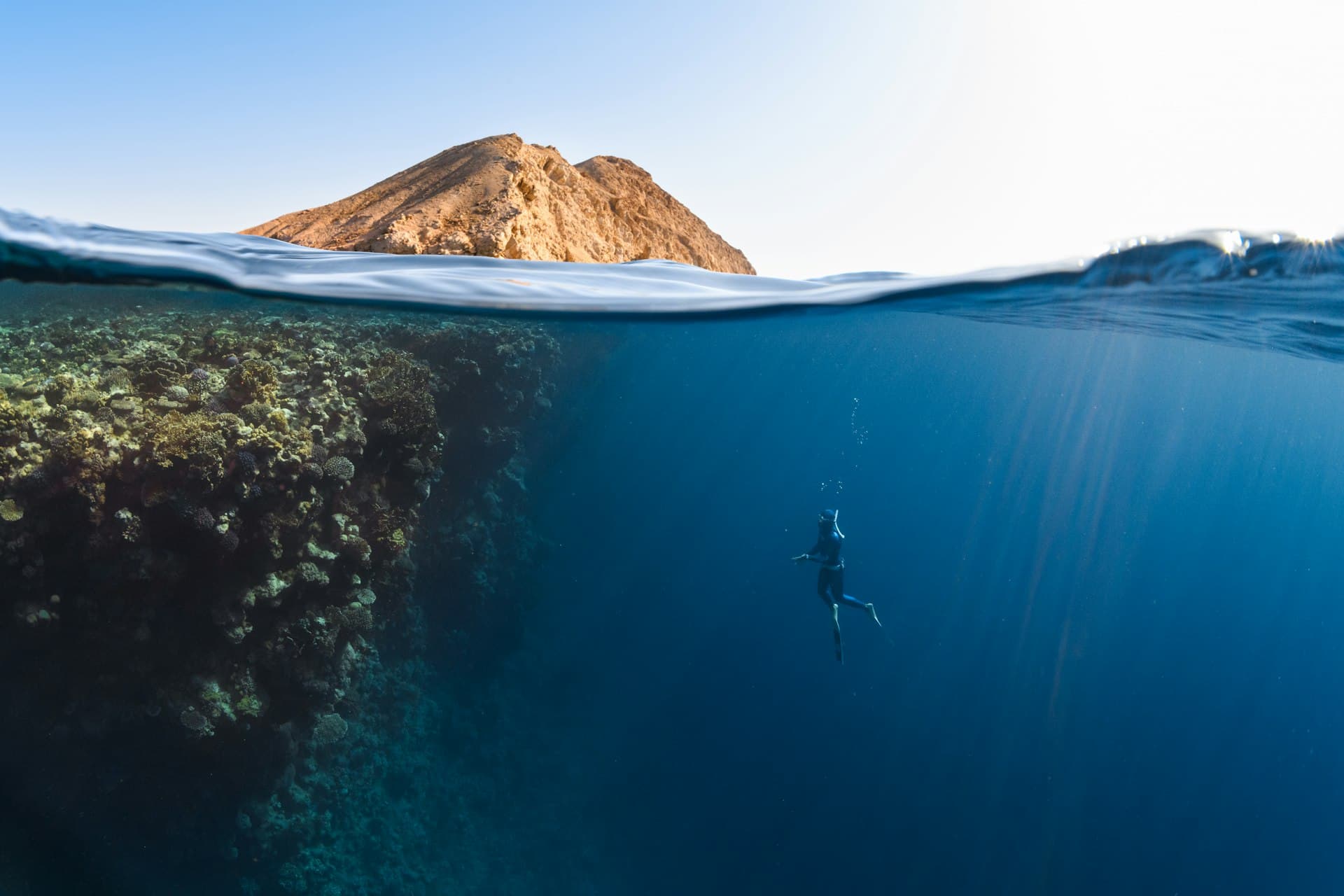
What the Egyptian Red Sea looked like 40 years ago — no dive boats on every site, no resorts on every beach, no crowds. Just 170 islands of pristine reef, 350 miles of untouched wall, and water so clear it hurts. This is the Farasan Banks, a UNESCO Biosphere Reserve off Saudi Arabia's remote southern coast and arguably the last true frontier in Red Sea diving.
The Farasan Banks are not a resort destination. There are no dive centers on the islands, no beachfront hotels, no taxi boats running divers to the reef every hour. This is liveaboard-only expedition diving — you board a boat in Al Lith or Jeddah and spend 7–10 nights sleeping, eating, and diving across a 5,408 km² marine protected area that sees maybe 1–3 liveaboard vessels total. Most dive sites here go weeks between visitors.
The payoff? Scalloped hammerheads in schools of 20–80 individuals. Whale shark aggregations of over 100 juveniles at a single reef every spring. The highest live coral cover in the Saudi Red Sea at roughly 30%. And the kind of underwater silence that comes from being the only diver on a wall.
This guide covers everything you need to know to plan a Farasan Banks expedition: the dive sites, the operators, the logistics, the costs, and the risks.
What Makes the Farasan Banks Different
The Banks stretch roughly 350 miles (560 km) along the southwestern Saudi coast — about the distance from Miami to Key West — and consist of submerged atolls, pinnacle reefs, horseshoe-shaped atolls (sha'ab), and wall drops that plunge from shallow plateaus straight to 300+ meters. The southern Red Sea is an active rifting zone, creating exceptionally deep channels between reefs (up to 1,840 m in the axial trough) that funnel nutrient-rich upwellings toward the surface.
This geography produces three things that make the Farasan Banks unique:
Extraordinary coral health. Live coral cover averages 30% across surveyed sites — the highest in the Saudi Red Sea and significantly higher than most Egyptian Red Sea sites. The Farasan Islands were designated a UNESCO Man and Biosphere Reserve in 2021 and an IUCN Green List site. There is no coastal development on the Banks themselves, no agricultural runoff, and minimal fishing pressure. The corals here behave like corals did before industrial fishing changed reefs worldwide.
Pelagic density that rivals the Pacific. The upwelling channels draw scalloped hammerheads in large schools, oceanic whitetip sharks, silvertip sharks, tiger sharks, whale sharks, mantas, and dugongs. The nutrient-rich water supports baitfish populations that in turn attract the larger predators. At sites like Long Reef and Dohra Nord, barracuda and trevally form tornado-like aggregations that are rare in most of the Red Sea.
Near-total solitude. The Farasan Banks are not on the typical Red Sea liveaboard circuit. Most Saudi itineraries run out of Jeddah and focus on the northern reefs around Yanbu. The Banks require a dedicated trip — at least a 2.5-hour road transfer from Jeddah to Al Lith, then a full day of sailing to reach the first southern sites. Most liveaboards run just two or three Farasan Banks itineraries per season. On any given day, the probability of seeing another dive boat underwater is close to zero.
Dive Sites: An Overview
The Farasan Banks catalog currently includes 42 named dive sites across nine geographic zones, though the true total is estimated at 50–60+ with new sites being discovered each season.
Zone 1: Northern Banks (Mar Mar Group)
These sites are 3–5 hours' sail from Al Lith and represent the first reefs southbound. Mar Mar Island offers vertical wall dives with gorgonian fans, swim-throughs, and sandy bottoms where rays rest. Gorgonia Reef (Shabrur) is an isolated submerged reef with grape coral formations and whip madrepores at 25–40 m. Long Reef features an elongated plateau with strong currents and large sedentary barracuda schools — one of the best shark observation sites in the northern group.
Best for: Grey reef sharks, whitetip reef sharks, barracuda schools, gorgonian fans.
Zone 2: Dohra — Jadir — Malathu Group
This group of four sites features turtle nesting islands, cave systems, and canyons. Dohra Nord (Turtle Island) has a flat island where turtles lay eggs, plus two huge coral blocks with narrow valleys where hammerheads patrol. South West Malathu sits on a plateau with madreporic towers and regularly hosts hammerheads, grey sharks, silky sharks, and barracuda.
Best for: Hammerhead encounters, turtle nesting observations, canyon dives.
Zone 3: Sha'ab Ambar Atoll
A large horseshoe-shaped atoll roughly 40 km south of the Mar Mar group. Sha'ab Ammar North offers coral plateaus and excellent night diving. The southern edge has steeper drops and stronger currents with more pelagic activity. This is a favorite site for liveaboards because the atoll provides sheltered anchorage.
Best for: Atoll diving, night dives, hammerheads, barracuda.
Zone 4: Danak — Jabbara — Mudarr Group (Southern Atolls)
These seven sites represent the expedition-grade section of the Banks. Choppy Reef features an isolated elongated reef with black coral bushes and colored sponges — a biological community unique to the Farasan Banks. Mudarr Reef is a windy, exposed site where dolphins are often sighted alongside grey sharks and hammerheads. Jabbara Island is the southernmost atoll in the established catalog, less frequently visited, and truly expedition-style diving.
Best for: Remote atoll exploration, dolphin encounters, black coral communities.
Zone 5: Saqah — Eagle — Mubarak Group
Six island reef sites in the middle Banks. Saqah Island has a green surface with emerald lagoon and ospreys; its terrace at 25 m hosts large coral blocks. Eagle Island offers multiple dive points (East, South, North West) across a range of difficulty levels.
Best for: Island reef diving, variety of skill levels.
Zone 6: Southern Exploration (Deep South)
Dorrish Island is the most remote site in the catalog. Virtually untouched reefs, large pelagics, and expedition diving with emergency response time exceeding 6 hours to Jeddah. Marabit ElKheil offers intermediate-level diving in the far south.
Best for: Extreme expedition diving, untouched reefs.
Zone 7: Canyon & Al Lith Local Sites
Canyon Reef features canyon formations and shallow plateaus near Al Lith, often used as a final dive before return. Shib Habil Reef is the whale shark aggregation site — a shallow platform 4 km offshore Al Lith where over 100 juvenile whale sharks (2.5–7 m) gather from March to May. KAUST research tracked 47 individual whale sharks here from 2009–2014 in the largest study of its kind.
Best for: Whale shark encounters (March–May), easy final dives.
Zone 8: Pinnacles & Wreck Sites
Seven Sisters and Five Sisters are pinnacle formations rising from deep water with walls dropping 300+ meters. Mantas and hammerheads visit these pinnacles in winter and spring. Al Lith Wreck is a cargo ship sunk in the early 2000s, now encrusted with corals and home to glassfish, lionfish, and moray eels.
Best for: Pinnacle dives, wreck diving, manta encounters.
Zone 9: Farasan Islands Shore & Near-Island Sites
These seven sites are accessible by day boat from Farasan Island or Jizan — the only non-liveaboard option. Abu Galawa Soraya offers shallow coral gardens with visibility exceeding 25 m. The Caves of Farasan are caverns with light penetration and resident reef sharks. The Blue Hole is a deep sinkhole in the reef platform that draws pelagics. Ras Qummah and Coral Maze are beginner-friendly.
Best for: Shore-based day trips, beginner divers, cavern diving, blue holes.
Marine Life Highlights
The Farasan Banks host 79 species of hard coral and 230+ species of fish. The real draw, however, is the pelagic life.
Whale sharks (Rhincodon typus) aggregate at Shib Habil reef from December through May, with peak numbers in March–May. Over 100 juveniles use this shallow platform as a feeding ground — one of the only confirmed nursery habitats in the Indian Ocean basin. The sharks range from 2.5 to 7 meters and are approachable on snorkel or scuba.
Scalloped hammerheads (Sphyrna lewini) school at multiple sites including Dohra Nord, Sha'ab Ammar, and Long Reef. Groups of 20–80 individuals are reported on good days, primarily November through May.
Oceanic whitetip sharks are sighted at southern atoll sites, particularly Jabbara. Silvertip sharks and tiger sharks are less common but regular enough to keep experienced divers watching the blue.
Manta rays visit cleaning stations October through April. Dugongs feed in seagrass beds around Farasan Island and the sheltered bays — one of few Red Sea locations where encounters are realistic.
Turtles — both green and hawksbill — nest on the sandy beaches of multiple islands and are abundant on reef sites year-round.
Liveaboard Operators
The Farasan Banks are accessed almost exclusively via liveaboard. Here are the established options:
M/Y Almonda — A 40 m/144 ft motor yacht operated by Ocean Breeze Liveaboards, accommodating up to 24 guests. Runs 7–10 night Farasan Banks itineraries departing from Al Lith. Pricing from approximately $195/person/day ($1,558–$2,848 full trip depending on cabin and season). Offers short-term DAN insurance upon request. 8.7/10 rating across 67+ reviews.
M/Y Eclipse — Operated by Eclipse Red Sea. Runs Farasan Banks, Farasan South Explorer, Qumais Islands, and Seven Reefs itineraries. Season runs November–May. Embarkation at Al Ahlam Marina, Al Lith.
M/Y Saudi Explorer — Operated by Equator Diving. Runs Seven Reefs (Yanbu), Five Sisters (Rabigh), and Al Lith/Farasan itineraries.
Dive Pro Liveaboard — Listed on PADI Travel for Farasan Banks itineraries. Approximately €1,150–€1,650 per person for 7–8 nights.
Scuba Zone — Offers Farasan Banks liveaboard packages.
All operators require Advanced Open Water certification and many recommend 50+ logged dives for Farasan Banks itineraries. A dive computer is mandatory. Medical certificate (fitness to dive, less than 2 years old) is standard.
The Numbers That Matter
Visibility: 20–40 m year-round. Peak 30–40 m occurs December–February when cold upwelling clears the water column. Summer (June–September) drops to 10–20 m due to plankton blooms.
Water temperature: 22–33°C. Coolest 24–26°C in January–February. Warmest 30–33°C in July–August. A 3 mm wetsuit suffices October–May; 5 mm recommended for multiple dives in winter.
Currents: Mild to moderate at inner-reef sites. Strong to very strong at outer walls and channel passes, particularly the southern atolls (Choppy Reef, Mudarr, Jabbara). Drift diving is standard — zodiac pickup is the norm.
Depth range: 1–50+ meters. Coral gardens at 1–8 m, primary dive depth 15–35 m on reef plateaus, wall dives to 50+ m.
Best season: November to May. Peak December–March for whale sharks, hammerheads, and best visibility. June–September is the no-go window — extreme heat (42°C+ air), poor visibility, and jellyfish.
Practical Information
Getting There
Fly to King Abdulaziz International Airport (JED) in Jeddah. Liveaboard operators provide a 2.5-hour road transfer south to Al Ahlam Marina in Al Lith for embarkation. Alternatively, fly to Jizan Regional Airport (GIZ) and take the free government ferry to Farasan Island for shore-based diving.
Visa
Saudi Arabia offers a tourist e-visa online (visa.visitsaudi.com) for 49 eligible countries. Approximately USD 130–140, valid for up to 90 days. Processing usually 24–72 hours. Visa on arrival available for some nationalities.
Regulations
- Minimum certification: Advanced Open Water for Banks itineraries
- 50+ logged dives recommended by most operators
- Dive computer mandatory
- Medical certificate required (less than 2 years old)
- DAN insurance with evacuation coverage mandatory
- No alcohol anywhere in Saudi Arabia
- Modest dress required on land
Safety — The Critical Issue
There is no hyperbaric chamber on the Farasan Islands, at Al Lith, or anywhere in the Jazan region. The nearest chamber is at King Fahd Hospital in Jeddah — at least 5 hours from Al Lith by road, and much longer from the southern Banks. Speedboat evacuation is not permitted in Saudi Arabia for diving emergencies. DAN insurance with medical evacuation coverage is non-negotiable.
Who This Is For
The Farasan Banks are for experienced divers who value pristine reefs over convenience. You will not find shore diving, rental equipment on the islands, or last-minute boat trips. This is a destination where you book months ahead, fly to Saudi Arabia, sign the expedition waiver, and trust your liveaboard crew for 7–10 days.
If you are an advanced diver who has done the Egyptian Red Sea circuit and wondered what lies on the other side — this is it. If you chase hammerhead schools, whale shark aggregations, and the feeling of being the only diver on a wall that drops 300 meters into blue — book it.
If you prefer resort diving with daily trips, rental shops, and a cold beer at the end of the day — there are 40 other Red Sea destinations in Egypt alone that are a better fit.
When to Go
| Month | Water °C | Visibility | Marine Life Highlights |
|---|---|---|---|
| Oct–Nov | 27–29 | 20–30 m | Mantas arrive, season opens |
| Dec–Feb | 24–27 | 25–40 m | Peak whale sharks, hammerheads, best visibility |
| Mar–May | 25–30 | 20–30 m | Whale shark peak, mantas |
| Jun–Sep | 28–33 | 10–20 m | Off-season — extreme heat, poor visibility |
Final Thoughts
The Farasan Banks is not a secret — the Saudi Red Sea Authority, UNESCO, and a growing number of liveaboard operators are actively promoting it. But it is still off the beaten path enough that most Red Sea divers have never heard of it, and the few who go come back with stories that sound exaggerated. The water clarity, the density of sharks, the feeling of diving a reef that might have been visited ten times this year — it is real.
Saudi Arabia opened to international tourism in 2019, and the diving industry here is young. The infrastructure is still emerging. But the reefs are ready right now. If you want to see what the Red Sea looked like before it became a mass-market destination, the Farasan Banks is your best remaining chance.