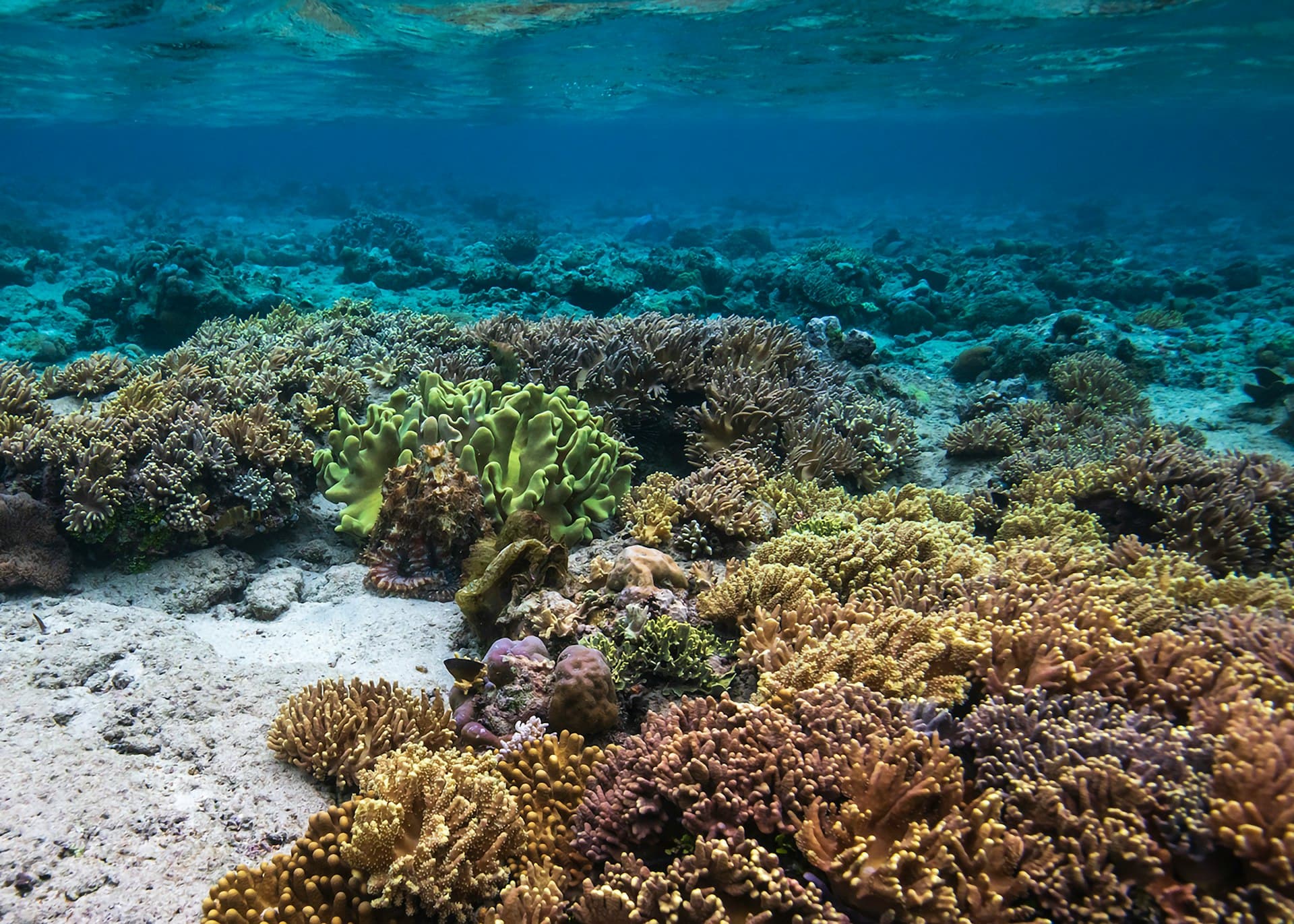
Top 10 Dive Sites in Bunaken: A Complete Guide
Bunaken National Marine Park has over 40 named dive sites across five islands, with a total estimate of 60–70+ sites including Manado Bay. This guide ranks the top 10 verified sites based on marine life quality, accessibility, condition consistency, and unique features.
Every site listed has monthly conditions data — temperature and visibility month by month — so you can match the site to your season and skill level.
1. Lekuan I (Turtle City)
Type: Vertical wall | Depth: 3–40 m | Skill level: Beginner | Current: Mild–Medium | Best season: Year-round (peak May–October)
The crown jewel of Bunaken diving. Lekuan I is a crescent-shaped wall along the south coast of Bunaken Island that stretches for kilometers. The wall drops vertically from 3 meters, with coral-encrusted faces, crevices, ledges, and overhangs that support the highest turtle density in Indonesia.
Green turtles are present on every dive — 10 to 12 per dive is normal. Hawksbills appear at roughly one for every seven greens. The shallow coral garden on the reef top at 5–12 meters is pristine, with pyramid butterflyfish, long-jawed mackerel, and fusilier schools. Whitetip reef sharks rest in the wall crevices; spotted eagle rays patrol the wall edge. Macro photographers find pygmy seahorses (Bargibant's and Denise's), orangutan crabs, and ghost pipefish.
Current is mild inside the crescent but strengthens at the corners. Most operators drop divers at the south end and let the current carry them north along the wall. Bottom times are generous because the reef top is shallow — a 3 mm wetsuit and 50–60 minute dive on air is standard.
Monthly conditions: 28–30°C water, 20–40 m visibility. June through August deliver 40 m visibility; the wet season holds at 20 m.
Access: 5 minutes by boat from Bunaken Island resorts. Multiple operators run this site daily.
2. Mandolin Reef
Type: Current-swept wall | Depth: 5–40 m | Skill level: Intermediate–Advanced | Current: Strong (drift dive) | Best season: May–October
Mandolin sits on the west coast of Bunaken facing Manado Tua, in the open strait between the two islands. The wall drops to 600 meters in places, and the current pushes through the channel at 1–2 knots during spring tides. This is the drift dive of Bunaken.
The reef face is terraced in large steps, with dense forests of whip coral at depth, carpets of sponges, and enormous barrel sponges. Napoleon wrasse — granddaddy-sized with prominent humps — are year-round residents. Bumphead parrotfish schools cruise the shallows. Whitetip reef sharks and blacktip reef sharks patrol the face. A resident school of black snapper known as "midnight snappers" holds at about 18 meters. Eagle rays glide along the wall face.
Advanced divers should note: the current can make the descent and ascent challenging if you drift past the exit point. This is a drift dive — you follow the current, you don't fight it. The boat shadows you along the surface and picks you up at the north end.
Monthly conditions: 28–30°C, 20–40 m visibility (best May–October, when current is strongest and water is cleanest).
Access: 10 minutes from Bunaken Island. Intermediate certification recommended.
3. Lekuan III
Type: Vertical wall | Depth: 3–40 m+ | Skill level: Intermediate | Current: Mild–Medium | Best season: Year-round (peak May–October)
The furthest section of the Lekuan crescent. Lekuan III is less crowded than Lekuan I, with deeper sections extending beyond 30 meters where black coral bushes grow at depth. Blacktip reef sharks are commonly sighted here, and barracuda schools patrol the blue water. Manta rays make occasional passes — drawn by cleaning stations on the reef top.
The wall is spectacular: vertical faces encrusted with hard and soft corals, enormous barrel sponges, gorgonian sea fans. Anthias and fusilier schools create a curtain of color along the wall face. Turtles are abundant, though slightly fewer than Lekuan I.
Currents are slightly stronger than Lekuan I and II because this section is more exposed to the open channel.
Monthly conditions: 28–30°C, 20–40 m visibility. Best July–September for manta sightings.
Access: 8 minutes from Bunaken Island. Suitable for Open Water divers with some drift experience.
4. Sachiko's Point (Lucky Point)
Type: Wall dive | Depth: 3–25 m+ | Skill level: Intermediate | Current: Mild–Medium (drift-style at corners) | Best season: Year-round
Sachiko's Point on the north-east point of Bunaken delivers a "fish soup" experience — thousands of red-tooth triggerfish and a huge resident school of black snapper create a density of fish life that is genuinely unusual. The site has a steep slope with giant gorgonians; the reef top has an extensive pristine coral garden that is worth a dive on its own.
Blacktip reef sharks, barracuda, Napoleon wrasse, batfish, and bumphead parrotfish are all regulars. Eagle rays glide past. Moray eels peer from crevices. The fish density at this site is remarkable even by Bunaken standards — this is the site where you take your wide-angle lens.
Current at the corners can push, creating a mild drift effect. The main wall face is sheltered enough for intermediate divers.
Monthly conditions: 28–30°C, 20–40 m visibility. Best May–October when the fish schools are densest.
Access: 10 minutes from Bunaken Island.
5. Siladen Jetty
Type: Shore/wall dive | Depth: 2–30 m | Skill level: Beginner | Current: Mild | Best season: Year-round
Siladen Jetty is the house reef of Siladen Resort & Spa — and it ranks as one of the best house reefs in Indonesia. The dive starts directly from the resort beach, with a pristine shallow coral garden at 2–6 meters that is among the best snorkel sites in the park. At 6–8 meters the sandy slope continues, and at 10 meters the wall begins, dropping to 30+ meters.
The site holds an extraordinary variety of marine life for a house reef. Turtles are present on every dive. Nudibranchs are abundant — pijama nudibranchs (Chromodoris), blue dragons (Pteraeolidia ianthina), and Nembrotha kubarayana are common. Cuttlefish are seen regularly. Anemones and anemonefish cover patches on the reef top. At depth, enormous barrel sponges and gorgonian fans grow on the wall face.
Because it's a shore dive, there's no boat schedule. You can dive it any time, and night dives from the jetty are excellent — octopus, Spanish dancers, and sleeping turtles are regularly encountered.
Monthly conditions: 27–30°C, 15–40 m visibility. Year-round.
Access: Shore entry from Siladen Resort. Open to resort guests only unless arranged through another operator with permission.
6. Celah Celah
Type: Fissure wall dive | Depth: 5–30 m | Skill level: Intermediate | Current: Mild–Strong (variable) | Best season: Year-round; excellent night dive
Celah Celah ("crack" in Indonesian) is named for the deep fissures and cracks in the wall that create swim-throughs, caves, and canyons. The site is on the south side of Bunaken, and its irregular wall face creates microhabitats that support an unusual density of macro life.
Pygmy seahorses live in the gorgonian fans. Harlequin shrimp are found on the sandy patches near the wall base. Nudibranch diversity is high — the cracks trap organic matter that supports a rich food web. Tuna and eagle rays hunt in the blue water above the wall. Reef sharks rest in the overhangs.
Celah Celah is one of the best night dive sites in Bunaken. When the sun drops, the macro life emerges — Spanish dancers, moray eels, lobster, and cuttlefish become active.
Monthly conditions: 28–30°C, 15–40 m visibility. Good year-round; best May–October for strongest marine life activity.
Access: 8 minutes from Bunaken Island.
7. Fukui Point
Type: Sandy slope with coral bommies | Depth: 3–30 m | Skill level: Beginner–Intermediate | Current: Mild–Medium | Best season: Year-round; afternoon recommended
Fukui is the only major non-wall dive site on Bunaken — and it offers a completely different experience. The site is a sandy slope with scattered coral bommies, large cabbage corals, and a group of five enormous Tridacna giant clams at approximately 20 meters.
Batfish schools are resident here, and large mackerel, barracuda, and reef sharks visit regularly. Two Napoleon wrasse are residents — fed by dive boats (unusual for Bunaken, where feeding is discouraged, but these are long-established). Giant trevallies patrol the deeper bommies.
The afternoon is the best time to visit because morning boat traffic from Lekuan divers passing by can disturb the site. The late-afternoon light on the cabbage corals is excellent for photography.
Monthly conditions: 28–30°C, 20–40 m visibility. Good year-round.
Access: 8 minutes from Bunaken Island.
8. Tanjung Kopi (Pangalingan)
Type: Sloping reef + wall | Depth: 5–30 m+ | Skill level: Advanced | Current: Strong and awkward | Best season: May–October
Tanjung Kopi on the north-east side of Manado Tua is the advanced diver's Bunaken site. The current here is strong and pulls in multiple directions — entering at the correct point is critical. The site is a steep slope that becomes a vertical wall at approximately 25 meters.
The reward is big-fish encounters. Dogtooth tuna hunt here. Giant trevally and eagle rays patrol the wall. Napoleon wrasse and reef sharks are common. The current-swept ledges hold harlequin shrimp and boxer crabs — macro opportunities alongside the pelagic action. Visibility is consistently excellent because the site faces open water.
This site is for experience-rated divers comfortable with strong currents and blue-water ascents.
Monthly conditions: 28–30°C, 25–40 m visibility. Best June–September when currents are strongest and water is cleanest.
Access: 15–20 minutes from Bunaken Island. Minimum Advanced Open Water recommended.
9. Bunaken Timur 1 (East 1)
Type: Wall dive | Depth: 3–40 m | Skill level: Beginner | Current: Mild (usually) | Best season: Year-round; morning recommended
The east coast of Bunaken is quieter than the south, and Bunaken Timur 1 is the pick of the east coast sites. The wall descends in three distinct coral zones: a pristine shallow coral garden on top to 10 meters, a mid-wall face with vertical coral-encrusted limestone, and deeper terraces at 20–30 meters.
Green turtles are present on every dive. Thousands of reef fish — large unicornfish, needlefish, mackerel schools, fusiliers — create dense walls of fish. Macro life on the deeper terraces includes pygmy seahorses, halimeda ghost pipefish, and squat lobsters.
The site is sheltered from the prevailing wind, making it an excellent alternative when the south coast is rough from a passing storm (though this is rare). Morning dives have the best light for snorkeling the coral garden before descending.
Monthly conditions: 28–30°C, 15–40 m visibility. Good year-round; morning recommended.
Access: 10 minutes from Bunaken Island. Suitable for all levels.
10. Manado Bay Muck Sites (Buluh & Underwater Parking Area)
Type: Muck dive | Depth: 5–20 m | Skill level: Beginner–Intermediate (buoyancy essential) | Current: Mild | Best season: Year-round (best October–April)
Manado Bay — the waters off the mainland — is Bunaken's flip side: black volcanic sand, manmade debris, and some of the best muck diving in Indonesia. Two sites stand out: Buluh and the Underwater Parking Area.
Buluh is famous for flamboyant cuttlefish, blue-ring octopus, and harlequin shrimp. The site is a black-sand slope with seagrass patches and coral rubble — classic muck diving habitat. Wunderpus and mimic octopus are seen here regularly.
The Underwater Parking Area is exactly what it sounds like — old debris, car tires, and metal scraps lying on a black-sand slope. Frogfish of several species are resident. Pygmy seahorses and seahorses live in the debris. Mantis shrimp, squat lobsters, Spanish dancers, nudibranchs, and stargazers are all present.
Visibility ranges 5–15 m — which is normal for muck diving and is part of the experience. The low visibility means your torch is your primary tool, not ambient light.
Monthly conditions: 27–30°C, 5–15 m visibility. Best October–April when the bay is calmest and water is settled.
Access: 30 minutes from Bunaken Island, 10 minutes from Manado. Combined wall-muck day trips are available from most Bunaken operators.