Bunaken Diving: The Complete Guide to Indonesia's Wall-Dive Capital
Bunaken does not do gradual.
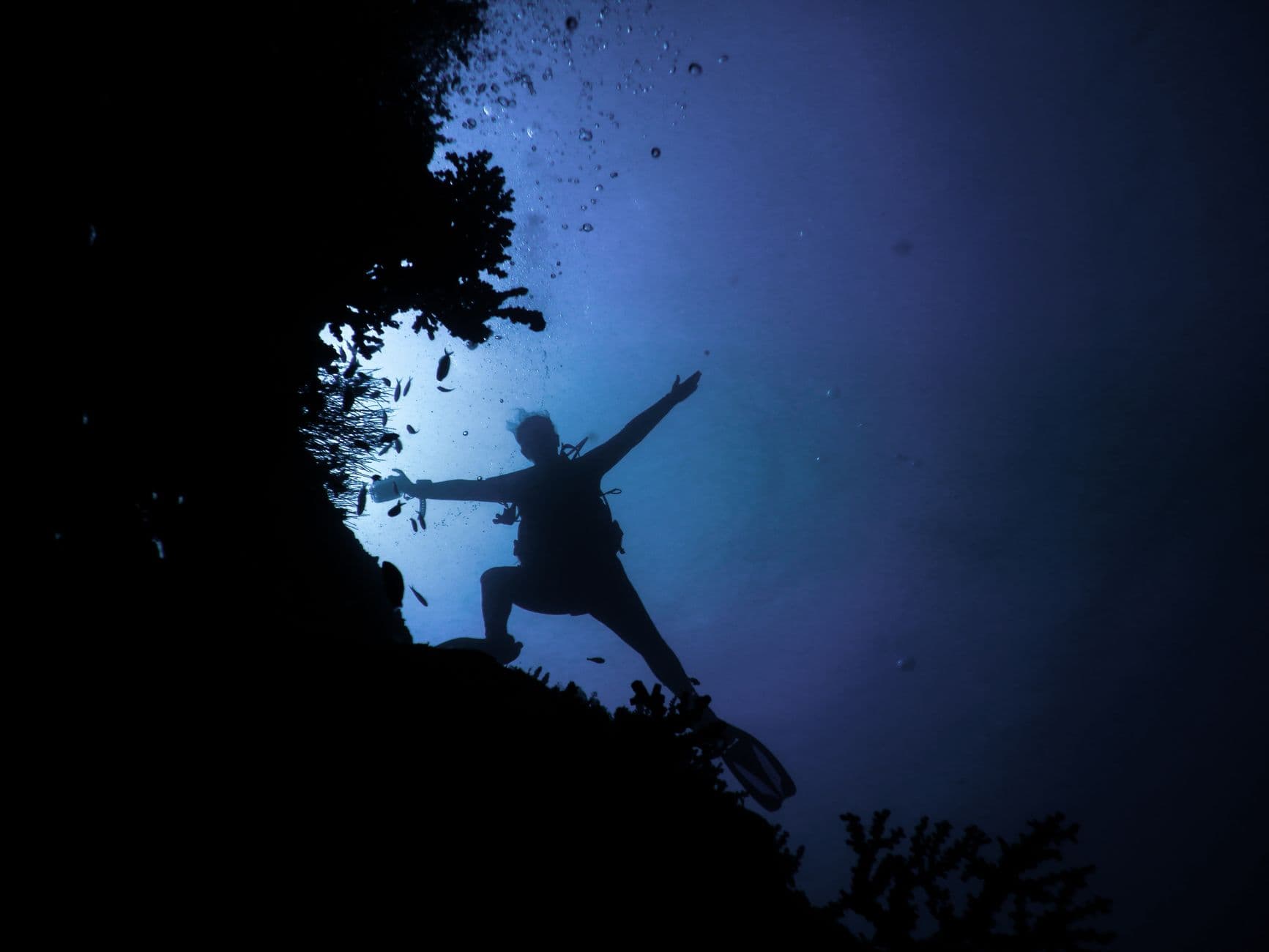
On most coral reefs, depth builds slowly — 20 meters of gentle slope, then maybe a wall. Bunaken drops from 3 meters straight to 1,800. There is no continental shelf here. The five islands of Bunaken National Marine Park sit in the heart of the Coral Triangle, North Sulawesi, and their volcanic walls are encrusted with corals, sponges, and life so dense that 90% of the reef is living cover.
This is the kind of place where a dive at Lekuan I yields twelve green turtles in a single bottom time. Where Pontoh's pygmy seahorse — a 2.5 cm animal — was first described from the same wall face where Napoleon wrasse cruise past with zero regard for the diver in their space. Where the bottom literally isn't visible because it drops beyond recreational limits.
And it's one of the most accessible premium dive destinations in Indonesia — 3.5 hours direct from Singapore, with year-round conditions and a dive resort for every budget.
What Makes Bunaken Unique
Wall Diving Without the Continental Shelf
The defining feature of Bunaken diving is geography. The islands of the park — Bunaken, Manado Tua, Siladen, Mantehage, and Nain — rise from 1,800+ meter depths with no gentle slope. At Lekuan, Mandolin, and Siladen Wall, you descend from reef top at 3 meters, pass through the coral garden at 5–10 meters, and the wall face drops vertically. At 15 meters you're already looking at a 1,785-meter drop. At 30 meters, the water below you is still 1,770 meters deep. This is not exaggeration — it's bathymetry.
For photographers, this means the light behaves differently. The wall acts as a giant reflector, bouncing ambient light off the encrusted vertical face. Shutter speeds at 20 meters on a June morning are unusually fast. For beginners, the wall means you can stay shallow — 5 to 12 meters — and still see a dense vertical reef ecosystem without needing depth.
Turtle City
Lekuan I is nicknamed Turtle City for a reason. Green turtles (Chelonia mydas) and hawksbills (Eretmochelys imbricata) graze on the reef top year-round, with 10+ per dive considered normal. The turtles are habituated to divers — not in a fed or touched way (guides enforce no-contact strictly), but familiar enough that they continue feeding while you hover a meter away.
Hawksbills are present but less common than greens. The ratio at Lekuan runs roughly 7:1 green to hawksbill. Peak turtle activity is morning through early afternoon, when the reef top gets the best light for algae growth.
The Coelacanth
In 1998, a second species of coelacanth (Latimeria menadoensis) — a fish thought extinct for 65 million years — was discovered alive off Manado. It lives in underwater caves below 100 meters, well beyond recreational limits, but the fact that a living fossil from the Cretaceous swims in the waters below Bunaken's walls gives every dive here a different weight. You're diving above one of the most significant marine biology discoveries of the 20th century.
Who Bunaken Is For
Bunaken works for every skill level, but it rewards different diver profiles differently.
Beginners and newly certified divers will find Bunaken ideal. The water is warm (27–30°C year-round), currents on the south coast walls are mild to moderate, boat rides are 5–15 minutes from Bunaken Island resorts, and the wall gives you a visually spectacular dive at any depth. Most resorts offer PADI Open Water courses, and Lekuan I and Bunaken Timur are regularly used as training sites.
Intermediate divers get the bulk of the value. The Lekuan crescent, Sachiko's Point, Mandolin Reef, and Siladen Wall all deliver strong marine life at recreational depths. Currents add a drift-diving element without being challenging. A 25-meter profile at Mandolin gives you Napoleon wrasse, barracuda, and the best soft coral displays in the park.
Advanced divers should target Mandolin at peak current for the drift experience, Tanjung Kopi on Manado Tua for Dogtooth tuna, and Nain Island's Batu Kapal for a technical deep dive (summit at 42 meters with cave systems). Manado Bay's muck sites — Buluh, Underwater Parking Area, Circus — deliver world-class macro at 5–15 meters.
The Five Islands
Each island in the park has a different character, and the best trip combines at least two.
Bunaken Island is the diving hub. Most resorts are here, and the south coast walls (Lekuan I–III, Celah Celah) are a 5-minute boat ride. The east coast delivers quieter sites like Bunaken Timur 1 and 2.
Siladen Island is smaller and quieter, with the boutique Siladen Resort & Spa. Its house reef at Siladen Jetty is among the best in the park. The wall is pristine, the soft coral gardens at Siladen Timur are exceptional, and the boat ride to Bunaken's south coast is 10 minutes.
Manado Tua is an uninhabited dormant volcano. The island has no accommodation, but it draws advanced divers to Tanjung Kopi (strong currents, big fish) and Tanjung Pisok (eagle ray cleaning station). Johnson's Wall is a top-ranked site (#250 in Dives+ Top 500) with caverns and pygmy seahorses.
Mantehage (Montehage) is the mangrove island north of Bunaken. Barracuda Point delivers massive aggregations. The mangroves themselves — 1,453 hectares — are critical nursery habitat for juvenile fish.
Nain is the most remote. Reaching it requires a 40-minute boat ride from Bunaken. Batu Kapal is a technical deep dive (summit at 42 meters) with cave systems that have claimed lives — dive guides sometimes refuse to run it.
Practical Overview
Bunaken sits in the Asia/Makassar timezone (UTC+8). The currency is Indonesian Rupiah (IDR), approximately 15,500–16,000 to 1 USD. English is widely spoken at all dive resorts. The nearest airport is Sam Ratulangi International Airport (MDC) in Manado, with direct flights from Singapore (3.5 hours) and connections from Jakarta and Bali. Manado to Bunaken Island is 30–45 minutes by speedboat. Park entrance fees run about IDR 150,000–200,000 (USD 10–15) for a multi-day pass.
Bottom Line
Bunaken delivers wall diving at a quality that rivals Raja Ampat and Komodo, with accessibility that neither can match. Direct flights from Singapore, 5-minute boat rides to world-class walls, turtles on every dive, and the knowledge that a living fossil swims in the deep below — it's one of the most compelling dive destinations in Southeast Asia for the diver who wants quality without the expedition logistics.