Top 10 Dive Sites in Belize: A Complete Guide
Belize crams an extraordinary range of diving into a relatively small area — barrier reef walls, coral atolls, sinkholes, wrecks, whale shark aggregations, and macro playgrounds. These ten sites represent the absolute best the country has to offer, ranked for overall experience.
1. Great Blue Hole (Lighthouse Reef Atoll)
Type: Sinkhole | Max depth: 125 m (rec dive to 40 m) | Distance from shore: ~80 km | Difficulty: Advanced (AOW minimum) | Best season: December–May
The Great Blue Hole is Belize's most famous dive, and it genuinely deserves the hype — though for reasons that surprise most first-timers. This 300-meter-wide, 125-meter-deep karst sinkhole sits at the center of Lighthouse Reef Atoll. During the last Ice Age 18,000 years ago, it was a dry limestone cave system. When sea levels rose, the roof collapsed, leaving a perfectly circular dark blue hole ringed by turquoise reef waters.
The dive: you descend into the circular opening, passing through a layer of hydrogen sulfide at around 30 meters that creates a visual haze. At 40 meters, giant stalactites — some over 10 meters long — hang from what was once the cave ceiling. These formations are the giveaway that this was dry land during the Ice Age. Caribbean reef sharks patrol the rim above you, silhouetted against the blue.
What divers don't always know: The Blue Hole is a geological spectacle, not a marine life dive. The interior is surprisingly sparse — few fish, limited coral. The real marine life is at Half Moon Caye Wall, a 10-minute boat ride away, where the atoll wall drops vertically from 5 meters into the abyss.
Access: Full-day trip from Ambergris Caye, Caye Caulker, or liveaboard. Most operators combine Blue Hole + Half Moon Caye Wall + a third shallow reef dive. Departures at 5:00–5:30 AM.
Practical tips: Book 2–3 weeks ahead in high season. Bring a dive light — it's dark below 30 meters. No gloves allowed (coral protection). Nitrox is strongly recommended to extend your no-deco time at 40 meters.
2. The Elbow (Turneffe Atoll)
Type: Drift / wall | Max depth: 40 m | Distance from shore: ~50 km | Difficulty: Advanced | Best season: December–May
The Elbow at the southern tip of Turneffe Atoll is Belize's most adrenaline-drenched dive. Two tidal currents converge here, creating a nutrient-rich vortex that attracts massive schools of fish. Horse-eye jacks, barracuda, and snappers form dense cylinders that you can swim through, while Caribbean reef sharks and blacktips cruise the outer edges looking for stragglers.
The current at The Elbow is strong — 2 to 3+ knots is normal — and the dive profile is pure drift. You're dropped upcurrent and carried along the wall, covering 500–800 meters in a single dive. The wall itself is a vertical drop from 10 meters to over 1,000, coated in barrel sponges, sea fans, and black coral.
Access: Full-day trip from Turneffe lodges, Ambergris Caye, or liveaboard. Operators need favorable tide and current windows. Not always available — check conditions.
Target species: Horse-eye jacks (100s), barracuda, Caribbean reef sharks, blacktip sharks, eagle rays, occasional hammerheads, snappers, groupers.
Practical tips: AOW certification minimum. Strong drift-diving experience required. Use a reef hook if you want to hold position. Bring a well-secured camera. This is not a dive for beginners or anyone uncomfortable with strong current.
3. Half Moon Caye Wall (Lighthouse Reef Atoll)
Type: Wall dive | Max depth: 40 m | Distance from shore: ~85 km | Difficulty: Intermediate–Advanced | Best season: December–May
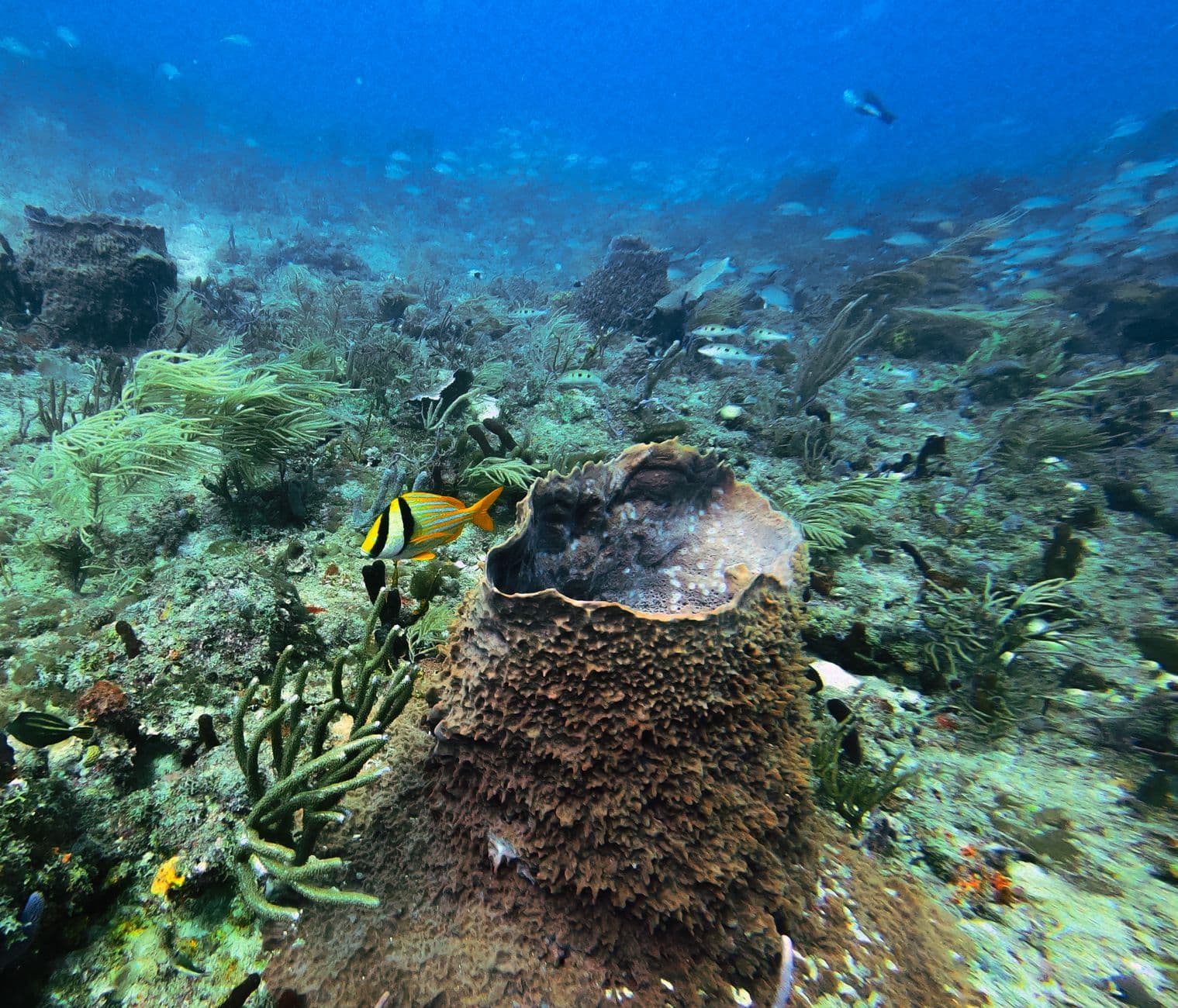
Half Moon Caye Wall is the best wall dive in Belize — and arguably the best pure reef dive in the country. The wall drops from 5 meters to over 1,000 meters in a single vertical face. Unlike the Blue Hole, this dive is packed with marine life: massive barrel sponges, black coral trees, sea fans the size of doors, and schooling fish at every level.
Above water, Half Moon Caye is a national park and a nesting colony for red-footed boobies. The island's lighthouse and booby sanctuary make for an excellent surface interval destination.
Target species: Caribbean reef sharks, eagle rays, barrel sponges, black coral, black groupers, turtles, endemic toadfish, schooling snappers.
Practical tips: Usually paired with the Blue Hole. Best conditions in the morning when the light hits the wall directly. Camera with a wide-angle lens is essential.
4. Gladden Spit (Southern Barrier Reef)
Type: Whale shark aggregation | Max depth: 5–15 m | Distance from shore: ~35 km | Difficulty: Beginner–Intermediate | Best season: March–June (full moon peaks)
Gladden Spit is one of the most reliable whale shark encounter sites in the Caribbean. The mechanism is unique: cubera snapper gather to spawn during the full moon (March–June), releasing eggs that floating on the surface attract feeding whale sharks. Because the timing is tied to the lunar cycle rather than plankton blooms, you can plan around it.
The whale sharks are typically 6–10 meters in length and feed at the surface, making this an encounter suitable for snorkelers and divers alike. Visibility during the spawn is 15–25 meters. Encounters are strictly regulated — 10-meter minimum distance, max 5 divers per shark.
Access: Boat trips from Placencia or Hopkins. Full-day excursions during the full moon window. Some operators guarantee or offer a free trip if no whale shark is sighted.
Practical tips: Book 2+ months ahead for full moon dates. March and April full moons are peak. Bring a surface marker buoy — you'll spend time at the surface. Dive operators provide whale shark briefing and enforce strict protocols.
5. Hol Chan Marine Reserve (Ambergris Caye)
Type: Marine reserve channel | Max depth: 18 m | Distance from shore: ~4 km | Difficulty: Beginner–Intermediate | Best season: Year-round
Hol Chan (Mayan for "little channel") is one of the oldest marine reserves in the Caribbean, established in 1987. This 7-square-mile cut through the barrier reef concentrates an extraordinary biomass of fish. The channel walls are layered with coral and the sandy bottom is home to nurse sharks and southern stingrays.
Night dives at Hol Chan are exceptional — octopus, green moray eels, and crabs emerge as the sun sets. The reserve is just 15 minutes by boat from San Pedro, making it the most accessible quality dive in Belize.
Target species: Nurse sharks, southern stingrays, eagle rays, turtles, barracuda, groupers, snappers, green moray eels, octopus (night).
Practical tips: Suitable for all certification levels. Go at slack tide for the calmest conditions. The adjacent Shark Ray Alley (3–5 m) is often combined as a second shallow dive or snorkel stop.
6. Turneffe Atoll — Gorgonian Wall
Type: Vertical wall | Max depth: 30 m | Distance from shore: ~50 km | Difficulty: Intermediate | Best season: December–May
Gorgonian Wall on the eastern edge of Turneffe Atoll is named for its dense fields of sea fans and gorgonians that coat the vertical wall face. The current here is generally moderate — 1–2 knots — making it more accessible than The Elbow while still delivering a proper wall experience. Eagle rays and reef sharks are regulars, and the coral health on this side of the atoll is excellent.
Target species: Eagle rays, Caribbean reef sharks, schooling grunts and snappers, sea fans, barrel sponges.
Practical tips: Good intermediate wall dive. Paired well with other Turneffe sites as part of a full-day trip.
7. Glover's Reef Atoll — Patch Reefs
Type: Patch reef / coral garden | Max depth: 12 m | Distance from shore: ~60 km | Difficulty: Beginner | Best season: February–June
Glover's Reef's central lagoon contains over 800 patch reefs and coral pinnacles, making it one of the richest coral habitats in the Caribbean. The atoll is a UNESCO site and hosts a Wildlife Conservation Society research station. The patch reefs are shallow (3–12 m), nearly current-free, and packed with colorful reef fish.
Target species: Parrotfish, angelfish, butterflyfish, damselfish, turtles, rays, elkhorn and staghorn coral.
Practical tips: Glover's Reef is remote — accessed via liveaboard or overnight stays at the research station. Best for photographers and divers who want solitude. Book well ahead.
8. Cayes Caulker — Rock Beauty / Caye Caulker Canyons
Type: Patch reef / canyons | Max depth: 20 m | Distance from shore: ~2 km | Difficulty: Beginner–Intermediate | Best season: Year-round
Caye Caulker offers the same barrier reef access as Ambergris Caye at significantly lower prices. Rock Beauty is a colorful patch reef named for its abundant angelfish. The Caye Caulker Canyons are a series of limestone cuts with swim-throughs and good fish life. This is the budget-conscious diver's base.
Target species: Angelfish, parrotfish, butterflyfish, rays, nurse sharks, lobsters.
Practical tips: Caye Caulker has fewer dive shops (5) than Ambergris but lower prices. The laid-back island vibe is a major draw. Most operators run half-day trips.
9. Mexico Rocks (Ambergris Caye)
Type: Shallow broken reef | Max depth: 12 m | Distance from shore: ~3 km | Difficulty: Beginner | Best season: Year-round
Mexico Rocks is a shallow broken reef system north of San Pedro with excellent swim-throughs and crevices. The coral bommies are separated by sandy channels, creating a maze-like underwater landscape. This is one of the best sites for beginner divers and snorkelers.
Target species: Parrotfish, angelfish, nurse sharks, lobsters, crabs, sergeant majors, chromis.
Practical tips: Ideal for check-out dives and new divers. Can be snorkeled if conditions are calm. Morning light is best for photography (the bommies catch the sun at the right angle).
10. Sayonara Wreck (Turneffe Atoll)
Type: Wreck / artificial reef | Max depth: 20 m | Distance from shore: ~50 km | Difficulty: Beginner–Intermediate | Best season: December–May
The Sayonara is a former passenger boat scuttled as an artificial reef near Turneffe Atoll. The wreck sits upright in 8–20 meters of water and is now encrusted with coral, barrel sponges, and sea fans. Barracuda hover above the deck, and queen angelfish and stoplight parrotfish patrol the hull. This is Belize's most accessible wreck dive.
Target species: Barracuda, queen angelfish, stoplight parrotfish, peacock flounder, giant barrel sponges.
Practical tips: Easy dive suitable for OW divers. Usually combined with other Turneffe sites. The wreck is small — you can explore it fully in 30 minutes. Bring a dive light to see inside the hull openings.
Summary Table: Belize Top Dive Sites
| Rank | Site | Type | Max Depth | Difficulty | Best Season | Key Species |
|---|---|---|---|---|---|---|
| 1 | Great Blue Hole | Sinkhole | 125 m | Advanced | Dec–May | Reef sharks at rim, stalactites |
| 2 | The Elbow | Drift/wall | 40 m | Advanced | Dec–May | Jacks, barracuda, reef sharks |
| 3 | Half Moon Caye Wall | Wall | 40 m | Int–Adv | Dec–May | Barrel sponges, black coral, sharks |
| 4 | Gladden Spit | Whale shark aggregation | 15 m | Beg–Int | Mar–Jun | Whale sharks, snapper spawn |
| 5 | Hol Chan Marine Reserve | Channel reserve | 18 m | Beginner | Year-round | Nurse sharks, rays, turtles |
| 6 | Gorgonian Wall | Wall | 30 m | Intermediate | Dec–May | Sea fans, eagle rays, sharks |
| 7 | Glover's Reef Patch Reef | Patch reef | 12 m | Beginner | Feb–Jun | Parrotfish, angelfish, coral |
| 8 | Caye Caulker Canyons | Canyons/patch | 20 m | Beg–Int | Year-round | Angelfish, rays, nurse sharks |
| 9 | Mexico Rocks | Broken reef | 12 m | Beginner | Year-round | Parrotfish, nurse sharks, lobsters |
| 10 | Sayonara Wreck | Wreck | 20 m | Beg–Int | Dec–May | Barracuda, angelfish, sponges |
Choosing Your Belize Dive Adventure
Open Water / Beginner: Start with Hol Chan Marine Reserve, Mexico Rocks, and Caye Caulker patch reefs. These are shallow, gentle, and consistent.
Advanced Open Water: Add Half Moon Caye Wall, Turneffe Atoll sites, and Glover's Reef inner lagoon. You have the depth rating for the wall dives.
50+ dives / experienced: The Elbow, Gladden Spit whale sharks, and the Great Blue Hole.
Liveaboard divers: A week-long itinerary can cover all three atolls plus the southern barrier reef — the most comprehensive Belize experience.
DivePass tracks real-time site conditions across Belize's dive sites so you can plan around visibility, current, and seasonal events. Check the app before you book your trip.