Diving Aqaba: Jordan's Red Sea Guide
Aqaba puts Jordan's entire Red Sea diving coast within reach of one compact city. Along roughly 25 km of shoreline, you can move from shallow coral pinnacles to a 1,161-ton freighter, a transport aircraft, a submerged military display, seagrass beds, and a wall that drops far beyond recreational limits. Many of the best-known sites are accessible from shore, so a week here does not require a liveaboard or long daily boat crossings.
That compact scale is Aqaba's defining advantage. It works for new divers who want forgiving entries, experienced recreational divers looking for wrecks and deeper reefs, photographers who want both wide-angle and macro subjects, and technical teams prepared for the deeper wrecks. The important part is matching the site to your certification rather than treating every wreck or reef as the same kind of dive.
Aqaba at a Glance
- Water temperature: about 21°C in February to 28°C in August
- Typical visibility: 15–40 m, with 20–35 m common through much of the year
- Main season: year-round; March–May and October–November offer the best balance
- Typical recreational depth: 3–40 m
- Access: shore and boat, with many established shore dives
- Current: usually mild at sheltered reefs, stronger near exposed walls and deep approaches
- Best suited to: beginners, wreck enthusiasts, underwater photographers, mixed-skill groups, and technical divers using qualified local support
Aqaba sits at the northeastern end of the Gulf of Aqaba. The surrounding desert limits river runoff, helping the water remain clear. The coast combines fringing coral, sandy channels, seagrass, pinnacles, artificial reefs, and steeper edges. Surface conditions can still change with wind, especially in winter, so same-day briefings matter even when a site is normally calm.
Three Diving Zones
North and City-Side Sites
Power Station is the headline dive in the north. The reef begins around 6 m and falls along a dramatic wall, with recreational routes reaching roughly 40 m before the terrain continues deeper. Hard and soft corals cover the face, and open-water encounters are possible along the edge. This is not the place for a casual first dive: current and depth can add task loading, so buoyancy, gas planning, and close attention to the guide are important.
First Bay North and First Bay South provide more sheltered alternatives. Their coral formations, sandy channels, and manageable profiles suit check dives, training, and photographers who prefer time over depth. The outer edge can be more exposed, but operators can tailor the route to the group.
Central Marine Reserve
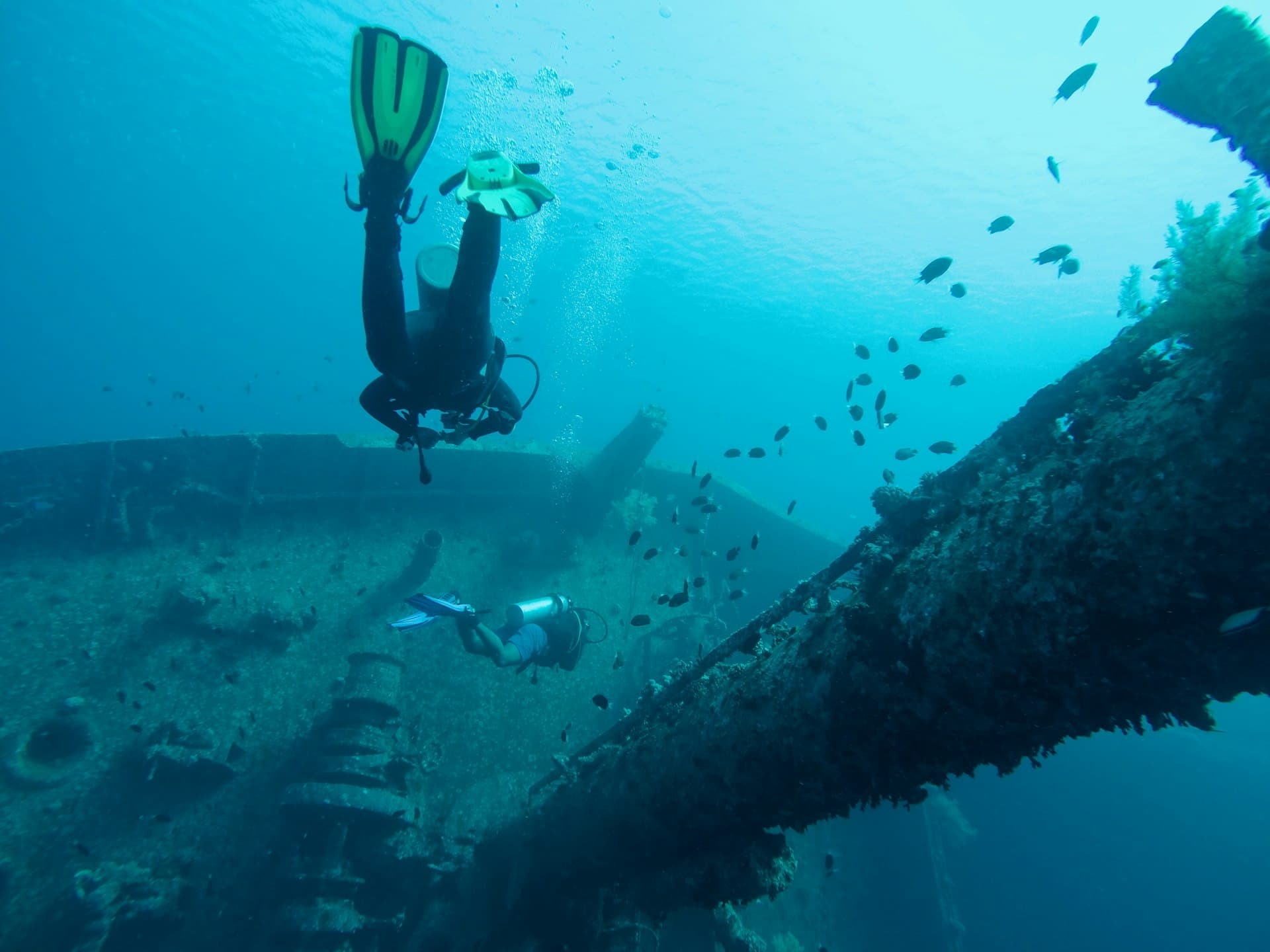
The central reserve contains Aqaba's most recognizable wreck and reef combination. Cedar Pride lies on its side between about 9 and 27 m. Purpose-sunk in 1985, the freighter now carries substantial soft-coral growth and gives qualified divers an impressive exterior route around the superstructure and crow's nest. Penetration is a separate activity that requires wreck training, suitable equipment, and local authorization.
Nearby Japanese Garden offers a completely different profile: dense hard and soft coral, a shallow upper section, and abundant reef fish. It is suitable for beginners, but “easy” does not mean careless. Fire coral and delicate growth make trim and buoyancy control essential.
The reserve's artificial-reef collection extends beyond Cedar Pride. The C-130 Hercules sits around 12–17 m, the L-1011 Tristar spans roughly 9–26 m, and the Underwater Military Museum places vehicles at about 18–28 m. These are excellent wide-angle subjects, but exterior sightseeing and overhead penetration must never be confused. Stay outside unless your training, plan, and guide explicitly support entry.
South Beach and Tala Bay
South Beach holds many of Aqaba's easiest shore entries and some of its strongest photography sites. Seven Sisters consists of shallow coral pinnacles reached across seagrass, generally between 5 and 12 m. The nearby M42 Duster, usually called The Tank, creates a natural two-part dive: living coral and a compact artificial reef on one gentle profile.
Kiwi Reef is a macro-focused counterpoint to the large wrecks. Coral heads and seagrass between roughly 9 and 18 m reward slow searching for sea slugs, shrimp, pipefish, seahorses, juvenile fish, and cryptic scorpionfish. Eel Garden combines a sandy slope, a garden-eel colony, black coral, and a fish-covered pinnacle at about 15–27 m. Rainbow Reef, only 3–18 m deep, is a favorite after sunset when Spanish dancers, lobsters, morays, and feather stars emerge.
Farther out, Yellowstone Reef, Black Rock, King Abdullah Reef, and the Ashraf's Grotto–Paradise area offer deeper or more varied profiles. Routes must stay within certification limits; some named systems continue far below recreational depth.
Who Will Enjoy Aqaba Most?
New and Returning Divers
Aqaba is unusually friendly to beginners because protected shore entries can lead to real coral, pinnacles, and shallow artificial reefs without a long boat ride. First Bay, Japanese Garden, Gorgone One, Seven Sisters, and The Tank can all support approachable plans when conditions are suitable. A diver returning after a long break should still ask for a check dive before visiting a wall or deeper wreck.
Wreck Divers
Few compact destinations offer this much variety: a cargo ship, military vehicle, transport aircraft, wide-body jet, and arranged military display. The appeal is not just novelty. Each structure has a different depth range, orientation, level of coral growth, and photographic geometry. Cedar Pride is the classic; the Tristar and C-130 provide aircraft silhouettes; the museum creates an unusual multi-object route.
Photographers
Bring both wide-angle and macro options if possible. Wide-angle works for Cedar Pride, Power Station, the C-130, the Tristar, Seven Sisters, and the military museum. Macro is strongest when you slow down at Kiwi Reef, Eel Garden, Rainbow Reef at night, and sheltered coral heads. Red Sea bannerfish (Heniochus intermedius), two-band anemonefish (Amphiprion bicinctus), purple tangs (Zebrasoma xanthurum), and sohal surgeonfish (Acanthurus sohal) add reliable reef color. Hawksbill turtles and eagle rays are possible, especially in spring, but they should be treated as welcome encounters rather than promises.
Advanced and Technical Divers
Power Station's wall and the deeper recreational sections of King Abdullah Reef reward strong buoyancy and gas discipline. Al Shorouk, around 35–60 m, and Taiyong, around 35–57 m, are technical dives. They may involve decompression, mixed gas, overhead hazards, and boat-dependent logistics. Choose an operator that can document the required gases, equipment, emergency plan, and team experience.
When to Go
Aqaba can be dived in every month, but the experience changes.
March through May brings gradually warming water from about 21–25°C, improving visibility, and comfortable desert weather. Turtles, nudibranchs, and occasional eagle rays are reported more often in spring.
June through September offers the warmest water, approximately 24–28°C, and visibility often in the 20–35 m range. Shallow dives can be long and comfortable, but July and August are intensely hot on land. Early starts, shade, and hydration are part of safe dive planning.
October and November are the all-round choice for many divers: water remains around 24–27°C, visibility is often 20–35 m, and air temperatures are easier than midsummer. These months work well for combining diving with Petra or Wadi Rum.
December through February brings 21–23°C water and occasional wind interruptions. A 5–7 mm suit is sensible for many divers, especially on repetitive days. Cooler months can be excellent for macro photography and quieter sites.
Shore Diving Versus Boat Diving
Shore diving is central to Aqaba, not a budget substitute. It can provide direct access to reefs, pinnacles, and several artificial structures. It also gives operators flexibility to choose a sheltered site when wind affects boats. Expect a walk over sand or uneven ground, and ask whether transport, tanks, weights, entry assistance, and marine fees are included.
Boat diving remains valuable for exposed sites, technical wrecks, and itineraries that combine several distant areas. Confirm how many dives are included, whether lunch and equipment are provided, group size, expected return time, and whether the planned sites match your certification.
Choosing an Operator
Aqaba has many established dive centers, including PADI-listed resorts and technical providers. Certification logo alone is not enough. Ask specific questions:
- Which sites are planned, and what are their actual depth and current conditions today?
- Is emergency oxygen on the shore vehicle or boat?
- What is the lost-diver and evacuation procedure?
- Are marine fees, equipment, transfers, and Nitrox included?
- What is the guide-to-diver ratio?
- For wrecks, is the plan exterior-only or does it include an overhead environment?
- For technical dives, which gases, backups, surface support, and chamber contacts are confirmed?
Jordan's unified emergency number is 911. Divers should rely first on the operator's emergency action plan and current local medical guidance. Hyperbaric receiving arrangements and direct numbers can change, so confirm them with the operator before the first dive rather than depending on an old directory entry.
Conservation and Good Diving Practice
Aqaba Marine Reserve protects a narrow, heavily used coast. Divers must not remove shells, coral, rocks, organisms, or sediment. Fishing and spearfishing are prohibited within the reserve. Use designated entries and moorings, keep fins clear of coral and seagrass, and do not chase or touch wildlife.
Artificial reefs do not reduce the need for careful buoyancy. Aircraft skin, wreck growth, and the coral around popular sites can all be damaged by contact. Photographers should secure gauges and alternate air sources before approaching a subject. At shallow sites such as Seven Sisters, surge can move a diver farther than expected, making early trim checks worthwhile.
Planning a Dive-and-Desert Trip
King Hussein International Airport is roughly 10 km from central Aqaba. Amman is about four hours away by road under normal conditions, and JETT operates intercity services with schedules that should be checked directly. Petra and Wadi Rum are common additions, but transfers and hikes should be arranged around dive days rather than squeezed between them.
After diving, follow your computer and training agency's altitude and no-fly guidance. Wadi Rum and Petra involve elevation and travel, so discuss the route with your operator if you plan to leave Aqaba soon after your final dive. A buffer day makes the itinerary safer and less rushed.
The Bottom Line
Aqaba succeeds because it offers contrast without long transfers: coral gardens beside wrecks, shallow shore dives beside a serious wall, and wide-angle subjects beside detailed macro habitats. It is easy to build a mixed-skill trip, but only if every diver respects the difference between a 10 m artificial reef, a 27 m wreck, and a 50 m technical objective. Choose sites deliberately, keep the same-day briefing central to the plan, and Aqaba delivers one of the most varied compact dive trips in the northern Red Sea.