Top 12 Dive Sites in Tubbataha: A Complete Guide
Tubbataha Reefs Natural Park is a compact destination — two atolls and a satellite reef with 24 named dive sites across the system. But while the geography is small, the diversity of dive experiences packed into these waters is extraordinary. You can start the morning drifting along a vertical wall with 30+ grey reef sharks circling overhead, spend midday at a manta cleaning station on a shallow wreck, and finish the afternoon exploring a sheltered coral garden with green sea turtles grazing in the seagrass — all within a 20-minute boat ride.
This guide ranks the top 12 dive sites across Tubbataha's three reef systems, based on marine life reliability, underwater topography, and what each site delivers best. Every site here is confirmed by multiple liveaboard operator itineraries.
1. Shark Airport
Zone: North Atoll (northwest side) | Depth: 8–35 m | Difficulty: Intermediate–Advanced | Current: Moderate to strong | Best season: March–June
Shark Airport is the closest thing Tubbataha has to a signature dive site — and it earns its reputation. The site consists of a sandy plateau at 15–20 meters with scattered coral bommies, then a gradual drop-off. The plateau sits at a current convergence point where tidal flow around the North Atoll creates consistent cleaning station conditions. Grey reef sharks gather here in numbers that are genuinely difficult to describe: 30+ individuals circling in a slow current, hovering over the sandy bottom like aircraft in a holding pattern, waiting their turn at the wrasse cleaning stations.
The shark behavior here is the main event. Unlike passing encounters at wall sites where sharks swim past and disappear into the blue, at Shark Airport the sharks stay. They circle. They use the cleaning station. Divers can sit on the sand at 15–18 meters and watch the full cycle — a grey reef shark approaches, a cleaner wrasse picks parasites from its gills and skin, the shark drifts off, and the next one takes its place.
Manta rays visit the same cleaning station, especially in April and May. Eagle rays and devil rays pass through the plateau. Whitetip reef sharks rest on the sand between coral bommies.
What makes it unique: The density and predictability of grey reef sharks on a single dive. There is no reliable shark encounter in the world quite like Shark Airport — the sharks are so consistent that operators treat them as guaranteed.
Dive profile: Descent to the plateau at 15–18 m. Find a stable position on the sand near the bommies and observe the cleaning station activity. After 20–30 minutes, drift over the edge to the 25–30 m drop for the second phase of the dive, where larger pelagics (hammerheads, silky sharks) may appear.
Practical tips: Descend early — the best cleaning station positions fill with divers quickly. Stay still on the bottom and let the sharks come to you; chasing them reduces encounter quality. Bring a wide-angle lens. Minimum depth is 15 m, so this dive works for most cert levels, but the current can be strong.
2. Black Rock
Zone: South Atoll (northern point) | Depth: 5–40 m+ | Difficulty: Advanced | Current: Strong | Best season: April–June
Black Rock is the most famous dive site on the South Atoll — a dramatic rocky pinnacle rising from the deep on the northern tip of the atoll, where tidal exchange through the 8 km inter-atoll channel creates some of the strongest current in the park. This is also the best site in Tubbataha — and arguably in the Philippines — for encountering tiger sharks.
The site features a rocky pinnacle with steep walls dropping to abyssal depths on all sides. Large gorgonian fans and barrel sponges cover the walls. The current channels around the pinnacle, focusing nutrients and plankton, which in turn concentrates predators. Grey reef sharks, silky sharks, and whitetip reef sharks patrol the walls constantly. Scalloped hammerheads school in the blue water beyond the wall, typically in April through June.
Tiger shark encounters at Black Rock are the main attraction. Sightings occur throughout the season, with April and May offering the highest probability. These are not bait-attracted encounters — tiger sharks pass through because the pinnacle's current-swept profile creates hunting conditions they naturally patrol.
What makes it unique: The risk-reward site of Tubbataha. If conditions align — moderate current, clear visibility, a cooperative tiger shark — Black Rock delivers the most memorable dive in the park.
Dive profile: Descend along the pinnacle wall to 25–30 m and hold position facing into the current. The dive leader positions the group to observe the cleaning station and pelagic zone simultaneously. After 15–20 minutes, drift around the pinnacle to the leeward side for a quieter second phase.
Practical tips: Black Rock is the most current-dependent site in Tubbataha. If the current is too strong to hold position, the dive is aborted — no exceptions. This is an advanced-only dive requiring strong currents experience. Minimum 50 logged dives recommended.
3. Amos Rock (Southwest Rock)
Zone: North Atoll (southwest corner) | Depth: 5–40 m+ | Difficulty: Intermediate–Advanced | Current: Moderate to strong | Best season: March–June
Amos Rock is the signature pinnacle dive of the North Atoll, sitting at the southwest corner where the current wraps around the atoll and converges into a cleaning station environment. A rocky pinnacle rises from 25 meters, surrounded by steep slopes with massive gorgonian sea fans, barrel sponges, and soft corals.
This is Tubbataha's most reliable manta ray cleaning station outside the South Atoll. Eagle rays and manta rays visit regularly, and the shark activity rivals Shark Airport — grey reef sharks, whitetip reef sharks, and silky sharks are all cleaned here by wrasse. Large schools of midnight snapper, jacks, and barracuda school around the rock.
What makes it unique: The combination of shark cleaning station and manta ray cleaning station on the same pinnacle. The visibility around Amos Rock is typically excellent (25–40 m), and the gorgonian-covered wall is spectacular in its own right.
Dive profile: Drop onto the pinnacle at 25 m, observe cleaning station activity, then ascend along the wall to 15 m for a shallow-water phase on the reef top.
Practical tips: Amos Rock is frequently combined with the nearby Malayan Wreck on the same dive profile — ask your dive leader if this is possible. The site can be drifted if current is strong, with pickup downstream.
4. Wall Street
Zone: North Atoll (south/southwest wall) | Depth: 5–50 m+ | Difficulty: Intermediate–Advanced | Current: Strong — drift dive | Best season: March–June
Wall Street is a spectacular vertical wall on the southwestern face of the North Atoll. The wall is covered with massive gorgonian sea fans — some over 2 meters in diameter — barrel sponges, and colorful soft corals. Strong currents sweep along this wall, making it a consistent drift dive that delivers pelagic encounters on every run.
Grey reef sharks patrol the wall in numbers. Whitetip reef sharks rest on ledges. Eagle rays and manta rays frequently pass by on the current. The wall itself is a dramatic geological feature — a near-vertical drop-off from 5 meters to abyssal depths that creates the kind of underwater landscape photographers dream about.
What makes it unique: The gorgonian coverage along Wall Street is the densest in the park. Combined with the shark activity and the sheer scale of the wall, this is the site that best represents "classic Tubbataha wall diving."
Dive profile: Pure drift. Descend at the mooring line to 15–18 m on the wall top, then let the current carry you along the wall face. Typical drift covers 500–800 meters before ascent.
Practical tips: This is the quintessential drift dive. Be comfortable deploying an SMB from depth. If you tend toward seasickness, take medication before the dive — the pickup after a long drift in swell can trigger it.
5. Jessie Beazley Wall
Zone: Jessie Beazley Reef (outer wall) | Depth: 5–50 m+ | Difficulty: Intermediate–Advanced | Current: Moderate to strong | Best season: April–May
Jessie Beazley Reef lies 20 km north of the North Atoll, a 30-minute crossing by boat. The isolation pays off — this reef is less visited than the main atolls and often has even more abundant pelagic life. The wall drops from 5 meters to abyssal depths, with large gorgonians and healthy coral cover.
Grey reef sharks are incredibly numerous here — some operators report this as the best shark wall in the entire park. Manta rays, eagle rays, and devil rays cruise the wall. Hammerheads appear on the deep edge in April through June.
What makes it unique: The isolation factor. Fewer divers mean less disturbance and more natural animal behavior. The crossing is worth it.
Dive profile: Wall drift from 15–30 m. The greater distance from the main group means dives here tend to be longer as operators maximize the visit.
Practical tips: Jessie Beazley is typically visited on dedicated days rather than as a drop-in site. The crossing can be rough in wind. Bring a windbreaker for the surface interval.
6. Manta Bowl (Manta Cleaning Station)
Zone: South Atoll (east side, near lagoon channel) | Depth: 8–30 m | Difficulty: Intermediate | Current: Moderate | Best season: March–June (peak April–May)
Manta Bowl is a sandy-bottomed depression with coral-encrusted bommies at its edges, located near the lagoon channel on the east side of the South Atoll. As the name suggests, this is primarily a manta ray cleaning station — reef manta rays (Mobula alfredi) and occasionally oceanic mantas (M. birostris) visit to be cleaned by wrasse.
The site is most productive when currents bring plankton-rich water through the inter-atoll channel. Eagle rays and devil rays also visit. Reef sharks are common. The coral bommies host gorgonians and provide shelter for reef fish.
What makes it unique: The most reliable dedicated manta cleaning station in Tubbataha, with consistent visits throughout the season. The bowl topography keeps mantas in view from multiple positions.
Dive profile: Settle on the sand at 12–15 m near the bommies and wait. The mantas approach the cleaning station, hover while being cleaned, and then circle back.
Practical tips: Mantas are most active when the current is flowing through the channel — early afternoon dives often have the best current alignment. Stay still and let the mantas come to you.
7. Malayan Wreck
Zone: North Atoll (southwest rim) | Depth: 3–20 m | Difficulty: Beginner | Current: Mild to moderate | Best season: March–June
The Malayan Wreck is a shallow shipwreck resting on the reef flat at 4–8 meters, said to be of Malaysian origin. The wreck is heavily coral-encrusted and serves as an artificial reef, attracting clouds of glassfish, anthias, and juvenile reef fish. Octopus and lionfish frequently inhabit the wreck structure. This is also a known manta ray cleaning station.
The shallow depth and good light make this an excellent photography site. The wreck can be combined with nearby Amos Rock on the same dive.
What makes it unique: Tubbataha's most accessible wreck dive with the added bonus of occasional manta encounters.
Dive profile: Explore the wreck structure at 4–8 m, then drift over to the adjacent reef flat for the second phase.
8. Delsan Wreck
Zone: North Atoll (southwest side) | Depth: 5–25 m | Difficulty: Beginner–Intermediate | Current: Moderate | Best season: March–June
A partially submerged steel-hulled wreck whose superstructure breaks the surface at low tide. The wreck is heavily coral-encrusted — jacks, snapper, and barracuda school around the structure. Groupers and moray eels hide in the wreckage. Sea turtles frequently swim around the wreck.
What makes it unique: A visible-from-the-surface wreck that's become fully integrated into the reef ecosystem.
Dive profile: Dive the wreck exterior at 5–20 m. Penetration is not recommended due to structural condition.
9. North Wall
Zone: North Atoll (northern exterior) | Depth: 5–50 m+ | Difficulty: Advanced | Current: Strong | Best season: April–June (hammerhead peak)
The exposed north face of the North Atoll. Advanced-only — the strongest currents on the North Atoll and heavy surge when conditions are active. The reward is Tubbataha's most reliable hammerhead encounter: scalloped hammerheads and occasional great hammerheads school in the blue water beyond the wall. Pelagic tuna and giant trevallies hunt along the wall.
What makes it unique: The best hammerhead site in the park when conditions align.
10. South Wall
Zone: South Atoll (southern exterior) | Depth: 5–50 m+ | Difficulty: Advanced | Current: Very strong | Best season: April–May
The outer south wall of the South Atoll — a near-vertical drop-off from 5 meters to abyssal depths. Massive gorgonians, black coral trees, and barrel sponges. The current is consistently the strongest in the park. Grey reef sharks, scalloped hammerheads, and tuna patrol this wall.
What makes it unique: The most dramatic wall in Tubbataha. The sheer vertical drop is matched only by the consistently strong current and pelagic activity.
11. Ranger Station
Zone: North Atoll (east side, Bird Island) | Depth: 3–35 m | Difficulty: Beginner–Intermediate | Current: Mild | Best season: All season
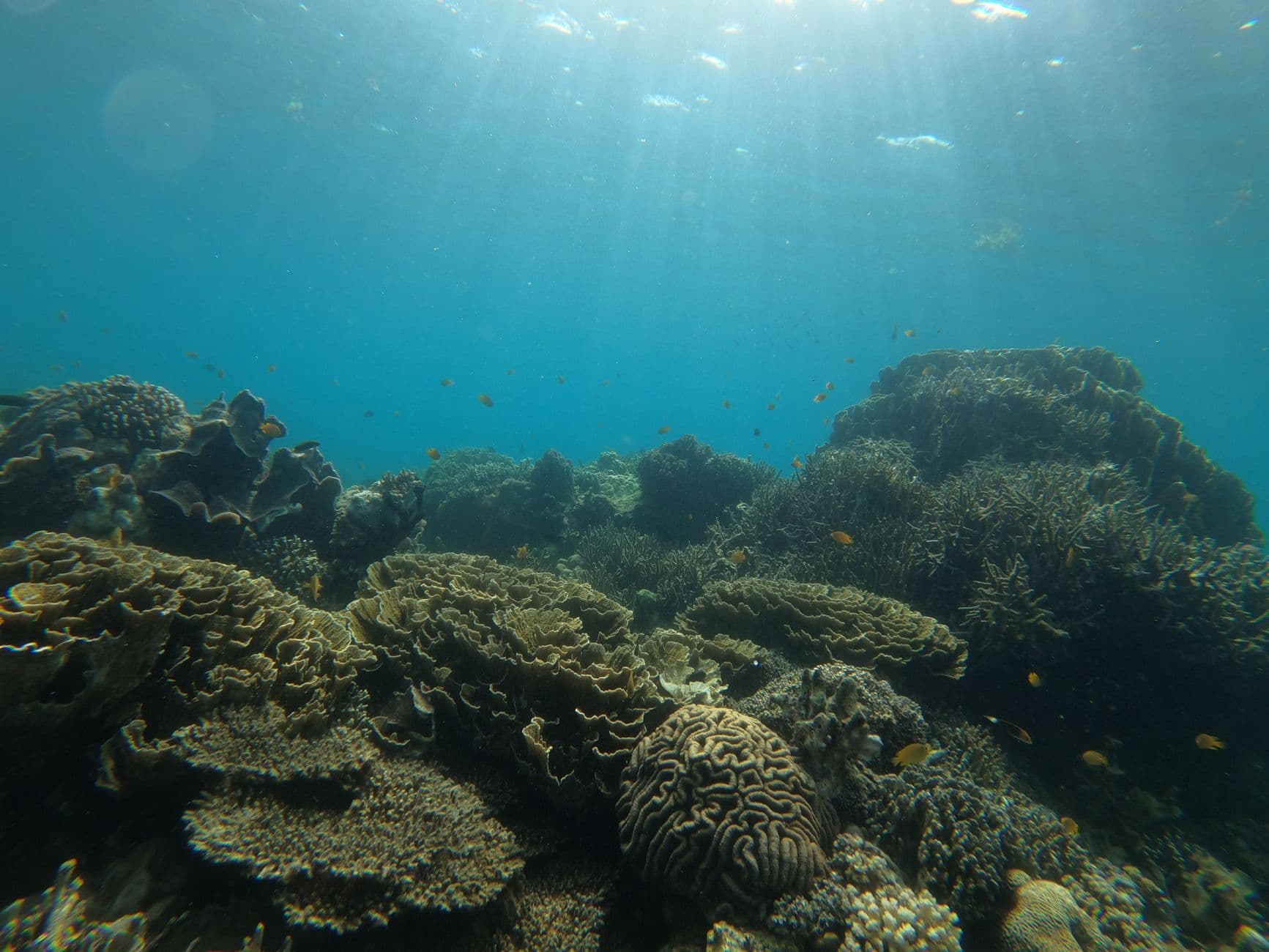
A gentle reef slope near the Bird Island ranger station, transitioning from 3–15 m to a wall dropping to 30 m+. Excellent coral cover with table corals, staghorn thickets, and anemone gardens. Green sea turtles graze on seagrass beds in the shallows. Good for macro photography — nudibranchs, shrimp, gobies.
What makes it unique: The best beginner site at Tubbataha and the top site for turtle encounters.
12. Bird Island
Zone: North Atoll (eastern sand cay) | Depth: 1–25 m | Difficulty: Beginner | Current: Mild | Best season: All season
The only sandy beach on the North Atoll. Shallow reef flat with patch reefs, coral bommies, and sand channels. Green sea turtles nest on the beach and feed in seagrass beds. Rich seabird colony above. Excellent snorkeling.
What makes it unique: Tubbataha's only beach snorkeling site with nesting turtles and seabird colonies.
Summary Table
| Rank | Site | Zone | Max Depth | Difficulty | Best For |
|---|---|---|---|---|---|
| 1 | Shark Airport | North Atoll | 35 m | Int–Adv | Grey reef shark cleaning station |
| 2 | Black Rock | South Atoll | 40 m+ | Advanced | Tiger sharks, hammerheads, strong current |
| 3 | Amos Rock | North Atoll | 40 m+ | Int–Adv | Manta + shark cleaning station |
| 4 | Wall Street | North Atoll | 50 m+ | Int–Adv | Gorgonian wall, drift dive, sharks |
| 5 | Jessie Beazley Wall | Jessie Beazley | 50 m+ | Int–Adv | Sharks, isolation, pristine reef |
| 6 | Manta Bowl | South Atoll | 30 m | Intermediate | Manta cleaning station |
| 7 | Malayan Wreck | North Atoll | 20 m | Beginner | Shallow wreck, manta occasional |
| 8 | Delsan Wreck | North Atoll | 25 m | Beg–Int | Visible wreck, turtle encounters |
| 9 | North Wall | North Atoll | 50 m+ | Advanced | Hammerhead schools |
| 10 | South Wall | South Atoll | 50 m+ | Advanced | Vertical wall, pelagics |
| 11 | Ranger Station | North Atoll | 35 m | Beg–Int | Turtles, macro, check-out dive |
| 12 | Bird Island | North Atoll | 25 m | Beginner | Snorkeling, turtle nesting |
Choosing Your Tubbataha Dive Experience
- Open Water (12+ dives): Ranger Station, Bird Island, Coral Garden, Malayan Wreck, The Playground, South Atoll Lagoon.
- Advanced Open Water (25+ dives): Add Manta Bowl, Delsan Wreck, Jessie Beazley Plateau, Wall Street (calm conditions).
- 50+ logged dives: Add Shark Airport, Amos Rock, Jessie Beazley Wall, East Wall.
- 100+ logged dives + strong current experience: Black Rock, North Wall, South Wall.
Bottom Line
Tubbataha packs an extraordinary range of dive experiences into a small geographic area. The top sites — Shark Airport, Black Rock, Amos Rock, Wall Street, and Jessie Beazley — each deliver something different, from nursing-home turtle meadows to adrenaline-charged tiger shark pinnacles. The beauty of Tubbataha is that most of these sites are within a 20-minute boat ride of each other. You can dive five completely different site types in a single day. Plan around your skill level and the marine life you want to see most, and trust your liveaboard operator to match you to the right sites on the right days.