Tubbataha Diving: The Complete Guide to the Philippines' Pristine Atolls
Tubbataha sits 150 kilometers offshore in the middle of the Sulu Sea, and that isolation is exactly what makes it extraordinary. This UNESCO World Heritage site is the only true atoll system in the Philippines — two massive coral atolls and a satellite reef rising from abyssal depths, protected as a no-take marine reserve since 1988. The reefs here have had nearly four decades to recover from human pressure, and the result is one of the most biodiverse marine ecosystems on the planet: 600+ species of fish, 360+ species of coral, 11 species of sharks, and 13 species of marine mammals.
There is a catch. Tubbataha is accessible exclusively by liveaboard during a strict 3-month window — mid-March to mid-June. The park closes completely for the remaining 9 months, giving the ecosystem time to regenerate without human presence. Only 2,000–3,000 divers visit each year. If you want to dive Tubbataha, you plan around its season, not yours.
What Makes Tubbataha Unique
The Only True Atolls in the Philippines
Tubbataha is an atoll system formed on an extinct volcanic seamount. The North Atoll is a roughly circular ring about 5 km across with a shallow central lagoon. The South Atoll is larger at 8 km across, with a deeper lagoon. A deep channel 8 km wide and 50–150 meters deep separates them, creating a natural pelagic corridor. Twenty kilometers north, Jessie Beazley Reef forms a separate submerged reef with its own outer wall. Together they span 97,030 hectares — larger than New York City.
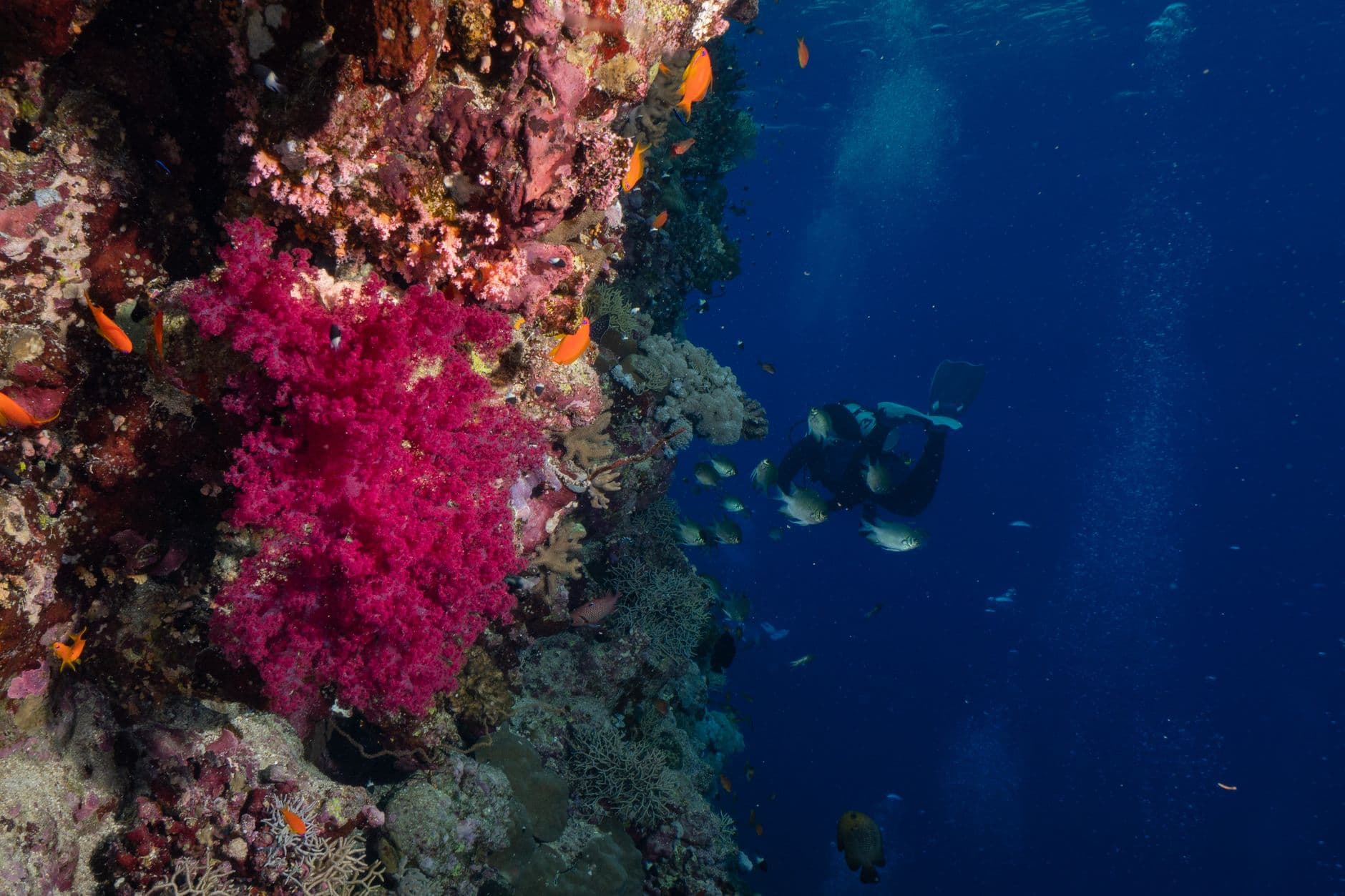
The atoll walls drop from near-surface to abyssal depths of 500+ meters. There is no gradual shelf. One moment you're at 15 meters on a coral-covered reef flat, the next you're looking into an endless blue drop-off where grey reef sharks patrol and hammerheads appear from the depths.
The Shark Capital of the Philippines
Every dive at Tubbataha has sharks. Grey reef sharks are guaranteed — you will see them. At Shark Airport on the North Atoll, divers regularly count 30+ grey reef sharks circling overhead like aircraft in a holding pattern, using the current-swept plateau as a cleaning station. The South Atoll's Black Rock is famous for tiger shark encounters — the best spot in Philippine waters for seeing these apex predators. Scalloped hammerheads school in impressive numbers (20–50 individuals) at North Wall and around Jessie Beazley during April through June. Whitetip reef sharks rest on ledges. Silky sharks patrol the outer walls. Whale sharks appear in March and early April.
Conservation That Works
Tubbataha is one of the most effectively managed marine protected areas in Asia. Established in 1988 as a no-take zone, the park has seen fish biomass increase by over 200% since protection began. Full-time rangers live on the South Atoll ranger station for months at a time, monitoring for illegal fishing and enforcing park rules. The park's success has made it a global model — UNESCO, WWF, and other conservation organizations regularly cite Tubbataha as a case study in marine protected area effectiveness.
Who Tubbataha Is For
Tubbataha is best suited for intermediate to advanced divers who are comfortable with drift diving in moderate to strong currents. Many sites require a drift-dive technique where the boat drops divers upcurrent and picks them up downstream. The current on exposed walls like North Wall, South Wall, and Wall Street can hit 2–3 knots. Divers need good buoyancy control — the atoll walls drop from 15 meters to 500+ with no shelf.
That said, there are beginner-friendly sites. Ranger Station, Bird Island, Coral Garden, The Playground, and the South Atoll Lagoon offer shallow, calm conditions suitable for Open Water divers and snorkelers. The key is matching your skill level to the right sites — your liveaboard operator will manage this.
Advanced Open Water certification is the recommended minimum. DAN or equivalent dive insurance is mandatory — the nearest hyperbaric chamber is at Ospital ng Palawan in Puerto Princesa, 8–12 hours away by boat.
The Liveaboard Experience
There is no other way to dive Tubbataha. Twelve verified liveaboard operators run trips from Puerto Princesa, Palawan, ranging from budget-friendly wooden-hull boats at $1,300 per person for a week to luxury steel-hulled vessels at $4,000+. The crossing takes 8–12 hours overnight, and you wake up at the atoll.
A typical day involves 4–5 dives: an early-morning wall dive, a mid-morning reef or cleaning station dive, a lunch break on anchor, an afternoon site, and a late-afternoon or sunset dive (no night diving is permitted). Operators run two atoll groups typically — a couple of days at North Atoll and Jessie Beazley, then a day or two at South Atoll before the return crossing.
Park fees run $75–100 per person per trip. Nitrox is available on most boats for an extra $50–90 per trip. Equipment rental for a full set runs $180–270 per trip. Book 6+ months ahead — prime weeks in April sell out by January.
The 12 Liveaboard Operators
The fleet ranges from Philippine Siren (premium, $3,500–4,500) and Solitude One (new-build 2022, $3,000–4,000) at the top end, through mid-range options like Stella Maris Explorer ($2,500–3,200) and Blue Horizon ($2,500–3,200), down to budget-friendly Princess Maani ($1,950–2,800) and M/Y Sakura ($1,300–2,200). The Philippines Aggressor, Discovery Fleet, Infiniti Liveaboard, Atlantis Azores, M/Y Resolute, and Oceanic round out the fleet. All include full board, tanks and weights, and guided dives in their rates.
Bottom Line
Tubbataha is the crown jewel of Philippine diving — pristine atolls, guaranteed shark encounters on every dive, and a conservation success story that sets the global standard. The trade-off is the short season, the liveaboard-only access, and the 8-hour overnight crossing. If you plan around those constraints, you get arguably the best reef diving in Southeast Asia. Book ahead, bring your dive insurance, and get ready for a week where every single dive has sharks.