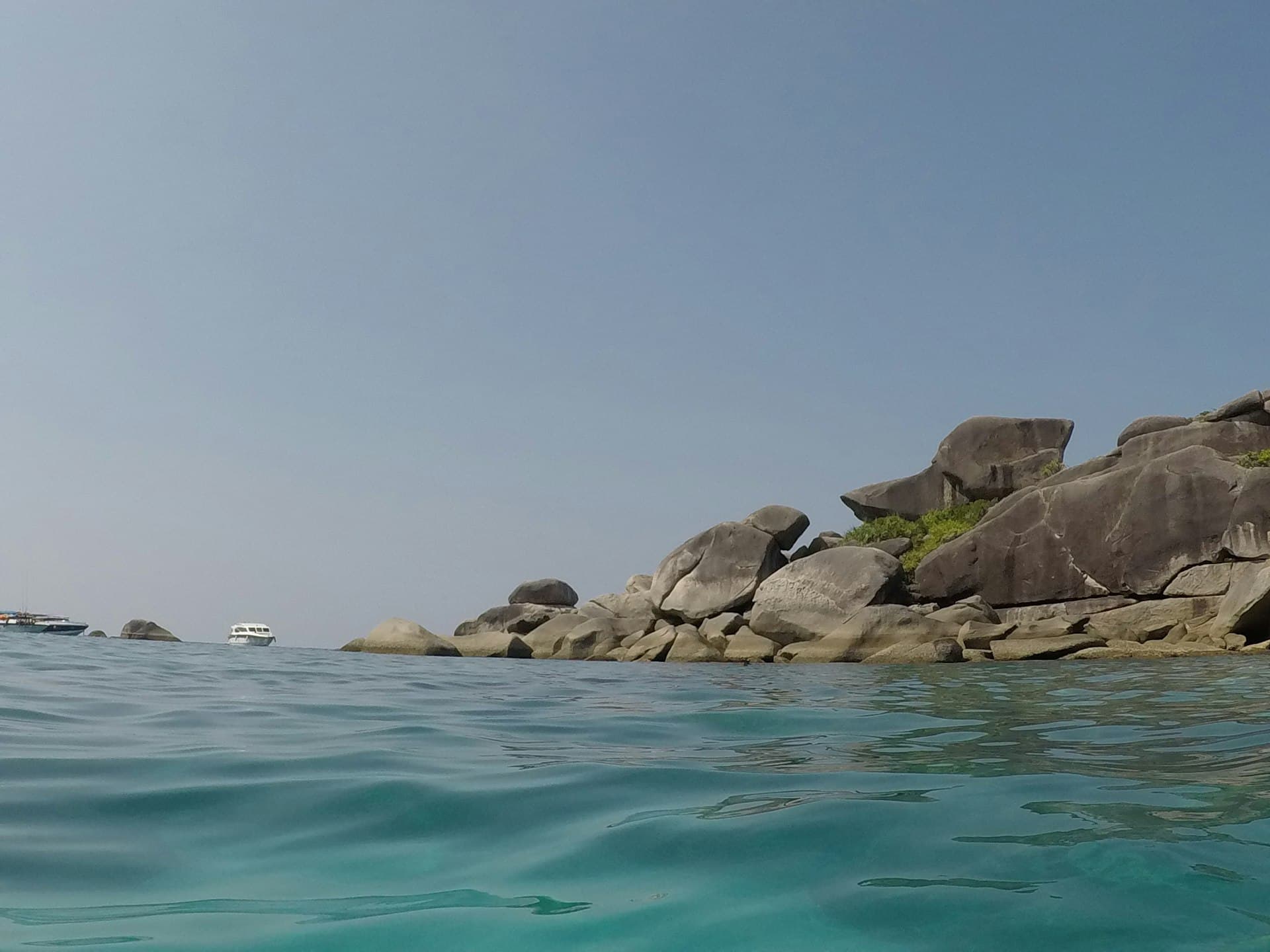
Top 8 Dive Sites in the Similan Islands, Thailand
The Similan Islands span 14 kilometers of granite islands and extend north another 45 kilometers to include isolated seamounts and Richelieu Rock. Every site has its own character — some are gentle coral gardens for beginners, others are current-swept boulder labyrinths for experienced drift divers.
This guide ranks the top dive sites across the full Similan circuit so you can plan your liveaboard itinerary around the experiences that matter most to you.
1. Richelieu Rock
Type: Horseshoe-shaped limestone pinnacle | Depth: 3–35 m | Skill: Open Water – Advanced | Best season: November–May (closed with park)
Why it's the best: Richelieu Rock is Thailand's #1 dive site — and for good reason. This horseshoe-shaped limestone pinnacle rises from 35 meters to break the surface at low tide, sitting alone in the open Andaman Sea 18 kilometers east of the Surin Islands. It is one of the most reliable whale shark encounter sites in all of Southeast Asia. Sightings are reported almost weekly during peak season (February–April), and on the best days, multiple whale sharks circle the pinnacle on a single dive.
Beyond the whale sharks, Richelieu Rock delivers staggering biomass. Harlequin sweetlips form schools numbering in the hundreds. Barracuda, giant trevally, and dogtooth tuna patrol the outer walls. Fusiliers in the thousands swirl around the pinnacle's soft coral-covered faces. And the macro life is equally exceptional — pygmy seahorses (under 1 cm) live on sea fans at 15–20 m, ornate ghost pipefish hide among crinoids, and dozens of nudibranch species cover the reef.
The site forms a C-shape with an inner lagoon protected from currents and two outer walls exposed to stronger flow. On a calm day, Open Water divers can explore the sheltered interior. On a current day, the outer walls are a drift dive for advanced divers only.
Marine life: Whale sharks (peak Feb–Apr), reef manta rays (year-round), harlequin sweetlips (hundreds), barracuda, giant trevally, fusiliers (thousands), pygmy seahorses, ghost pipefish, nudibranchs, moray eels, lionfish.
Gear tip: Bring both wide-angle and macro lenses. The site is equally famous for big animals (whale sharks, mantas) and tiny creatures (pygmy seahorses).
2. Elephant Head Rock (Hin Pusa / Hin Pousar)
Type: Granite boulder labyrinth | Depth: 3–35 m | Skill: Advanced | Best season: January–April
Why it's a marquee site: Elephant Head Rock is the crown jewel of the Similan Islands themselves — a jumble of house-sized granite boulders between Islands 7 and 8 that creates a complex underwater labyrinth of swim-throughs, tunnels, and chambers. Named for the elephant-head profile visible above water, this site sprawls across the channel and offers an entire dive's worth of exploration without ever covering the same ground twice.
The boulder formations create multiple interconnected passages at 8–14 m that experienced divers can navigate in sequence, emerging from one tunnel into a cathedral-like chamber before finding the next opening. Sand channels between the boulders drop to 35 m and are prime leopard shark resting grounds — this is one of the most reliable leopard shark encounters in the Similans.
The west side of Elephant Head gets significant current and creates drift conditions through the boulder maze. This is not a beginner dive — strong buoyancy control is essential to avoid damaging the coral or yourself on the granite.
Marine life: Leopard sharks (consistent, resting on sand between boulders), giant moray eels, honeycomb morays, whiprays, harlequin sweetlips, trevallies, octopus, leaf fish, ghost pipefish.
Gear tip: A dive light is essential — the swim-throughs and under-boulder overhangs get dark even on the sunniest day.
3. Koh Bon Ridge (Koh Bon Pinnacle)
Type: Submerged seamount with cleaning station | Depth: 8–35 m | Skill: Advanced | Best season: October–May
Why it's marquee: Koh Bon Ridge is Thailand's premier manta ray cleaning station — a submerged seamount rising from deep water (60 m+) with an extensive reef flat on top at 8–12 m. Resident reef manta rays (Mobula alfredi) visit the ridge year-round to have parasites removed by cleaner wrasse. Individual mantas can be recognized by their unique belly spot patterns — no two are alike.
The ridge extends north–south and attracts large pelagics due to its isolated position. On a good dive, you'll see multiple mantas making passes over the cleaning station, hovering stationary while cleaner fish work, then gliding off into the blue. Grey reef sharks, leopard sharks, whitetip reef sharks, giant trevallies, and dogtooth tuna are regular companions.
Strong currents sweep both sides of the ridge — this is always a drift dive configuration. Your guide will drop you upcurrent of the ridge and you'll drift over the cleaning station zone.
Marine life: Reef manta rays (year-round resident population, peak Oct–May), grey reef sharks, leopard sharks, whitetip reef sharks, giant trevallies, dogtooth tuna, Napoleon wrasse, turtles, batfish.
4. Koh Tachai Pinnacle
Type: Twin pinnacles with cleaning stations | Depth: 5–35 m | Skill: Advanced | Best season: October–May
Why it's marquee: Koh Tachai Pinnacle consists of two main pinnacles (southern and northern) rising from deep water (~40 m+), covered in colorful soft corals, sea fans, and anemones. Like Koh Bon, it has established manta ray cleaning stations on both pinnacles. The water here consistently delivers 25–40 m visibility — some of the best in the entire region.
The sandy channel between the two pinnacles at ~18 m is a leopard shark hotspot, and whale sharks are sighted here with more regularity than any site except Richelieu Rock. The combination of two distinct pinnacle structures, excellent visibility, and reliable manta and whale shark encounters makes Koh Tachai an essential stop on any Similan liveaboard.
Marine life: Manta rays (year-round resident population, peak Jan–Apr), whale sharks (Dec–Apr, peak Feb–Mar), leopard sharks (common between pinnacles), grey reef sharks, whitetip reef sharks, eagle rays, giant trevallies, dogtooth tuna, Napoleon wrasse.
5. West of Eden
Type: Boulder field and pelagic wall | Depth: 5–35 m | Skill: Advanced | Best season: January–May
Why it's great: West of Eden sits on the western side of Island 8 (Ko Similan) and features large granite boulders sloping into deep water. Named for the Eden-like underwater landscape of coral-encrusted boulders, the site is known for excellent visibility (25–40 m in peak season) and reliable encounters with larger marine life. Multiple boulder fields extend from shallow to deep, with swim-throughs and cleaning stations on the deeper boulders.
The site often produces manta ray sightings as the western boulder fields attract cleaning station activity. Grey reef sharks are common, and leopard sharks rest on sand patches between the boulders. Manta rays visit cleaning stations on the deeper boulders.
Marine life: Manta rays (cleaning stations on deeper boulders), grey reef sharks, leopard sharks, giant trevallies, schools of barracuda, Napoleon wrasse, fusiliers, turtles, batfish.
6. North Point (Koh Ba Ngu North)
Type: Northern boulder wall | Depth: 5–35 m | Skill: Advanced | Best season: January–April
Why it's great: North Point marks the northernmost tip of the Similan Islands chain at Island 9 (Ko Ba Ngu). The underwater landscape is spectacular — giant granite boulders covered in colorful corals and sea fans, with strong currents creating nutrient-rich conditions for pelagic marine life. This is a classic drift dive along the boulder wall, often the last dive of a liveaboard trip heading north toward the pinnacles.
Grey reef sharks are consistent, manta rays pass through, and the sheer fish biomass is impressive. Whale sharks occasionally visit.
Marine life: Grey reef sharks, manta rays, leopard sharks, large schools of trevallies, barracuda, batfish, sweetlips, Napoleon wrasse, whale sharks (occasional).
7. Deep Six
Type: Boulder field and macro site | Depth: 8–35 m | Skill: Advanced | Best season: January–April
Why it's great: Deep Six sits on the western side of Island 6 (Ko Payu) and is one of the best macro dive sites in the Similans. The boulder field here has fewer visitors than the marquee sites, which means marine life is less skittish and more abundant. Leaf fish, ghost pipefish, and nudibranchs are reliably found among the boulders, while leopard sharks rest on sandy patches between them.
The site also attracts larger animals — giant groupers hide in the overhangs, and moray eels are abundant. For photographers who want a mix of macro and wide-angle subjects, Deep Six delivers.
Marine life: Leopard sharks, giant groupers, moray eels, lionfish, leaf fish, ghost pipefish, nudibranchs, stingrays.
8. Hide-a-Way (Hu Yong Bay)
Type: Sandy slope and seagrass | Depth: 2–18 m | Skill: Beginner | Best season: All season
Why it's great: Hide-a-Way is the southernmost dive site in the Similans, tucked into the sheltered eastern bay of Island 1 (Ko Hu Yong). It's the go-to check-out dive for liveaboard trips starting their Similan circuit — gentle sandy slope with scattered coral bommies and seagrass beds. But don't mistake easy for boring. Leopard sharks frequently rest on the sandy patches here, and the seagrass beds attract grazing green turtles. Garden eels sway in the current on deeper sand flats, and the macro life (gobies, shrimp gobies, juvenile reef fish) is excellent for photography.
Marine life: Leopard sharks (resting on sand), green turtles, garden eels, stingrays, razorfish, gobies.
Gear tip: Perfect for a check-out dive to dial in your buoyancy before the bigger sites. Bring a macro lens for the small stuff.
Summary Table
| Rank | Site | Type | Depth | Skill | Best Season | Key Species |
|---|---|---|---|---|---|---|
| 1 | Richelieu Rock | Limestone pinnacle | 3–35 m | Open–Adv | Nov–May | Whale sharks, mantas, sweetlips |
| 2 | Elephant Head Rock | Granite labyrinth | 3–35 m | Advanced | Jan–Apr | Leopard sharks, morays, trevallies |
| 3 | Koh Bon Ridge | Seamount cleaning station | 8–35 m | Advanced | Oct–May | Manta rays, grey reef sharks |
| 4 | Koh Tachai Pinnacle | Twin pinnacles | 5–35 m | Advanced | Oct–May | Mantas, whale sharks, leopard sharks |
| 5 | West of Eden | Boulder field wall | 5–35 m | Advanced | Jan–May | Mantas, grey reef sharks, barracuda |
| 6 | North Point (Island 9) | Boulder drift wall | 5–35 m | Advanced | Jan–Apr | Trevallies, barracuda, grey reef sharks |
| 7 | Deep Six | Boulder field/macro | 8–35 m | Advanced | Jan–Apr | Leaf fish, ghost pipefish, groupers |
| 8 | Hide-a-Way | Sandy slope/seagrass | 2–18 m | Beginner | All season | Leopard sharks, turtles, garden eels |
Planning Your Itinerary
A typical 4-day/3-night Similan liveaboard covers 10–14 dives across 10–15 different sites. A well-designed itinerary includes:
- Day 1: Check-out dive at Hide-a-Way or Coral Reef, then 2–3 dives at inner Similan sites (Lucky Hole, Snapper Alley, Miang Bay, Beacon Point)
- Day 2: West-side boulder dives (Elephant Head Rock, West of Eden, Deep Six) and a late-afternoon turtle dive at Turtle Bay
- Day 3: Northern pinnacles — Koh Bon Ridge (morning, best for mantas), Koh Tachai Pinnacle (midday), and Richelieu Rock (afternoon, best for whale sharks)
- Day 4: Morning dive at North Point (Island 9) or a return to a favorite site, then the journey back to Khao Lak
If you're diving from a day trip (Islands 4, 8, 9 only), prioritize West of Eden, Garden of Eden, and Turtle Bay for the best experience within your limited range.