Similan Islands Diving Guide: 42 Sites Across 9 Granite Islands
The Similan Islands are Thailand's premier dive destination — nine granite islands in the Andaman Sea surrounded by schools of fish numbering in the thousands, resident manta ray populations at cleaning stations, and some of the most reliable whale shark encounters in Southeast Asia. With 42 named dive sites spanning the inner islands, northern pinnacles, and the legendary Richelieu Rock, the Similans offer everything from gentle coral gardens for beginners to drift dives through boulder labyrinths for the experienced.
Accessible only from mid-October to mid-May (the park closes for monsoon rest), this is a destination that demands — and rewards — careful planning.
What Makes the Similan Islands Unique
The Granite Boulder Topography
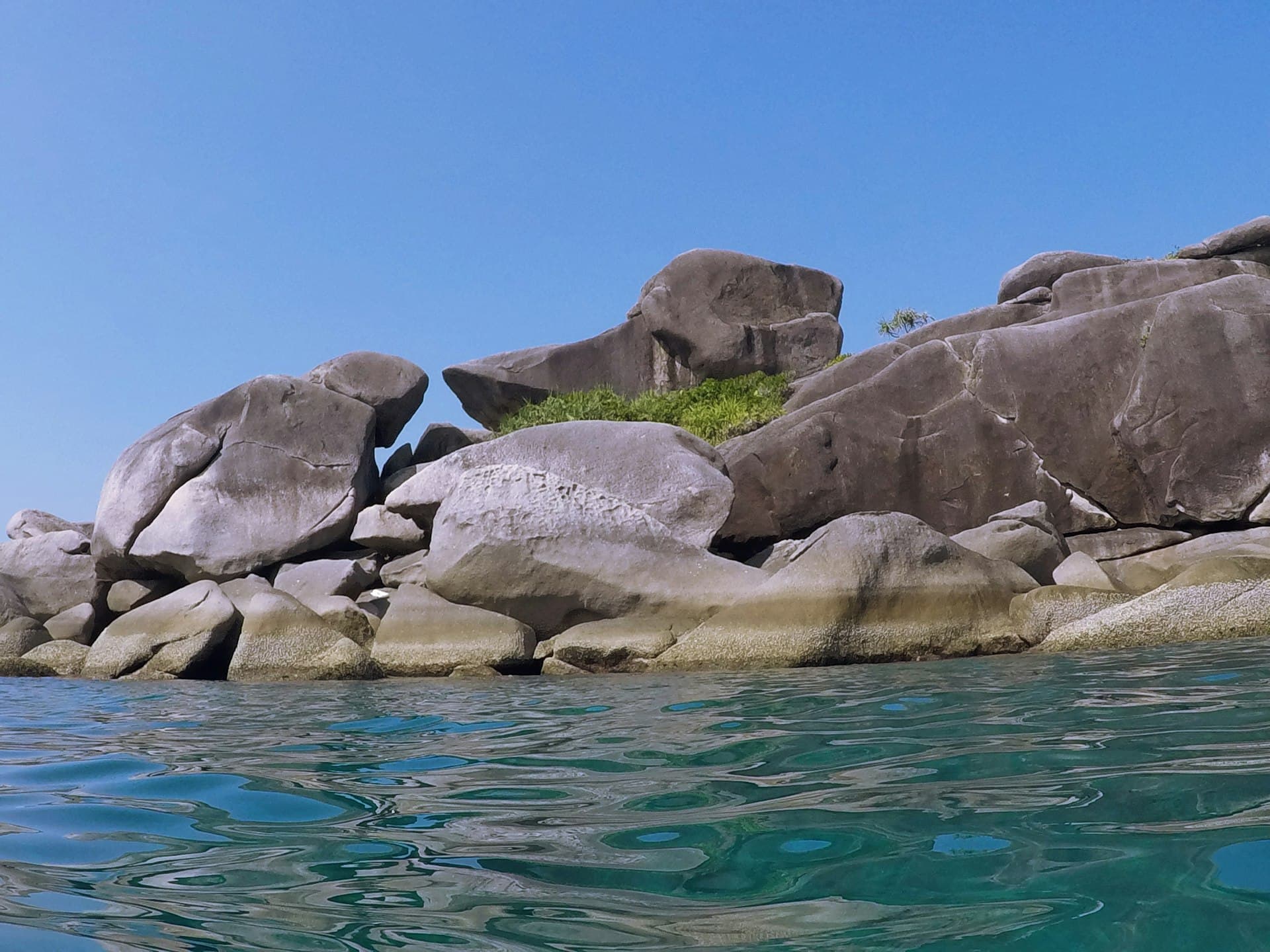
The Similan Islands are the exposed tops of a submerged mountain range, composed of massive granite boulders over 200 million years old. This creates an underwater landscape found nowhere else in Thailand — giant rounded boulders, natural swim-throughs, arches, and labyrinth-like passages. At sites like Elephant Head Rock, these boulder formations create interconnected chambers that experienced divers can explore for an entire dive without surfacing.
The East–West Divide
The islands' geography creates distinctly different diving on each side. The eastern side is sheltered, with gentle sandy slopes, seagrass beds, and coral gardens — ideal for beginners, macro life, and calm conditions. The western side faces the open Andaman Sea, with massive granite boulder formations, strong currents, and nutrient-rich upwellings that attract pelagics — manta rays, whale sharks, and grey reef sharks.
Three Distinct Zones
A typical Similan liveaboard covers three completely different diving zones. The inner Similans (Islands 1–9) offer 28+ named dive sites across 14 kilometers of islands. The northern pinnacles (Koh Bon and Koh Tachai) are isolated seamounts rising from deep water with premier manta ray cleaning stations. And Richelieu Rock — Thailand's most famous single dive site — is a horseshoe-shaped limestone pinnacle in the open Andaman Sea with the most reliable whale shark encounters in the country.
Getting There
The primary gateway is Phuket International Airport (HKT), with direct flights from Bangkok (1h20m, dozens daily), Singapore, Kuala Lumpur, Hong Kong, Dubai, Doha, and other Asian hubs. From Phuket, it's a 1-hour drive north to Khao Lak, the main departure point for Similan liveaboards. Most trips depart from Thap Lamu pier, just 15 minutes from Khao Lak town.
Khao Lak itself is a well-developed dive hub with hotels from budget bungalows (500–1,500 THB/night) to luxury resorts (3,500–12,000 THB/night), dozens of restaurants, dive shops, and supermarkets. All Similan liveaboard trips include transfers from your hotel to the pier.
Types of Trips
Liveaboard (Recommended)
Almost all Similan diving is done by liveaboard — multi-day trips that allow 10–14+ dives across 30+ different sites. A typical 4-day/3-night trip costs 18,000–35,000 THB (approximately $500–$1,000 USD) and covers the full circuit from the inner islands to Koh Bon, Koh Tachai, and Richelieu Rock. Five-day trips go further north to include the Surin Islands.
Day Trips
Day trips from Khao Lak are possible but limited. Speedboats reach the park in about 1.5 hours, and most day trips offer 2 dives at Islands 4, 8, and 9 only. Day trips cost 3,500–5,500 THB. They don't reach Koh Bon, Koh Tachai, or Richelieu Rock — those require liveaboards.
Who the Similan Islands Is For
The Similans work for every level of diver — with some caveats.
Open Water divers can easily dive the eastern sites: Hide-a-Way, Coral Reef, Miang Bay, Paradise Reef, and Turtle Bay all offer gentle conditions, shallow depths (2–18 m), and excellent reef life. Many liveaboards start with an easy check-out dive.
Advanced Open Water divers unlock the full experience. Elephant Head Rock's boulder labyrinth, West of Eden's pelagic-rich walls, Koh Bon Ridge's manta cleaning station, and Richelieu Rock's whale shark encounters all require strong buoyancy control and comfort with currents.
Experienced divers will appreciate the deep pinnacles at Koh Bon and Koh Tachai, the outer wall at North Point (Island 9), and the drift conditions at Deep Six and Koh Payu Pinnacle.
The Similans are less suited for divers who prefer shore diving (there are no dive shops on the islands), divers on a tight daily budget (liveaboards are the only way to see the full range), and anyone traveling during the closed season (mid-May to mid-October).
Marine Life Highlights
The Similan Islands are recognized as an Important Shark and Ray Area (ISRA) by the IUCN Shark Specialist Group. Here's what you can expect to see:
Whale sharks at Richelieu Rock — sightings reported almost weekly during peak season (February–April). Reef manta rays year-round at Koh Bon Ridge, with a resident population visiting the cleaning station. Leopard sharks resting on sandy patches between granite boulders at Elephant Head and the eastern sites — one of the most commonly sighted sharks in the Similans. Grey reef sharks patrolling western reef slopes. Green and hawksbill turtles grazing on seagrass beds and foraging around coral heads year-round.
The fish life is extraordinary. Schools of harlequin sweetlips numbering in the hundreds are a signature sight at Richelieu Rock. Fusiliers, snapper, trevallies, barracuda, and batfish form dense aggregations at current-swept sites. Macro life includes pygmy seahorses (under 1 cm) living on sea fans at Richelieu Rock, ornate ghost pipefish, and dozens of nudibranch species.
Practical Overview
- Best season: Mid-October to mid-May (park closed mid-May to mid-October)
- Peak season: January–April (calmest seas, best visibility 25–40 m)
- Water temperature: 27–30°C (81–86°F) year-round
- Visibility: 15–40 m (peak Jan–Apr: 25–40 m)
- Current: Mild on eastern side; moderate to strong on western sites and pinnacles
- Timezone: UTC+7 (Indochina Time, no DST)
- Currency: Thai Baht (THB); ~35 THB = 1 USD
- National park fee: 500 THB (included in most trip costs)
- Visa: 30-day visa exemption for US, UK, EU, Canadian, Australian, NZ, Japanese, South Korean passport holders
Safety: Hyperbaric Chamber Access
There is NO hyperbaric chamber on the Similan Islands or in Khao Lak. The nearest operational chambers are in Phuket, approximately 2 hours by road from Khao Lak. The SSS Network Phuket Hyperbaric Chamber (+66 76 379 139) is the primary facility, with backup at Vachira Phuket Hospital (+66 76 361 234) and Bangkok Hospital Phuket (+66 76 254 425).
For liveaboard trips near Richelieu Rock, evacuation times increase significantly — Phuket is 5–6 hours away. DAN insurance with evacuation coverage is mandatory, and most operators require proof of dive insurance before boarding.
The 22 Dive Shops
Similan diving is organized from the mainland. There are zero dive shops on the islands themselves, but Khao Lak and Phuket together host 22 verified dive operators. The largest fleet is the Manta Queen (Khao Lak Explorer/KSA) with 8 vessels, offering budget-friendly liveaboards starting at 4,500 THB/day. Luxury options include the Deep Andaman Queen (25,000–45,000 THB for 4D/3N) and the Pawara Catamaran (22,000–35,000 THB for 4D/3N). Most major operators are PADI 5 Star centers with multilingual staff.
Bottom Line
The Similan Islands deliver the most complete liveaboard diving experience in Southeast Asia. The combination of unique granite boulder topography, reliable pelagic encounters (whale sharks, manta rays, leopard sharks), and a well-established liveaboard infrastructure makes them an essential destination for any diver traveling to Thailand. Plan around the October–May season, book your liveaboard early, and prepare for some of the best diving of your life.