Diving Seychelles: Complete Guide to the Indian Ocean's Vertical Paradise
Seychelles is not the Maldives. It's not trying to be.
Where the Maldives is a horizontal expanse of coral atolls, Seychelles is vertical — ancient granite boulders that rise from the seabed, carved by 750 million years of ocean into swim-throughs, overhangs, and pinnacles that have no equivalent anywhere else. The 115 islands — granitic Inner Islands and coralline Outer atolls — sit in 1.4 million km² of Indian Ocean, and 30% of that is marine protected area.
This is a destination built around structure and complexity. Not shallow gardens you can do in 30 minutes and a shorty, but walls that drop 40+ meters, channels that run at 3 knots on spring tides, and underwater topography that forces you to plan every dive like a route through a national park. If you want to drift past 50 grey reef sharks at Booby Rock, photograph your fiftieth turtle at fifty different sites, or experience the best whale shark encounter in the Indian Ocean, this guide covers what you need to know.
What Makes Seychelles Unique
The Granite Boulder Gardens
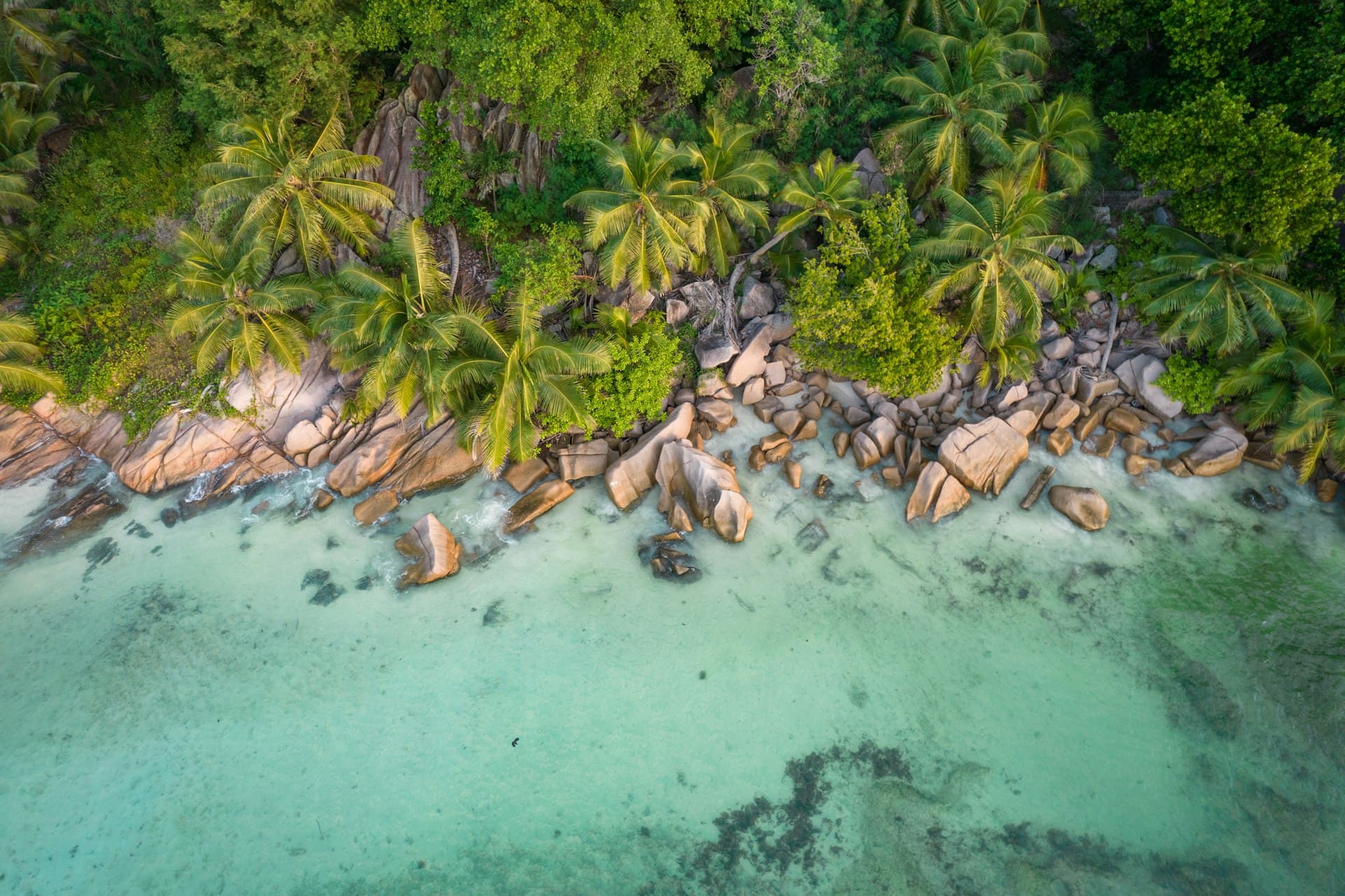
The defining feature of Seychelles diving is the underwater granite. The Inner Islands — Mahé, Praslin, La Digue, Silhouette — sit on the Seychelles microcontinent, a fragment of Gondwana that drifted away 65 million years ago. The pink and grey granite boulders you see on the beaches continue underwater, creating the only vertical boulder-garden topography in the world dive map.
Sites like Sharks Bank, Trois Bancs, and Lost City are not coral reefs in the traditional sense. They are submerged boulder fields where granite pinnacles rise from 30 meters to within a few meters of the surface, covered in soft corals, sea fans, and sponges. The swim-throughs between boulders form tunnels, arches, and overhangs that force water movement and concentrate marine life. This topography is unique — you cannot find it in the Maldives, the Coral Triangle, or the Caribbean.
Two Distinct Worlds: Inner Islands and Outer Atolls
Seychelles splits cleanly into two dive experiences:
Inner Islands (Mahé, Praslin, La Digue, Silhouette): 75+ named dive sites accessible by day boat. Granite boulder terrain, moderate visibility (10–30 m, peak 40 m in calm season), strong marine protection, excellent infrastructure. This is where 90% of divers spend their time. Sites range from 5 m coral gardens for beginners to 35 m drift dives at Trois Bancs that demand reef hooks and experience.
Outer Atolls (Alphonse, Desroches, Astove, Cosmoledo, Farquhar): Pristine coral atolls accessible only by private charter or as part of a resort package. Visibility regularly exceeds 30 m, and some walls at Astove and Cosmoledo are among the healthiest coral ecosystems in the Indian Ocean. These are expedition-grade dives — no chamber on any outer island, evacuation 4–24+ hours to Mahé. Budget: €400–800+/night at the resorts.
Marine Life: The Numbers
Year-round residents include hawksbill and green turtles on nearly every dive, grey reef sharks at most reef-edge sites, whitetip and blacktip reef sharks, eagle rays, giant trevally, bumphead parrotfish, and the critically endangered Napoleon wrasse (actively tracked via tagging at Desroches Channel). Octopus, cuttlefish, and moray eels are common across all terrain types.
Seasonal visitors are where Seychelles shines. Whale sharks arrive reliably September–November in the inner islands, making this one of the most accessible whale shark encounters in the Indian Ocean. Reef manta rays peak August–November, especially at Alphonse Pass and outer atoll channels. Humpback whales pass through in October, often with calves. The Seychelles shark sanctuary (established 2012) means these populations are genuinely protected — sharks are not afraid, and encounters at sites like Booby Rock and South Marianne are consistent.
Who Seychelles Is For
Seychelles rewards intermediate and experienced divers most. The best sites are current-driven, require comfortable buoyancy in three dimensions (the boulder fields demand vertical control you do not need on flat reefs), and presuppose experience with drift diving.
Beginners: Mahé and Praslin have plenty of beginner-friendly sites — L'Ilot (5–12 m), Turtle Rock (8–18 m), and the St. Pierre Islet (5–18 m) in Curieuse Marine Park are all calm, shallow, and full of life. Nearly every operator runs introductory courses. But the quality of Seychelles diving scales directly with your comfort in current and your depth tolerance. If you are Open Water with fewer than 20 dives, plan a check-out dive at Coral Garden or Aquarium before you attempt anything with "drift" in the name.
Intermediate (20–50 dives): You can access 70% of the dive sites. Shark Bank (25–35 m, moderate current) and Twin Barges Wreck (18–22 m) are excellent targets. Ave Maria channel at moderate tide and the granite boulders of Brissare Rocks are manageable and rewarding.
Advanced (50+ dives): You unlock the tier-one sites — Booby Rock (15–30 m, strong current, up to 12 grey reef sharks), South Marianne (drift, jackfish, tuna, eagle rays), Trois Bancs (the 50-hammerhead drift), and the Ennerdale Wreck (three sections at 30 m, intact wheelhouse). The outer atolls — Desroches Channel, Astove Outer Wall, Alphonse Pass — are genuinely world-class and uncompromising.
The 19 Dive Operators
Seychelles has better dive-shop infrastructure than most Indian Ocean destinations. Nineteen verified operators are spread across the islands: Mahé has seven land-based centers including Big Blue Divers (PADI 5-Star, 75+ named sites on their directory), Blue Sea Divers, and Oceanika PADI. Praslin has five including Octopus Diver, Whitetip, and Equinoxe. La Digue has two (Trek Divers and Azzurra Pro Dive). The Outer Islands have resort-based operations at Alphonse (5-star PADI), Desroches, and Astove. Four liveaboard vessels — Sea Pearl, Galatea, Sea Bird, and Illusions — cover multi-day routes including Aldabra and the remote atolls.
Prices run €75–110 per dive depending on location, operator, and whether nitrox is included. Liveaboard packages for outer-atoll itineraries range from €2,500–5,000 for a week.
Practical Overview
Getting there: Seychelles International Airport (SEZ) on Mahé has direct flights from London, Paris, Frankfurt, Zürich, Istanbul, Dubai, Abu Dhabi, Doha, Nairobi, Addis Ababa, Johannesburg, and Mauritius. Domestic flights to Praslin (20 min) and ferries from Mahé to Praslin (1 hr, 3x daily) make inter-island travel straightforward. Outer islands require private charter from Mahé (45 min–1.5 hrs), typically arranged through resort packages.
Visa: Visa-free for all nationalities — 3-month Visitor's Permit on arrival. Must complete Travel Authorisation online before departure (€10.90 standard). Valid passport (6+ months), proof of accommodation, onward ticket required.
Currency: Seychelles Rupee (SCR). ~SCR 13–14 = €1. USD and EUR widely accepted at dive centers and hotels. ATMs available in Victoria (Mahé), limited on Praslin, scarce on La Digue. Credit cards accepted at most dive shops and hotels but bring cash for small purchases.
Season: Peak diving March–May and September–November (calmest seas, best visibility 20–40 m). NW monsoon November–April brings warm (28–30°C) water and calm conditions. SE trade winds May–October bring cooler water (24–27°C), plankton blooms, and the whale shark season you came for. December–January and July–August are holiday peaks — book early, pay more.
Safety note: Seychelles Hospital in Victoria (Mahé) has a hyperbaric chamber. A secondary chamber exists on Silhouette Island (status unverified). There is no chamber on Praslin, La Digue, or any Outer Island. Evacuation from outer atolls to Mahé takes 4–24+ hours. DAN International diving insurance with evacuation coverage is mandatory.
Marine park fees: SCR 200 (~€14) per park entry. Ste. Anne Marine Park, Baie Ternay, Curieuse, Ile Cocos, and Port Launay each charge separately. Tour operators usually include fees in package price. Mandatory Tourism Levy of SCR 75–100/person/night collected by accommodation.
Bottom Line
Seychelles is the Indian Ocean destination for divers who want structure, complexity, and the feeling of discovering something genuinely different. The granite boulder gardens are unlike anything else in the world. The whale shark season is the most reliable in the Indian Ocean east of Africa. The outer atolls — Astove, Alphonse, Desroches — deliver near-pristine coral walls that most divers will never see.
It costs more than the Maldives, takes more planning, and demands more experience to access the best sites. But for divers who can handle current, control their trim in three dimensions, and want to be somewhere that still rewards effort with solitude, Seychelles delivers.