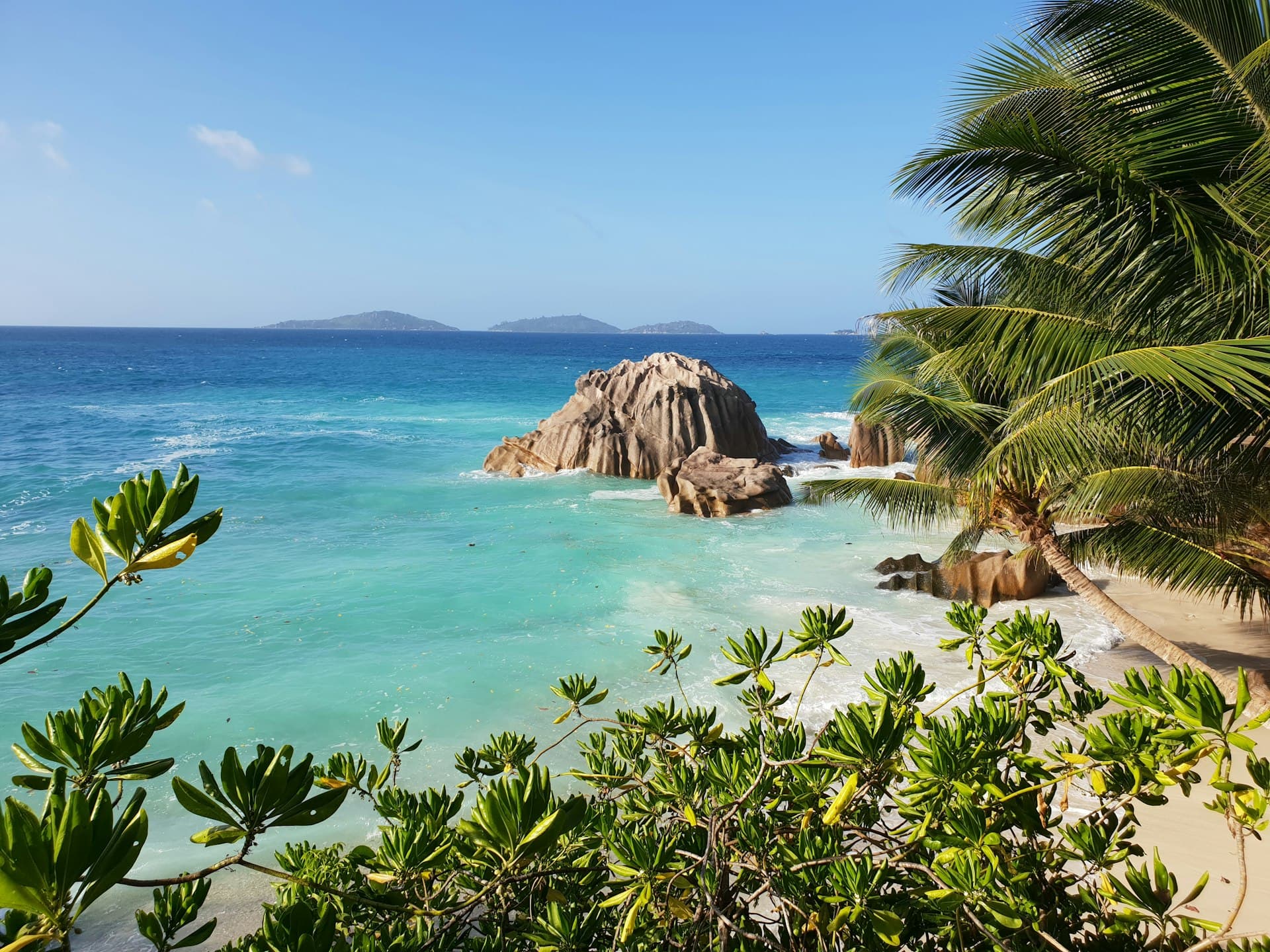
Seychelles Dive Conditions: Seasons, Visibility, Temperature
Seychelles sits 4° south of the equator — tropical, stable, and warm year-round — but "year-round" does not mean uniform. Two monsoon systems, the inter-monsoon transitions, and the split between inner granite islands and outer coral atolls create distinct seasonal windows that determine everything from what you'll see to what you should pack.
Water temperature swings 6°C across the year. Visibility can sit at 10 meters during the SE trades when plankton blooms the water, then open up to 40 meters during the NW monsoon calm. Current at the same site changes direction and strength depending on whether you're diving in the dry season or the wet. And the two animal encounters that drive most dive travel here — whale sharks and manta rays — are strictly seasonal. This guide breaks down the numbers so you can time your trip to match what you're after.
The Numbers That Drive Every Dive
Water temperature: 24–30°C (75–86°F) year-round around Mahé and the inner islands. The coolest months are July–August (24–26°C / 75–79°F). The warmest are February–April (28–30°C / 82–86°F). Outer atolls (Alphonse, Desroches, Astove) run 1–2°C warmer on average but follow the same seasonal pattern.
Visibility: 10–40 m depending on season and location. The inner islands have moderate visibility year-round — 15–25 m is typical, with peak 30–40 m during inter-monsoon transitions (April, October–November). The outer atolls regularly run 20–40 m+ with less seasonal variation. The SE trade wind season (May–October) drops visibility in the inner islands to 10–25 m as plankton blooms the water — but that plankton is what draws the whale sharks and mantas.
Current: Varies by site rather than by season. Sites exposed to open water — Shark Bank, Booby Rock, South Marianne, Trois Bancs, Desroches Channel — can run 2–3 knots at spring tides regardless of season. Protected inner-island sites — St. Pierre, the Mahé coral gardens, Ste. Anne Marine Park — are calm enough for Open Water divers year-round. Current direction at channel sites like Ave Maria and Booby Rock shifts with tidal stage, not season.
Depth range by site type: Coral gardens and islet reefs 5–18 m; granite boulder fields 12–30 m; drift walls and channels 15–40+ m; the Ennerdale Wreck at 28–33 m; Aldebaran Wreck at 30–40 m. Outer atoll walls drop from 5 m beyond recreational limits.
The Two Monsoons
Seychelles has a tropical monsoon climate with two dominant wind patterns that define the dive calendar.
Northwest Monsoon (November–April): The Calm Season
The NW monsoon is Seychelles at its most serene. Winds blow from the northwest across the equator, bringing hot, humid air and calm seas. The water is warm — 28–30°C (82–86°F) from December through April — and a 3 mm shorty or thin full suit is all you need. Visibility in the inner islands runs 20–40 m, with peak conditions in March–April (the transition to the SE trades) when the water column settles and plankton levels are lowest.
This is the best season for photographers. Calm surface conditions mean less motion blur at the safety stop, and the visibility allows wide-angle shots of the granite boulder formations. It is also the easiest season for beginners — protected sites are glassy, currents are at their most predictable, and there is no plankton haze to degrade the experience.
Drawback: This is the low season for large pelagic encounters. Whale sharks are absent (they arrive with the SE trades). Manta ray activity is lower. Humpback whales are not present. If you are coming for megafauna, this is not your window.
Key conditions by month (inner islands):
- November: 27–29°C, 25–40 m visibility. NW monsoon settling in. Excellent diving — clean water, building calm.
- December: 28–29°C, 20–35 m visibility. Holiday peak — book early, pay more. Seas calm.
- January: 28–29°C, 15–30 m visibility. Calm seas, warm water. Low season for pelagics.
- February: 28–30°C, 15–30 m visibility. Warmest month of the year. Excellent visibility building.
- March: 28–30°C, 15–30 m visibility. Transition starting. Good for photography.
- April: 28–30°C, 20–40 m visibility. Peak conditions. Calmest seas all year, best visibility, water at maximum warmth.
Southeast Trade Winds (May–October): The Megafauna Season
The SE trades shift in May. Winds blow from the southeast, stronger and cooler, and the character of Seychelles diving changes completely. Water temperature drops — 24–27°C (75–81°F) at its coolest in July–August — and visibility in the inner islands comes down to 10–25 m as plankton blooms turn the water green. A 5 mm full suit is the right call from June through September, and you will appreciate a hood on deeper dives below the thermocline.
This is the season the megafauna comes for. The plankton bloom triggers a feeding chain: whale sharks arrive reliably September–November (the tail end of the SE trades into the NW monsoon transition) and are encountered consistently at sites around Mahé, Praslin, and La Digue. Reef manta rays peak August–October, especially at outer atoll passes. Humpback whales pass through in October, often with calves. If you are coming for big animals, you book in this window.
Drawback: The wind. SE trades blow 15–25 knots on exposed sites, and the leeward (northwest) coast of Mahé — where most operators run — is protected but not immune. Surf at boat exits can be moderate. Visibility in the inner islands is the lowest of the year. The outer atolls, with their open-ocean location, suffer less — Astove and Desroches regularly run 25–40 m visibility even during the trades.
Key conditions by month (inner islands):
- May: 27–29°C, 20–35 m visibility. Transition — visibility still good, winds building. Whale sharks start appearing late month.
- June: 25–27°C, 10–25 m visibility. SE trades established. Cooler water, plankton bloom. Manta activity increasing.
- July: 24–26°C, 10–25 m visibility. Coolest temperatures. Lowest visibility month. Outside atolls still excellent.
- August: 24–26°C, 10–25 m visibility. Manta peak at outer atolls. Still cool. Visibility improving late month.
- September: 25–27°C, 15–25 m visibility. Whale shark peak. Mantas strong. Visibility improving as trades ease.
- October: 26–28°C, 20–35 m visibility. Transition — trades easing, visibility jumping. Whale sharks still strong. Humpback whales passing through. One of the best months overall.
Inter-Monsoon Transitions: The Sweet Spot
The two inter-monsoon periods — March–May and September–November — are when the trades are switching and the sea goes flat. These windows deliver the best of both worlds: calm conditions, peak visibility (20–40 m), and, in the September–November window, the whale shark and manta ray seasons are in full effect.
March–May: Calmest seas all year, 28–30°C water, 20–40 m visibility. Low pelagic activity but excellent conditions for photography, beginners, and exploring the granite boulder sites without current stress. September–November: 26–28°C water, 20–35 m visibility, whale sharks (Sept–Nov peak), mantas (Aug–Nov peak), humpback whales (Oct). This is the consensus "best time to dive Seychelles."
Outer Atolls: Different Rules
The outer atolls — Alphonse, Desroches, Astove, Cosmoledo — are deep in the Indian Ocean, 200–600 km from Mahé. Their conditions follow a different pattern from the inner islands:
Water temperature: 26–29°C year-round, with less seasonal swing than the inner islands. Visibility: 20–40 m+ year-round. Plankton blooms affect the outer atolls less, and visibility rarely drops below 20 m even during the peak SE trades. Current: Stronger and more consistent than the inner islands. Channel dives at Desroches, Alphonse Pass, and Cosmoledo Pass demand comfort with 2–3 knot flows. Reef hooks are standard equipment. Access: These sites are expedition-grade. Evacuation to Mahé is 4–24+ hours depending on atoll and weather. No chamber on any outer island. A private resort or liveaboard is required — there are no day-boat operations from Mahé to the outer atolls.
The outer atolls are best dived April–May and October–November — the inter-monsoon windows when seas are calmest and the long boat journeys from the resort bases are least uncomfortable. July–August, the peak of the SE trades, can make outer-atoll boat access challenging even for the resort-based operators.
Reading the Current at Seychelles Sites
Current in Seychelles is driven by three factors:
1. Tidal stage. The Indian Ocean around Seychelles has a mixed semidiurnal tide with a range of 1.0–2.5 m. This range generates significant flow through channels and around headlands. Sites like Booby Rock and Ave Maria are substantially different on neap vs spring tides — springs can double the current speed.
2. Monsoon. The NW monsoon (Nov–Apr) produces generally calmer currents across all sites. The SE trades (May–Oct) drive stronger, more consistent flow, especially on exposed southern and eastern reef edges. A site that is moderate in January can be strong in July.
3. Site topography. Granite boulder fields create local acceleration zones — water narrows between boulders and speeds up even at otherwise moderate sites. Sites like Trois Bancs ("Three Ridges") channel water through the gaps between granite ridges, producing consistent drift conditions regardless of season.
If you are not comfortable with drift diving, stay on the protected sites: St. Pierre, Coral Garden, Aquarium, L'Ilot, Turtle Rock, and the inside of Ste. Anne Marine Park. These are genuinely calm and suitable for Open Water divers with fewer than 20 dives.
Gear Notes for Seychelles
Wetsuit: 5 mm full suit for June–September (24–26°C water). 3 mm full suit or shorty for October–May (27–30°C). Outer atolls are consistently warmer — 3 mm year-round is usually sufficient. Rental wetsuits are available at most operators but quality varies — bring your own if fit matters to you.
Exposure for deep dives: The Ennerdale Wreck and Aldebaran Wreck sit at 28–40 m. Even in the warm season, a hood is a good call on a 35 m dive — the deeper water can run 2–3°C cooler than the surface.
Reef hook: Bring one if you plan to dive Booby Rock, South Marianne, Desroches Channel, or Trois Bancs. These are high-current drift sites where a reef hook lets you hold position without fighting the flow. Most operators can provide one, but having your own is better.
Dive computer: Drift dives and multi-level boulder-field profiles mean hand-calculated tables are useless. If you do not own a computer, rent one. The rental fleet at Big Blue Divers and Octopus Diver is well-maintained.
SMB: Required at every Seychelles drift site. The current at sites like Shark Bank and Trois Bancs can carry you 300+ meters from the drop point by the end of the dive. A delayed SMB deployed at 5 m is standard practice.
Buoyancy control: The granite boulder fields demand precise trim. Swim-throughs are tight. Stirring sediment drops visibility to zero inside the boulder gardens, and silting a tunnel in a current is genuinely dangerous. If you have not dived in six months, do a check-out dive at a shallow site like L'Ilot or Coral Garden before attempting anything with boulder structures.
Putting It Together
Seychelles conditions are seasonal but forgiving if you plan correctly. The inter-monsoon windows deliver world-class conditions for every dive level and photography style. The SE trades deliver the best megafauna encounters in the Indian Ocean. And the outer atolls — with their own rules and elevated risk profile — reward the divers who make the journey with genuinely pristine reef ecosystems.
Match your gear to the season, respect the current, carry DAN insurance with evacuation coverage, and Seychelles will deliver dives that sit permanently in your memory. DivePass tracks real-time conditions across inner-island sites and aggregates operator briefing notes so you have current data before every dive.