Top 10 Dive Sites in Santa Elena & Manabí, Ecuador
Ecuador's mainland coast delivers a range of diving that most travelers don't know exists. The sites here split into two distinct experiences: the easy-access artificial reefs and shore dives of El Pelado Marine Reserve near Ayangue, and the open-ocean encounters at Isla de la Plata and Bajo Cope that bring giant manta rays, humpback whales, and schooling hammerheads within reach of recreational divers.
This guide ranks the 10 best sites across the Santa Elena and Manabí provinces, covering everything from the island's signature coral reef to its most remote offshore shoal.
1. El Pináculo
Type: Rocky pinnacles | Depth: 6–18 m | Difficulty: Intermediate (moderate–strong current) | Best season: June–October | Access: Boat, 1h 15min from Puerto López
Three submerged rocky pinnacles rising from a sandy plateau, flanked by walls dropping into deep water. El Pináculo is the single best dive site on Ecuador's mainland coast — and one of the top manta ray sites globally. Giant oceanic manta rays use these pinnacles as cleaning stations from June through October, swimming slow, deliberate circles while barberfish pick parasites off their bellies and gills. Divers report mantas staying within arm's length for the entire dive.
Beyond the mantas, green sea turtles rest between pinnacles, whitetip reef sharks patrol the edges, and schools of Cortez rainbow wrasse and king angelfish fill the water column between pinnacles. The current here is moderate to strong — this is a drift dive where your operator drops you up-current and you ride the flow past each pinnacle. Advanced Open Water certification is recommended.
Target species: Giant oceanic manta rays (Jun–Oct, guaranteed), green sea turtles, whitetip reef sharks, spotted eagle rays, king angelfish, Cortez rainbow wrasse, barberfish.
Coordinates: -1.25882, -81.07837 (PADI published)
2. El Acuario
Type: Coral reef | Depth: 3–12 m | Difficulty: Beginner (Open Water) | Best season: Year-round | Access: Boat, part of Isla de la Plata day trip from Puerto López
The largest and most preserved coral reef on Ecuador's mainland coast. El Acuario covers over a hectare with massive coral formations reaching 3 meters tall — a near-southern limit for significant coral growth in the Eastern Pacific, made possible by the convergence of the warm Panama Current with the cool Humboldt.
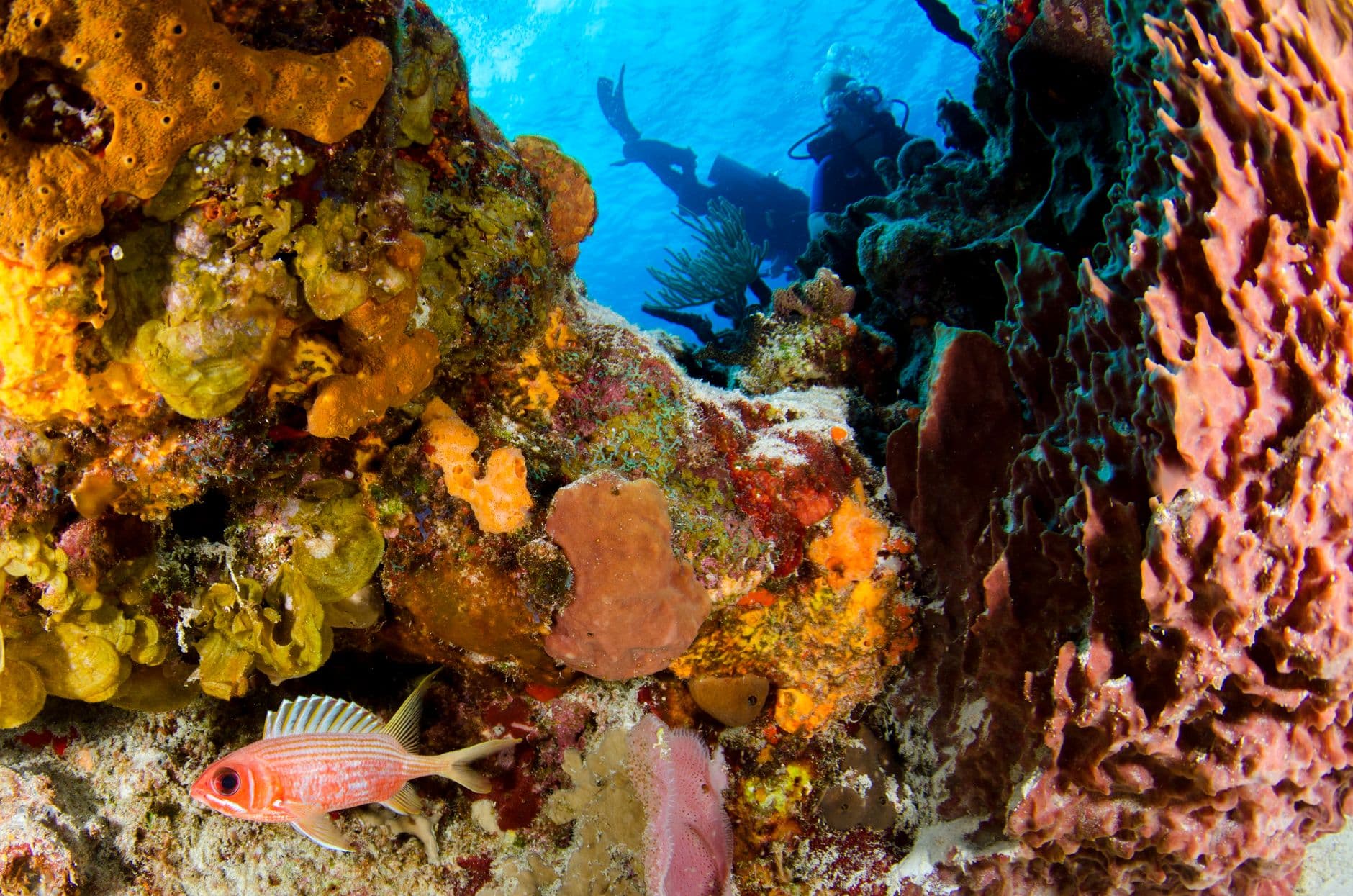
The name fits. Pufferfish in multiple colors drift between coral heads. Cortez angelfish pick at sponges. Trumpetfish hover vertically among gorgonian fans. Octopus hide in crevices. Devil scorpionfish lie motionless on the seafloor, perfectly camouflaged. Moray eels — including zebra morays and Panamic green morays — extend from crevices with mouths open in their characteristic breathing posture.
Because it's shallow and protected, El Acuario is accessible to Open Water divers with no special training. The visibility runs 10–25 m depending on the season. Bring a macro lens — the Christmas tree worms, pipefish, and cleaner shrimp at the cleaning stations make this one of the best macro photography sites along the entire Ecuadorian coast.
Target species: Cortez angelfish, king angelfish, pufferfish, trumpetfish, pipefish, octopus, devil scorpionfish, panamic green moray, zebra moray, lobsters, guitarfish, Christmas tree worms.
3. Tres Rocas
Type: Wall dive / rock formations | Depth: 17–25 m | Difficulty: Intermediate | Best season: June–October (manta peak); year-round (reef life) | Access: Boat, Isla de la Plata from Puerto López
Three prominent submerged rock formations forming the shallow wall of a drop-off that plunges to the open ocean. Tres Rocas is a primary manta ray cleaning station during the high season (June–October). The wall starts at about 15 m and drops to 25 m, where the three rock structures create current breaks that mantas and mobula rays use as cleaning stops.
Giant moray eels live in the crevices between rocks. Schools of barracuda and yellowfin tuna pass through. During July through September, humpback whale songs fill the water column — audible through the dive profile. This is one of the few places in the Eastern Pacific where you can hear whale song while watching mantas circle a cleaning station.
Target species: Giant oceanic manta rays (peak Jun–Oct), mobula rays, giant moray eels, green sea turtles, barracuda, yellowfin tuna, humpback whale song (Jul–Sep).
4. Bajo Cope
Type: Submerged reef system (pinnacles, walls, bubble reefs) | Depth: 12–30 m | Difficulty: Advanced (extreme open-ocean exposure) | Best season: July–September | Access: Boat, 1 hour from Ayangue (GPS-reached)
Bajo Cope is a 10.3-kilometer-long submerged reef system with no surface landmark — reached exclusively by GPS and sonar. This is open-ocean diving at its most adventurous. The reef is divided into multiple named sites: Las Agujas (the Needles) where sharp rock pinnacles create manta cleaning stations, Las Mantas where bubble reefs emerge from the seafloor, La Caída del Sol (Sunset Drop) with a deep wall profile, and Seco with a shallower bubble reef flat.
The giant oceanic manta rays here represent the world's largest documented population — 28,000+ individuals identified by Oregon State University. On a peak-season dive (July–September), divers report seeing 10–30 mantas on a single dive, some with wingspans exceeding 6 meters.
This site is advanced-only. The exposed open-ocean conditions mean significant current, choppy surface conditions, and no bottom reference in the blue water surrounding the reef. Divers need at minimum Advanced Open Water with solid drift-diving experience. A 5 mm wetsuit is mandatory — the Humboldt upwelling keeps water at 19–22°C even in peak summer.
Target species: Giant oceanic manta rays (guaranteed Jul–Sep), scalloped hammerhead sharks, spotted eagle rays, yellowfin tuna, school of barracuda.
5. El Cristo (The Christ Statue)
Type: Artificial reef (statue) | Depth: 11 m | Difficulty: Beginner (Open Water) | Best season: Year-round | Access: Boat, 15 min from Ayangue
An underwater statue of the Sacred Heart of Jesus of the Waters, placed at 11 meters depth by a Colombian businessman as an artificial reef. This is the most-visited dive point in Ayangue and the most photographed underwater attraction on Ecuador's mainland coast.
The statue sits on a sandy bottom surrounded by volcanic rock. Juvenile fish aggregate around the structure in dense schools. Sea lions occasionally swim through to investigate. The site is shallow and protected — ideal for beginner divers, discover scuba sessions, and underwater photography. The statue itself is roughly 2 meters tall, and divers can swim around it in a full circle.
Target species: Juvenile reef fish, Cortez angelfish, occasional sea lions, schooling reef fish.
6. Barco Hundido Rigel (Rigel Wreck)
Type: Wreck (artificial reef) | Depth: 8–15 m | Difficulty: Beginner–Intermediate | Best season: Year-round | Access: Boat, El Pelado from Ayangue
A deliberately scuttled Ecuadorian Navy ship, sunk by the Ministry of Environment to serve as an artificial reef and dive attraction. Divers can enter the ship's interior — the holds are open and the structure is safe for penetration with good buoyancy control.
Moray eels patrol the engine room. Octopus hide in the shadowed corners of the bridge. Crustaceans cling to the hull. The wreck sits at 8–15 meters, making it accessible to Open Water divers.
The ship is slowly deteriorating due to large waves and current. While still safe to enter as of 2026, its condition changes yearly. Ask your operator for the latest structural assessment before penetrating.
Target species: Panamic green moray, giant moray eel, octopus, crustaceans, reef fish.
7. La Roca Honda
Type: Manta cleaning station / reef | Depth: 12–30 m | Difficulty: Intermediate–Advanced (current can be strong) | Best season: June–October | Access: Boat, Isla de la Plata from Puerto López
Described by experienced divers as the most biodiverse spot in the Isla de la Plata complex. La Roca Honda is a crucial cleaning station where giant manta rays, mobula rays, and sea turtles congregate to have parasites removed by cleaner wrasse and barberfish.
The reef structure here is more complex than at El Pináculo — a series of rock ledges and overhangs at varying depths. The cleaning station action is concentrated around a specific rock feature at 18 meters. Current can be strong and variable; this site is best suited for divers comfortable with drift profiles.
Target species: Giant manta rays (peak Jun–Oct), mobula rays, green sea turtles, large fish schools, moray eels.
8. Salango Island
Type: Island reef / rock | Depth: 5–20 m | Difficulty: Beginner–Intermediate | Best season: Year-round (best Dec–May) | Access: Boat, 1 km from Salango village
A small island 1 kilometer offshore from the pre-Columbian village of Salango, within Machalilla National Park. The site holds archaeological significance — the Valdivia and Machalilla cultures (3500–1500 BCE) were among the earliest seafarers in South America, and the waters around Salango Island are part of their ancestral territory.
The diving is gentle: good visibility, calm waters, and a mix of rocky reef and sandy patches. Green sea turtles are common. Moray eels hide in the rock crevices. During the warm season (December–May), this is one of the most reliable beginner-friendly sites on the coast.
Target species: Green sea turtles, reef fish, Panamic green moray, whitetip reef sharks (occasional), seasonal manta rays.
9. Los Ahorcados Islets
Type: Rock formation / reef | Depth: 6–25 m | Difficulty: Medium (good for snorkeling and deeper diving) | Best season: Year-round | Access: Boat, 10 min from Las Tunas or 40 min from Ayangue
A three-pronged rock formation named after local legends of pirates being hanged here. The site serves as a refuge for migratory birds above the surface and hosts gorgonian coral formations, crustaceans, and mollusks below.
The dive profile is split: a shallow section (6–12 m) good for snorkeling and novice divers exploring the gorgonians, and a deeper section (18–25 m) with overhangs and rock walls where larger fish congregate. The three rock prongs create natural channels that concentrate current and marine life.
Target species: Gorgonian corals, crustaceans, mollusks, reef fish, octopus, moray eels.
10. Bajo Cantagallo
Type: Offshore shoal / seamount | Depth: 10–30 m | Difficulty: Advanced (open ocean, potential currents) | Best season: June–October | Access: Boat, longer trip from Puerto López
A high-traffic area for migrating giant manta rays and humpback whale breeding activities, located north of Puerto López. Bajo Cantagallo sits in the Humboldt Current corridor where manta rays aggregate in large numbers and humpback whales use the area for mating and calving.
Whale shark sightings have been increasing here in recent years, making this an emerging hotspot for three megafauna species on a single dive. The shoal itself is a seamount that rises from deeper water, concentrating pelagic activity at its summit.
This is an expedition-level dive. The boat trip is longer than other sites on this list, conditions are open-ocean, and good sea legs are required. Only advanced divers with open-ocean experience should attempt it.
Target species: Giant manta rays (peak Jun–Oct), humpback whales (Jul–Sep, audible), whale sharks (occasional), yellowfin tuna, scalloped hammerhead sharks.
Summary Table
| Rank | Site | Type | Max Depth | Difficulty | Best Season | Key Species |
|---|---|---|---|---|---|---|
| 1 | El Pináculo | Rocky pinnacles | 18 m | Intermediate | Jun–Oct | Manta rays, turtles, whitetip sharks |
| 2 | El Acuario | Coral reef | 12 m | Beginner | Year-round | Reef fish, morays, octopus |
| 3 | Tres Rocas | Wall / rocks | 25 m | Intermediate | Jun–Oct | Manta rays, morays, whale songs |
| 4 | Bajo Cope (Las Agujas/Las Mantas) | Submerged reef | 30 m | Advanced | Jul–Sep | Manta rays, hammerheads |
| 5 | El Cristo | Artificial reef (statue) | 11 m | Beginner | Year-round | Juvenile fish, sea lions |
| 6 | Rigel Wreck | Wreck | 15 m | Beginner–Int | Year-round | Morays, octopus, reef fish |
| 7 | La Roca Honda | Cleaning station | 30 m | Int–Adv | Jun–Oct | Manta rays, biodiversity |
| 8 | Salango Island | Island reef | 20 m | Beginner–Int | Year-round | Turtles, reef fish |
| 9 | Los Ahorcados | Rock formation | 25 m | Medium | Year-round | Gorgonians, macro life |
| 10 | Bajo Cantagallo | Offshore shoal | 30 m | Advanced | Jun–Oct | Manta rays, whales, whale sharks |
Choosing Your Santa Elena Dive Adventure
The key to reading this guide is matching sites to your skill level and the season.
- Open Water (0–20 dives): Stick with El Cristo, El Acuario, and Rigel Wreck during the warm season (December–May). The conditions are forgiving, the water is warm, and the marine life is accessible.
- Advanced Open Water (20–50 dives): Add El Pináculo and Tres Rocas (Isla de la Plata) and Salango Island. Plan for June–October if you want manta encounters, or December–May for better visibility and calmer conditions.
- 50+ dives with drift experience: Bajo Cope and Bajo Cantagallo are your targets. These are expedition-level dives that reward experienced divers with the best megafauna encounters on the coast. July–September is the peak window.
Bottom Line
Santa Elena and Manabí provinces offer a range of dive experiences that would be impressive in any Pacific destination. The easy-access artificial reefs of El Pelado give beginners a safe, shallow playground. The pinnacles and cleaning stations of Isla de la Plata deliver world-class manta ray encounters at a fraction of Galápagos prices. And Bajo Cope remains one of the most adventurous reef dives in the Eastern Pacific. Plan around the season that matches your priorities — warm and clear (December–May) or wild and megafauna-rich (June–October) — and pick your sites accordingly.