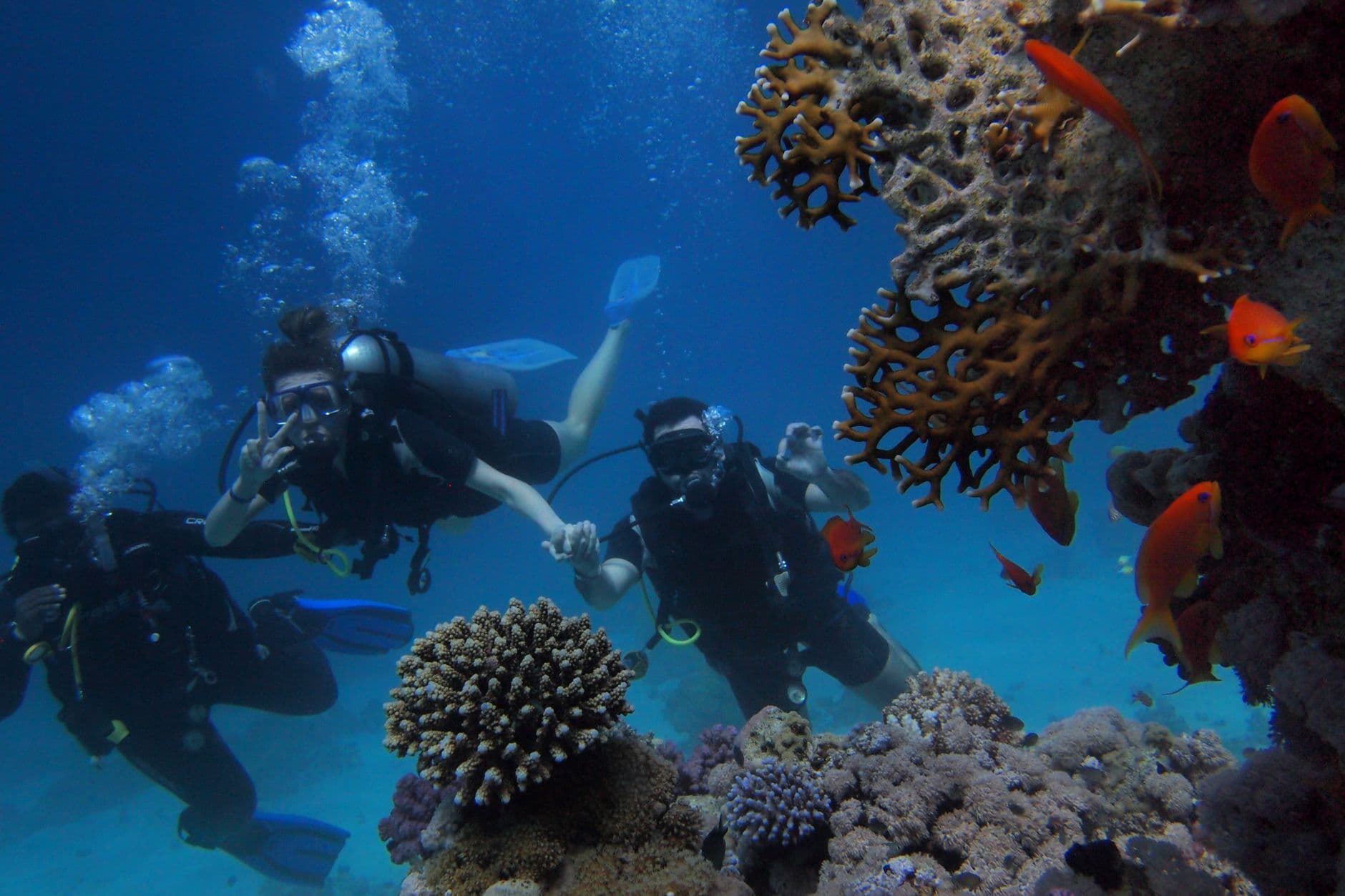
Why the Red Sea is a Diver's Dream
Egypt's Red Sea coast stretches roughly 1,200 kilometers along the western edge of the world's northernmost tropical sea. If you've only dived in the Caribbean, the difference will hit you on your first descent: visibility of 30 meters or more, water temperatures between 21 and 30 degrees Celsius year-round, and coral systems that rival any in the Indian Ocean.
The Red Sea isn't just a destination—it's a category of its own. With over 1,200 fish species (10% of them endemic) and 250+ coral species, the biodiversity here is staggering. Seven shark species call these waters home, from the ever-present grey reef shark to the seasonal scalloped hammerhead that arrives in force between May and August.
The Five Dive Regions
Egypt's Red Sea diving breaks down into five distinct regions, each with its own character.
Sharm el-Sheikh and South Sinai
This is the classic Red Sea experience. Resorts line the coast around Sharm, Nabq, and Ras Mohammed, and boat dives reach the Tiran Strait's legendary reefs. The Tiran Strait alone hosts some of the best drift diving on the planet—Jackson Reef and Shannon Reef pull strong currents that deliver you past walls draped in soft corals, where scalloped hammerheads patrol in the deep.
Ras Mohammed National Park sits at the southern tip of the Sinai Peninsula, where the Red Sea meets the Gulf of Aden. Shark and Yolanda Reefs feature walls that drop from 5 meters to over 700 meters. You'll find grey reef sharks, whitetip reef sharks, and massive schools of fusiliers and bait balls that stretch to the horizon.
Dahab
Dahab is the backpacker's capital of Red Sea diving. You dive from the shore here, which means no boat fees and no schedules. The cost per dive can be as low as $15, making it the most budget-friendly destination on the Red Sea.
The Blue Hole is Dahab's claim to fame—a 100-meter-deep sinkhole that tempts technical divers with its famous arch at 56 meters. Recreational divers stick to the outer reef, which is spectacular in its own right with turtles, moray eels, and octopus. The Canyon, a 30-meter-long fissure running from 18 to 30 meters, offers a swim-through experience that feels like floating through a cathedral.
Hurghada and El Gouna
Hurghada sits at the heart of Egypt's wreck diving. The Abu Nuhas reef complex, about 20 km south of the city, is home to the SS Thistlegorm—the most famous wreck in the Mediterranean and Red Sea. This WWII British ship sank in 1941 carrying locomotives, trucks, motorcycles, and cargo that remains remarkably intact at 27 to 30 meters depth.
Hurghada also serves as the gateway for day trips to the Giftun Islands, where shallow reef gardens teem with life and spinner dolphins visit the Samadai Dolphin House reef regularly. Dive costs here run $35 to $80 per dive, making it the most budget-friendly boat-diving option.
Marsa Alam and the South
Marsa Alam is where pristine meets wild. The reefs here have suffered less from tourism pressure than the northern areas, and the marine life reflects it. Abu Dabbab Bay is home to a resident dugong population—the only place in Egypt where you can swim with these gentle giants. Sea turtles nest on the beaches here year-round.
The Elphinstone Reef, 40 km south of Marsa Alam, is a pelagic hotspot. Between September and November, oceanic whitetip sharks gather in numbers that will make even seasoned divers hold their breath. This is a drift-diving destination that demands respect for its currents.
Offshore Liveaboard Diving
The Brothers, Daedalus, and Elphinstone form the holy trinity of Red Sea liveaboard diving. These three isolated reefs sit 60 to 120 km from shore, accessible only by multi-day liveaboard trips.
The Brothers Islands are twin seamounts where thresher sharks cruise year-round and whale sharks arrive between May and August. Daedalus Reef is where scalloped hammerheads gather—20 or more individuals have been counted on single dives. The walls drop to 400 meters, and mantas visit between June and August. A 7-night liveaboard costs between $900 and $4,200 depending on the vessel and season.
Who Should Dive the Red Sea?
The Red Sea works for every level of diver. Beginners find calm, shallow reef gardens at Hurghada and the Giftun Islands. Advanced divers chase pelagic encounters at Daedalus and Elphinstone. Technical divers test their skills at the Blue Hole and the deeper sections of the Thistlegorm wreck.
The safety infrastructure here is the best of any pipeline destination. Egypt operates hyperbaric chambers in Sharm el-Sheikh (which has treated over 1,800 divers), Hurghada (24/7 coverage), Marsa Alam, and Dahab. All dive operations are regulated by the CDWS, which limits boats to a maximum of 6 divers per guide. Still, DAN insurance is mandatory—offshore sites can take 6 to 12 hours to evacuate to a chamber.
Getting There and What It Costs
You'll fly into one of three airports: SSH (Sharm el-Sheikh), HRG (Hurghada), or RMF (Marsa Alam). Most nationalities pay a $25 USD visa on arrival.
A single dive in Dahab runs $15 to $30. Boat dives in Sharm cost $50 to $100. Liveaboards range from $900 to $4,200 for 7 nights. If you're budget-conscious, Dahab and Hurghada offer the best value without sacrificing quality.
The Red Sea delivers world-class diving at prices that make it accessible. The water is clear, the marine life is abundant, and the variety of sites means you can return year after year and still find something new.