Top 8 Dive Sites at Malpelo: A Diver's Guide
Every dive site at Malpelo sits roughly 500 kilometers from the Colombian mainland in the open Eastern Tropical Pacific. There are no sheltered bays, no shore dives, and no house reef with an easy entry. Everything is reached by tender from a liveaboard, and everything is shaped by the currents and upwelling that converge on this isolated volcanic seamount.
Within those constraints the sites differ a great deal — in depth, exposure, temperature, and what you are likely to see. This guide covers eight, ranked by how reliably they deliver, how distinctive they are, and the quality of the diving. Depths are the full range operators work; the productive part of most dives is shallower.
1. El Bajo del Monstruo
Type: Submerged pinnacle / cleaning station | Depth: 18–50 m | Difficulty: Advanced | Best season: Year-round (hammerheads densest Dec–Apr)
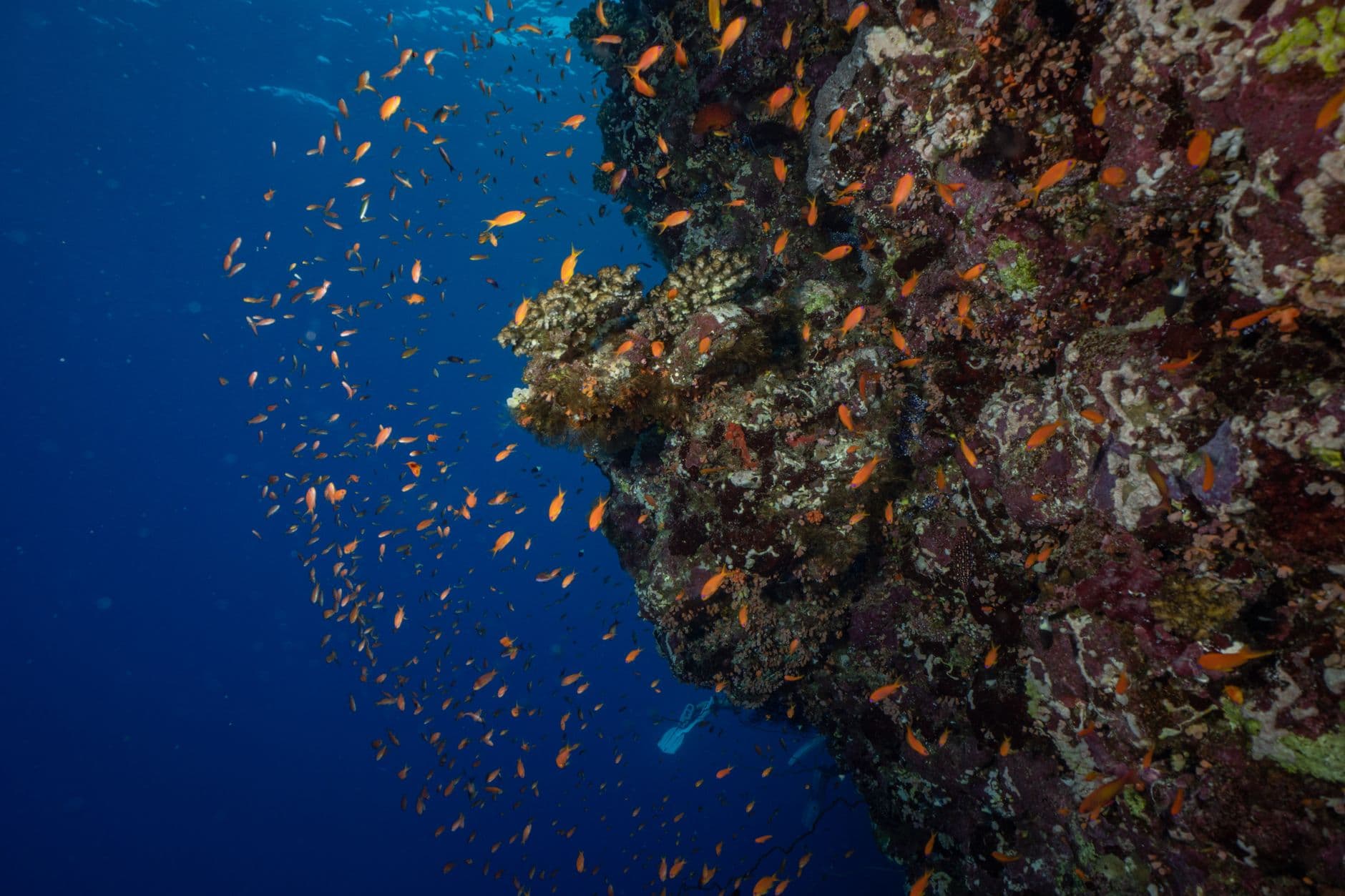
El Bajo del Monstruo — the Monster's Shoal — is Malpelo's best-known site and the anchor of most itineraries. A submerged pinnacle rises from deep water to within about 18 meters of the surface, its summit carrying gorgonian fans and black coral over dark volcanic rock. It is the island's primary hammerhead cleaning station.
The experience: The briefing is short. Negative entry from the tender, descend to 25–30 meters, hook into bare rock on the pinnacle's lee side, and wait. The waiting is usually brief. Small groups of hammerheads appear at the edge of visibility first, cruising the reef edge, and then the school arrives — scalloped hammerheads in formation, several hundred strong on a good day, passing overhead at cleaning-station depth. Close enough that you can watch cleaner fish working individual sharks.
The sharks: Scalloped hammerheads dominate, with schools of 200–500 reported at peak. This is one of the sites where smalltooth sand tigers (Odontaspis ferox) turn up on the deeper faces, generally at 25–40 meters. Silky sharks and Galápagos sharks work the periphery.
Beyond sharks: Giant manta rays visit the cleaning stations, most likely from around May through October. Yellowfin tuna cruise the blue beyond the pinnacle, bigeye trevally form dense schools in the current, and Pacific creolefish cover the summit in orange clouds.
Current and technique: 1–3 knots is normal. Reef hook technique is standard, and negative entries are used when current is running. Nitrox is strongly recommended — the working depth sits at the edge of air no-decompression limits for a repetitive multi-day schedule.
Access: Tender from the liveaboard anchorage, typically 10–15 minutes. Most itineraries run El Bajo repeatedly across a trip.
Skill requirements: An advanced certification, documented experience at depth and in current, and comfort with negative entries and hook technique. Confirm your operator's exact prerequisites when you book.
2. La Nevera
Type: Deep pinnacle / upwelling wall | Depth: 5–45+ m | Difficulty: Advanced (deep) | Best season: Dec–Apr for the biggest schools
La Nevera — the Icebox — earns its name. Cold upwelling produces a distinct thermocline at roughly 15–25 meters, and below it the water can drop to 16–18 °C, six to twelve degrees colder than the surface layer. This is the most physically demanding dive at Malpelo and one of the most rewarding.
The experience: The descent through the thermocline is abrupt. The temperature falls away within a meter or two of depth and the layers shear against each other in a shimmering distortion you can see as well as feel. Below it the water is darker, often clearer, and cold. The temperature boundary is the point: it concentrates pelagic activity, and the schools here tend to be tighter than at El Bajo.
The sharks: Scalloped hammerheads in large, compact schools. Galápagos sharks are more prominent here than at El Bajo, patrolling the deeper edges. Smalltooth sand tigers are reported along the wall faces. Silky sharks round out the list.
Beyond sharks: Bigeye trevally, yellowfin tuna, giant manta rays, and — in the warmer months — whale sharks in the blue beyond the wall. The wall face carries deep-water gorgonians and black coral. The endemic Malpelo barnacle blenny lives on this rock.
Current and technique: 1–3 knots. Hook technique is essential. The profile demands good gas consumption, conservative bottom times, and honest planning; nitrox is strongly recommended.
Exposure protection: A 7 mm full suit with a hood is the realistic recommendation for La Nevera, and gloves help. Divers who packed a 5 mm for "tropical Colombia" regret it here, particularly on the third or fourth dive of a long day.
3. El Bajo de Virginia
Type: Offshore seamount | Depth: 20–50 m | Difficulty: Advanced (deep, exposed) | Best season: Year-round
El Bajo de Virginia is a seamount roughly 1.5 kilometers southwest of the island — far enough offshore that it behaves like open ocean with a rock in it. It is one of the strongest pelagic sites in the sanctuary and, because of its depth and exposure, one of the most demanding.
The experience: You drop onto a summit surrounded by blue in every direction, hook in, and watch what the current brings. There is no reef to work along and no shallow option, so the dive is disciplined by design: a set depth, a set time, and a controlled ascent into open water.
The sharks: Scalloped hammerheads, silky sharks, and Galápagos sharks are all regular. Whale shark and giant manta encounters happen here more than at most sites.
Beyond sharks: Big schools of jacks and tuna use the seamount the same way the sharks do.
Current and technique: Current is always present and can exceed 2 knots. Hook dives are standard. A surface marker buoy and a clear plan for a blue-water ascent are not optional — this is the site where being swept off means being in open ocean.
Skill requirements: Deep experience beyond a basic advanced course, solid gas management, and comfort with a mid-water ascent in current.
4. La Gringa
Type: Offshore seamount | Depth: 25–50 m | Difficulty: Advanced (deep) | Best season: Year-round
La Gringa is a seamount around 3 kilometers from the main island, named after a US Navy survey buoy that once marked it. Its reputation rests on one thing: it is among the sites where divers most consistently encounter the smalltooth sand tiger shark during the day — a species almost never seen alive by divers anywhere.
The experience: A deep, current-swept seamount with strong pelagic traffic. Because the sand tigers are the draw and they sit deep, this dive is planned tightly, with a hard depth ceiling and a short bottom time.
The sharks: Smalltooth sand tigers are the reason to dive it. Scalloped hammerheads, Galápagos sharks, and silky sharks are also present.
Beyond sharks: Substantial schooling fish life and the usual pelagic traffic that offshore structure attracts.
Current and technique: Strong. Hook technique and disciplined ascents. Nitrox strongly recommended given the depth.
5. Los Mosqueteros
Type: Three rock pinnacles | Depth: 10–35 m | Difficulty: Advanced | Best season: Year-round
Los Mosqueteros — the Three Musketeers — are three rock pinnacles rising off the island's northern tip, standing guard over the approach. They are among the shallower of Malpelo's serious sites, which makes them a useful counterweight to a schedule full of deep profiles.
The experience: The dive typically works between the pinnacles, using the gullies and the structure for shelter and drifting where the current dictates. Each pinnacle has its own character, and the multi-stop format covers all three when conditions allow.
The sharks: Whitetip reef sharks gather in the gullies between the pinnacles. Scalloped hammerheads pass overhead in moderate schools, and silky and Galápagos sharks hunt around the bases.
Beyond sharks: Eagle rays and manta rays patrol overhead. Coral growth and fish diversity are better here than on the exposed seamounts.
Current and technique: Moderate to strong, and it funnels between the pinnacles. Drift experience matters, and gas management needs to account for a multi-stop plan.
6. La Catedral
Type: Volcanic rock formation / canyons and overhangs | Depth: 15–35 m | Difficulty: Intermediate–Advanced | Best season: Year-round
La Catedral — the Cathedral — is an amphitheatre of towering rock buttresses on the island's southeast face, forming canyons and overhangs that give the site its name. The topography is the most striking at Malpelo, and light coming through the fissures does the rest.
The experience: The dive follows the buttresses and canyons at 15–35 meters. Whitetip reef sharks rest in the sandy alleys between the walls, and the overhangs hold octopus and lobsters. Hammerheads pass in the blue above — the site sits in the traffic pattern rather than on a cleaning station.
The sharks: Whitetip reef sharks in numbers, resting on the sand. Scalloped hammerheads overhead in moderate schools. Silky sharks working the outer edges.
Beyond sharks: Bigeye trevally school through the canyons, and the rock faces carry gorgonians. The light effects make this the best topography site at Malpelo for photography.
Current and technique: Moderate, though it accelerates where it funnels between the buttresses. Good buoyancy control matters — both for your own safety in the canyons and to avoid damaging the fans.
7. La Pared del Náufrago
Type: Vertical wall | Depth: 15–60+ m | Difficulty: Advanced | Best season: Year-round
La Pared del Náufrago — the Castaway's Wall — is Malpelo's premier wall dive, dropping past 60 meters on the island's western side and named for the isolation of the site.
The experience: The wall falls away into blue from the moment you leave the surface. Current sweeps nutrient-rich water up the face, so the action is split between the wall itself — encrusting life, gorgonians, whitetip reef sharks tucked into overhangs — and the open water off it, where the pelagics are.
The sharks: Large silky sharks in the blue. Whitetip reef sharks along the wall. Hammerheads patrol the edge of visibility.
Beyond sharks: Dolphins, sailfish, and ocean sunfish are all reported off this wall — the most varied blue-water list of any Malpelo site.
Current and technique: Strong, and it runs along and up the wall. Excellent buoyancy control is required: a wall this deep punishes an uncontrolled descent, and the depth available far exceeds what the dive plan should allow. Set a hard ceiling before you enter.
8. El Bajón
Type: Vertical wall | Depth: 10–50+ m | Difficulty: Advanced | Best season: Strongest in the plankton-rich months
El Bajón — the Big Drop — is a sheer wall on Malpelo's north face, running from about 10 meters to past 50. It is exposed, and it catches the plankton-rich water that draws pelagics in.
The experience: A wall dive on an exposed face, with the productive water bringing traffic through. Hammerheads school at depth here rather than at cleaning-station depth, so the profile tends to run deeper than the schooling dives elsewhere on the island.
The sharks: Schooling hammerheads at depth. Whale sharks pass through in the warmer months. Silky and Galápagos sharks are regular.
Beyond sharks: Sandy shelves at the deeper end hold species you will not see on the pinnacles, and the plankton that reduces visibility here is what brings the filter feeders.
Current and technique: Strong and unpredictable, including down-currents on the wall face. This is a site where you should be watching your depth continuously and be ready to move off the wall rather than fight it.
Summary by Zone
| Zone | Sites | Characteristics |
|---|---|---|
| Signature pinnacle | El Bajo del Monstruo | Primary hammerhead cleaning station; smalltooth sand tigers deep |
| Cold-water sites | La Nevera, El Freezer | Sharp thermocline, 16–18 °C below it, deep profiles |
| Offshore seamounts | El Bajo de Virginia, La Gringa, Los Gemelos | Deep, exposed, strongest pelagic traffic — advanced only |
| Walls | La Pared del Náufrago (15–60+ m), El Bajón (10–50+ m) | Vertical drops, pelagics in the blue |
| Northern pinnacles | Los Mosqueteros | Three pinnacles, gullies, whitetips and rays |
| Topography | La Catedral, Las Columnas, La Cueva del Antiguo Peruano | Canyons, spires, and a cavern swim-through |
| Gentler sites | El Arrecife, El Mirador, El Aerolito | Check-out and later-in-the-day dives; the best small-subject life |
Essential Tips for Malpelo
- Book well ahead. Access is capped by permit and the cool-season months are the most sought after. Trips fill far in advance.
- Get comfortable with current before you arrive. Every dive here involves it. Practise hook technique and negative entries somewhere forgiving first.
- Bring your own reef hook. It is standard equipment at Malpelo — do not count on a spare in your size being aboard.
- Pack a 7 mm and a hood. The thermocline can reach 16–18 °C, and repetitive diving compounds cold exposure. This is the most common packing mistake at Malpelo.
- Prepare for the crossing. Roughly 30–36 hours each way from Buenaventura. Take seasickness medication before you sail, not after.
- Bring wide-angle. The schooling dives call for it. El Aerolito is the one site where a macro setup earns its space.
- Dive conservatively — this one is not negotiable. There is no recompression chamber on the island and the nearest facilities are on the mainland, well over a day away by boat. Set hard depth ceilings, stay inside no-decompression limits, and carry dive accident insurance with evacuation cover.
- Pack for both temperatures. You will be warm on deck and cold at depth. A hoodie for the surface and a hood for the water are both worth the space.