Malpelo Diving: The Complete Guide to Colombia's Shark Sanctuary
About 500 kilometers from the Colombian coast, Malpelo rises out of the open Pacific as a bare volcanic spire with no beaches, no harbour, and no tourism infrastructure of any kind. What it has instead is a Colombian Navy detachment, a very large seabird colony, and some of the most consistent shark diving in the Eastern Tropical Pacific.
The island is about 1.6 kilometers long and no more than roughly 730 meters wide — bare rock, and only the emergent summit of something much bigger: the Malpelo Ridge, a submarine volcanic range running about 300 kilometers northeast–southwest and about 100 kilometers wide, rising roughly 4,000 meters from the surrounding ocean floor. That structure sits in the path of the Pacific Equatorial Countercurrent, and the resulting upwelling is what draws scalloped hammerheads, silky sharks, and the rarely seen smalltooth sand tiger to the pinnacles around the island.
UNESCO inscribed the Malpelo Fauna and Flora Sanctuary as a World Heritage site in 2006. The property covers about 857,500 hectares of island and surrounding ocean — an area comparable in size to Yellowstone National Park (roughly 898,000 hectares). It is one of the largest no-fishing zones in the Eastern Tropical Pacific, and Colombia has expanded the protected area around it more than once since inscription. Malpelo Ridge is also a designated Important Shark and Ray Area.
This is not beginner territory, and it is not a comfortable trip. It is a serious, current-exposed, liveaboard-only destination.
What Makes Malpelo Distinctive
The Hammerhead Aggregations
Malpelo hosts one of the largest scalloped hammerhead (Sphyrna lewini) aggregations documented anywhere. The schools gather at cleaning stations around the island's submerged pinnacles — El Bajo del Monstruo, La Nevera, and the offshore seamounts — where cleaner fish work the sharks over while divers watch from 25–30 meters.
Schools of 200–500 individuals are routinely reported at El Bajo del Monstruo. Aggregations are present year-round but are densest in the cool, productive months from roughly December through April, when the upwelling is strongest.
The mechanism is oceanographic. The Malpelo Ridge deflects the Equatorial Countercurrent upward, creating a persistent upwelling that fuels phytoplankton blooms. Those blooms feed zooplankton, zooplankton feeds baitfish, and baitfish concentrate the predators. Cocos Island works on a similar principle across a broader current convergence; Malpelo's contribution is a small, steep, isolated structure that concentrates the effect into a handful of pinnacles.
The Smalltooth Sand Tiger
Malpelo is one of the few places in the world where sightings of the smalltooth sand tiger shark (Odontaspis ferox) have been confirmed — this is one of the reasons the site holds World Heritage status. It is a deep-water species that is very rarely seen alive by divers anywhere, and at Malpelo it is encountered along the steep walls and deeper pinnacle faces, generally in the 25–40 meter range.
Sightings are not guaranteed on any given dive or any given trip. They are, however, more likely here than at almost any other recreational dive destination, and for many experienced divers that possibility is the whole reason for the crossing.
Giant Manta Rays and Other Pelagics
Giant oceanic manta rays (Mobula birostris), which reach wingspans of up to about 7 meters, visit cleaning stations around the island. Encounters cluster in the warmer months, roughly May through October, when surface waters are warmest and plankton is abundant.
Whale sharks (Rhincodon typus) also pass through in the warmer half of the year, most often between June and October. Sightings are opportunistic rather than reliable.
Other regular visitors include Galápagos sharks (Carcharhinus galapagensis) and silky sharks (Carcharhinus falciformis), the latter often circling divers during safety stops. Large yellowfin tuna (Thunnus albacares) cruise the blue, bigeye trevally (Caranx sexfasciatus) form dense schools in the current, and Pacific creolefish (Paranthias colonus) cover the pinnacle tops.
The Volcanic Seascape
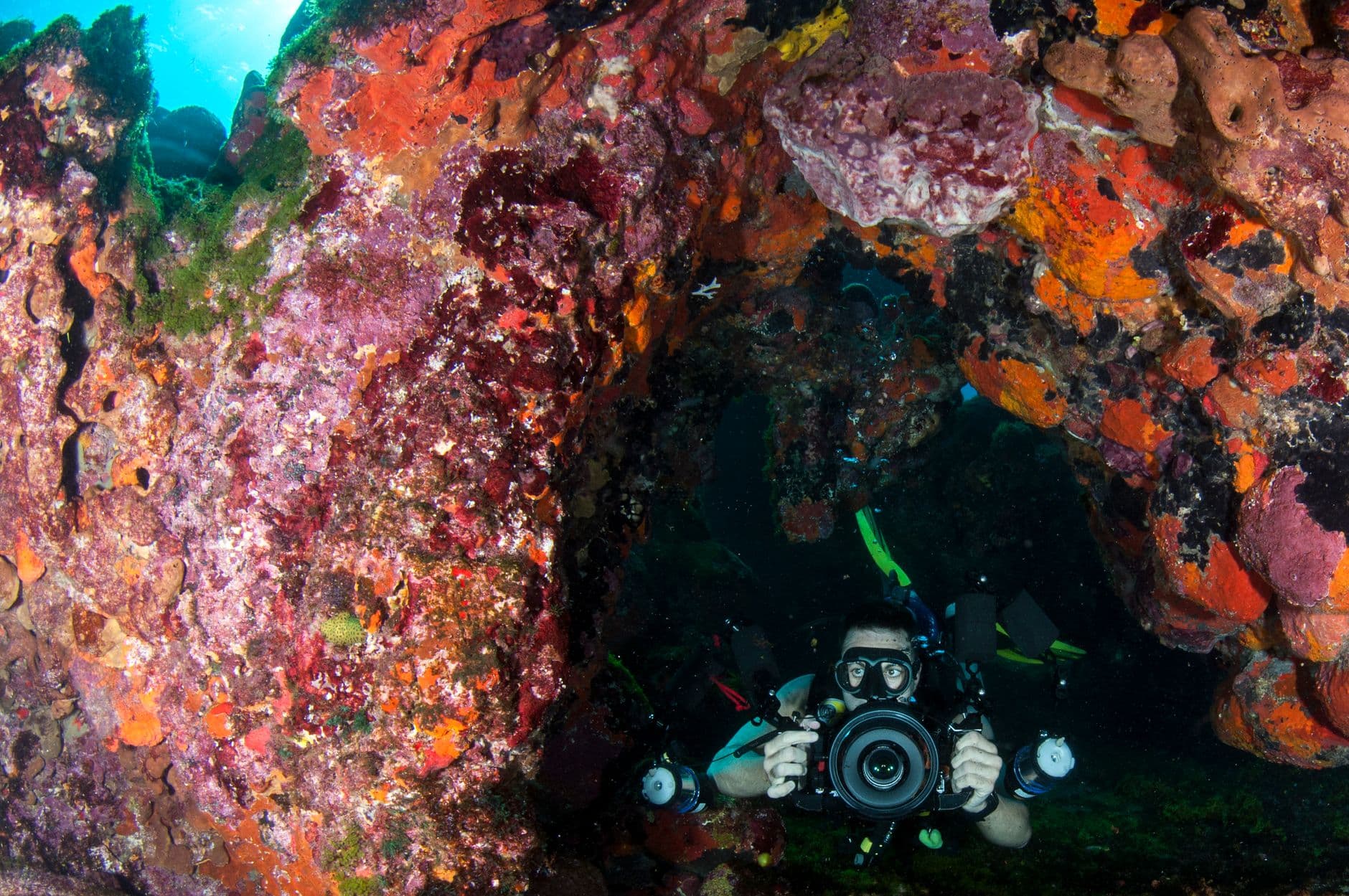
Malpelo is built from Miocene pillow lavas, volcanic breccias, and basaltic dikes dated to roughly 16–17 million years ago. There is no granite here and no coral-reef platform — the underwater terrain is dark volcanic rock: sheer walls, boulder fields, caverns, and detached pinnacles rising from deep water.
Above the surface the island is almost bare. Its highest point, Cerro de la Mona, stands about 360 meters above the sea. The terrestrial fauna is limited to three lizard species, an endemic land crab (Johngarthia malpilensis), and seabirds — including a Nazca booby colony estimated at 60,000–110,000 birds in a 2007 survey, one of the largest known. Malpelo has no native land mammals. A Colombian Navy detachment is stationed on the island permanently; there is nothing else.
The Dive Zones
Roughly fifteen named dive sites ring the island and its offshore seamounts. They group into a few recognisable types.
The Signature Pinnacle: El Bajo del Monstruo
El Bajo del Monstruo — the Monster's Shoal — is Malpelo's best-known site and the anchor of most itineraries. A submerged pinnacle rises from deep water to within about 18 meters of the surface and drops away past 50 meters. It is the island's primary hammerhead cleaning station: schools of several hundred scalloped hammerheads circle the summit, smalltooth sand tigers are reported on the deeper faces, and silky and Galápagos sharks work the edges.
The standard plan is a negative entry from the tender, an immediate descent to 25–30 meters, a reef hook into bare rock on the pinnacle's lee side, and then patience. Current across the summit commonly runs 1–3 knots.
The Cold-Water Sites: La Nevera and El Freezer
La Nevera — the Icebox — is a wall and pinnacle site where cold upwelling produces a distinct thermocline at roughly 15–25 meters. Below it the water can drop to 16–18 °C, six to twelve degrees colder than the surface layer. The temperature boundary itself is the attraction: it concentrates pelagic activity, and the visual distortion where the layers meet is dramatic. The profile ranges from about 5 meters down past 45.
El Freezer, on the island's south face, works the same way — a deep wall where the thermocline drops to 16–18 °C, with strong down-currents and a reputation for whale shark and Galápagos shark encounters during the plankton-rich months.
Both sites are the reason Malpelo needs more thermal protection than its latitude suggests.
The Offshore Seamounts: El Bajo de Virginia, La Gringa, Los Gemelos
El Bajo de Virginia is a seamount roughly 1.5 kilometers southwest of the island, 20–50 meters, with hammerheads, silky and Galápagos sharks, and periodic whale shark and manta encounters. Current is always present and can exceed 2 knots, so hook dives are standard.
La Gringa is a seamount about 3 kilometers from the island, 25–50 meters, and one of the sites where divers most consistently encounter the smalltooth sand tiger during the day.
Los Gemelos — the Twins — are two parallel seamounts rising to about 25 meters, joined by a sandy channel at around 40 meters. Pelagics funnel through the channel; eagle rays patrol the peaks. Deep, with strong and variable current.
These are the most demanding profiles at Malpelo: deep, offshore, and fully exposed.
The Walls: La Pared del Náufrago and El Bajón
La Pared del Náufrago — the Castaway's Wall — drops past 60 meters on the island's western side. Current sweeps nutrients up the wall face, and the blue water off it produces dolphins, sailfish, large silky sharks, and occasional ocean sunfish.
El Bajón is a sheer wall on the north face running from about 10 meters to past 50, exposed to plankton-rich water that draws schooling hammerheads at depth and passing whale sharks. Expect strong, unpredictable current.
The Topography Sites: La Catedral, Las Columnas, La Cueva del Antiguo Peruano
La Catedral is an amphitheatre of rock buttresses on the southeast face, forming canyons and overhangs at 15–35 meters, with whitetip reef sharks resting in the sandy alleys below, plus octopus, lobsters, and bigeye trevally. Moderate current.
Las Columnas are vertical rock spires standing 15–20 meters off the sandy bottom on the east coast, with narrow canyons between them that divers drift through. La Cueva del Antiguo Peruano is a cavern swim-through at about 25 meters on the southern side — short, but genuinely overhead, so cavern experience matters.
The Gentler Sites: El Arrecife, El Mirador, El Aerolito
El Arrecife slopes from 5 to past 40 meters on the eastern side and is commonly used as the trip's check-out dive. El Mirador is a shallow plateau at 12–25 meters on the north side, a sensible third or fourth dive of the day. El Aerolito is a boulder-field slope at 12–30 meters on the east side, with more small-subject life than anywhere else at Malpelo.
Los Mosqueteros — the Three Musketeers — are three rock pinnacles off the northern tip at 10–35 meters, with whitetip reef sharks in the gullies between them and rays overhead. Moderate to strong current.
Marine Megafauna: What You Are Likely to See
Malpelo Ridge is a designated Important Shark and Ray Area. The species below are the ones divers realistically encounter; seasons indicate when sightings are most likely, not when a species is guaranteed.
Sharks
| Species | Best Season | Reliability | Depth Range |
|---|---|---|---|
| Scalloped hammerhead (Sphyrna lewini) | Year-round (densest Dec–Apr) | Very high (schools of 200–500) | 18–35 m |
| Silky shark (Carcharhinus falciformis) | Year-round (strongest Apr–Jul) | Very high | 5–35 m |
| Whitetip reef shark (Triaenodon obesus) | Year-round | Very high (most sites) | 5–35 m |
| Galápagos shark (Carcharhinus galapagensis) | Year-round | High | 20–40 m |
| Smalltooth sand tiger (Odontaspis ferox) | Year-round | Moderate — rare elsewhere, plausible here | 25–40 m |
| Whale shark (Rhincodon typus) | Jun–Oct | Occasional | 5–30 m |
| Tiger shark (Galeocerdo cuvier) | Year-round | Occasional | 15–30 m |
| Silvertip shark (Carcharhinus albimarginatus) | Year-round | Occasional | 20–40 m |
| Pelagic thresher (Alopias pelagicus) | Year-round | Rare | 20–40 m |
Rays
| Species | Best Season | Reliability | Notes |
|---|---|---|---|
| Giant oceanic manta (Mobula birostris) | May–Oct | Moderate–high | Wingspan up to about 7 m; visits cleaning stations |
| Pacific eagle ray (Aetobatus laticeps) | Year-round | Moderate | Small groups over the pinnacles and boulder slopes |
| Mobula / devil rays (Mobula spp.) | Year-round | Occasional | Usually in the blue, sometimes in numbers |
The blacktip reef shark (Carcharhinus melanopterus) and the marbled ray (Taeniurops meyeni) are sometimes listed for Malpelo. Neither belongs here: the blacktip reef shark is an Indo-Pacific species that does not occur in the Eastern Pacific at all, and the marbled ray's Eastern Pacific records come from Cocos Island and the Galápagos, not Malpelo.
Large Bony Fish
Yellowfin tuna patrol the blue water around the pinnacles. Bigeye trevally form dense schools, particularly around Los Mosqueteros and the deeper walls. Pacific creolefish blanket the pinnacle tops. Closer in, the rock holds snappers, groupers, moray eels, and — around the boulder fields — a surprising amount of small-subject life for a destination this pelagic.
When to Go
Malpelo sits about 4° north of the equator and has no winter in the temperate sense. The year divides into two periods driven by the position of the Intertropical Convergence Zone.
| Season | Months | Surface Temp | Below Thermocline | Visibility | Character |
|---|---|---|---|---|---|
| Cool / upwelling | Dec–Apr | 24–28 °C | 16–18 °C during strong upwelling | 10–25 m | Dry and sunny but often windy; peak productivity; densest hammerhead schools |
| Warm | May–Nov | 26–28 °C | 20–24 °C | 15–30 m | Calmer seas, more rain; mantas and whale sharks; silky sharks strongest Apr–Jul |
December–April is the period most divers target for hammerheads. Cold, nutrient-rich upwelling pushes productivity up, and the schools are at their densest. The trade-offs are real: the thermocline is shallower and much colder, plankton can cut visibility to 10 meters or less, and although the weather is dry and sunny it is also the windier half of the year.
May–November brings warmer, more stable surface water and generally calmer seas, along with more rain. This is when giant mantas and whale sharks are most likely, and silky shark and baitball activity is strongest from roughly April through July. Hammerheads are still present, typically in smaller schools.
Conditions at Malpelo vary far more than a seasonal table suggests. Trips a few weeks apart in the same season have recorded 27 °C at 30 meters on one and 15 °C in shallow water on another. Plan for the range, not the average.
Getting to Malpelo
Malpelo is reachable only by liveaboard. There is no airport, no hotel, no dive shop, and no shore access for visitors — the island itself is off-limits except to the Navy detachment and permitted researchers. The open-ocean crossing from Buenaventura takes roughly 30–36 hours each way.
The Journey
Step 1: Fly into Alfonso Bonilla Aragón International Airport (CLO) in Cali. Operators generally arrange the road transfer to the Pacific port of Buenaventura, around 3 hours.
Step 2: Board in Buenaventura. Most departures leave in the evening; with a passage of roughly 30–36 hours, the island comes up on the second morning.
Step 3: Dive at Malpelo. Itineraries commonly run a week or more at the island with several dives a day, all from tenders.
Step 4: The return crossing, again roughly 30–36 hours.
Permits and Access
Diving at Malpelo requires a permit from Parques Nacionales Naturales de Colombia, and access is deliberately capped — historically only one liveaboard operates at the island at a time, with a limited number of divers. Operators handle the sanctuary paperwork as part of the booking.
A sanctuary entrance fee applies per diver and is commonly collected on board in cash. Fee levels, vessel availability, and access rules are set by the sanctuary authority and change; confirm the current amounts and conditions with your operator before you travel, and budget for a fee you may need to pay in cash.
Malpelo trips are expensive relative to mainstream liveaboard destinations — the distance, the crossing, and the capped access all contribute. Confirm current rates directly with the operator rather than relying on published estimates.
Experience Requirements
Operators typically require an advanced certification, documented recent experience at depth and in current, and dive accident insurance with evacuation cover. Nitrox is standard practice here and is often required outright: the cleaning stations sit at 25–35 meters and the schedule is repetitive over many days.
Several sites — La Nevera, El Bajo de Virginia, La Gringa, Los Gemelos, El Bajón, and La Pared del Náufrago — run past 45 meters, and the wall goes considerably deeper than that. If your itinerary includes them, deep-diving experience beyond the basic advanced course is the honest prerequisite, and conservative gas planning is not optional. Confirm the exact requirements with your operator; they vary by vessel and by itinerary.
Entry and Logistics
Entry requirements: Travellers from the US, Canada, the EU, the UK, and Australia are generally visa-exempt for tourist stays of up to 90 days in Colombia. A passport valid for at least six months is required, and Colombia's online Check-Mig form must be completed between 1 and 72 hours before each flight in or out. Requirements change — verify the current rules for your nationality before booking.
Currency: Colombian peso (COP). US dollars are widely accepted in tourism, and liveaboards generally price in USD.
Language: Spanish is the official language. Liveaboard crews working international trips brief in English.
Safety and medical: This is the single most important planning factor. There is no airstrip, no clinic, and no recompression chamber on Malpelo, and the nearest recompression facilities are on the Colombian mainland — well over a day away by boat. Any medical emergency means either the crossing back or a weather-dependent at-sea transfer. Dive accident insurance with evacuation cover is required by operators and is genuinely load-bearing here. Dive conservatively, stay well inside no-decompression limits, and treat depth discipline as a hard rule rather than a guideline.
Seasickness: A 30–36 hour open-ocean passage in each direction is a real consideration. Bring medication, and start it before you sail rather than after you feel it.
Who Malpelo Is For
Malpelo suits divers who want:
- Consistent large-shark encounters — hammerhead schools, silky sharks, Galápagos sharks, and a genuine chance at the smalltooth sand tiger
- Advanced, current-exposed diving — hook-in technique, negative entries, and comfort in 1–3 knots are the baseline
- A liveaboard expedition — the crossing and the remoteness are part of the trip, not obstacles to it
- A fully protected sanctuary — a World Heritage site and Important Shark and Ray Area with no fishing pressure
Malpelo is a poor fit for:
- Divers new to current — every dive here involves it, and there is no sheltered alternative site to fall back on
- Reef and macro-focused divers — there is small-subject life, but it is not what the destination is for
- Non-divers — there are no beaches, no shore excursions, and no landings
- Divers with medical conditions requiring rapid evacuation — the distance from care is the constraint that should decide it
- Tight budgets — the cost of the crossing and the capped access make this an expensive trip
Conclusion
Malpelo is a demanding destination that asks for real experience and gives back encounters that are difficult to find anywhere else. The hammerhead aggregations at El Bajo del Monstruo are among the densest documented. The smalltooth sand tiger, almost never seen alive by divers, is a credible possibility on the deeper walls. The cold water at La Nevera and El Freezer is uncomfortable and is exactly what draws the animals in.
It is also 500 kilometers of open ocean from help, in strong current, with no infrastructure. Divers who go in prepared — thermally, physically, and in terms of dive discipline — get one of the best big-animal experiences in the Eastern Pacific. Divers who go in underprepared find out why the requirements exist.