10 Best Dive Sites in Lembeh Strait
Lembeh Strait has 55-70+ named dive sites across four zones: black-sand muck sites on the mainland side, coral reef sites on the Lembeh Island side, wrecks, and mixed sites. This ranking selects the ten that define the Lembeh experience — the sites that first-timers should not miss and that returning photographers will visit every trip.
1. Hairball 1 & 2 — The Most-Photographed Muck Site on Earth
Type: Muck (black volcanic sand) | Depth: 5–20m (max 30m) | Current: Very mild | Visibility: 5–15m | Skill: Beginner–Advanced
Hairball is the face of Lembeh. This black sand slope with sunken logs, bottles, and rocks is where National Geographic spent three weeks filming the black hairy frogfish in 2023-24. The species density here is extraordinary — you can see three species of frogfish on a single dive: hairy, painted, and giant.
Why it's #1: No other muck site on earth has the same combination of species density, photographic history, and accessibility. Hairball is a house reef for some resorts — zero boat time. The image of a black hairy frogfish on black sand is the defining photograph of macro diving.
Key species: Hairy frogfish (highest concentration anywhere), painted frogfish, flamboyant cuttlefish (eggs and hatchlings), common seahorse, wonderpus, coconut mimic octopus, long-arm octopus, Napoleon snake eels, Ambon scorpionfish, devilfish, dragonets, decorator crabs.
Pro tip: Night dives at Hairball are excellent. The frogfish become more active and you'll see species like the stargazer that bury in the sand during the day. Take a pointer — the frogfish may not move, but you need to see them first.
2. Jahir — The Definitive Night Dive
Type: Muck (pure black sand) | Depth: 5–28m (max 30m) | Current: Mild — diveable all day | Visibility: 10–20m | Skill: Beginner–Advanced
Named after the local guide who discovered it, Jahir is a large stretch of black volcanic sand with coral blocks and purple heart urchins. It's arguably the best night dive in Lembeh — possibly the best night dive anywhere in the world.
Why it's #2: Jahir's night dive is legendary. Bobtail squid, tropical bobtail squid, starry night octopus, and stargazers are regulars. During the day, the site delivers frogfish, mimic octopus, flamboyant cuttlefish, and mantis shrimp with eggs.
Key species: Hairy frogfish (one observed resting on sea urchin spines — courtship behaviour), giant frogfish (on shallow buoy line), mimic octopus, flamboyant cuttlefish, ornate ghost pipefish, Ambon scorpionfish, painted frogfish.
Pro tip: The large stretch means you can dive Jahir repeatedly without covering the same ground. Ask your guide to target the urchin patches for zebra crabs and to spend extra time at the coral blocks where frogfish and octopus hide.
3. Nudi Falls — Wall-to-Rubble Critter Highway
Type: Wall & Rubble | Depth: 3–28m | Current: None–Medium | Visibility: 10–20m | Skill: Beginner–Advanced
Nudi Falls is a vertical rock wall (3-20m) that transitions to a rubble slope with soft corals, then deeper sand. The diversity across the three microhabitats makes this a single dive that feels like three.
Why it's #3: This is the best site for nudibranch diversity in Lembeh — Goniobranchus kuniei, Nembrotha spp., and Risbecia tryoni are regulars, with mass mating events recorded. It's also a reliable site for the endemic Lembeh seadragon (Kyonemichthys rumengani), found nowhere else on earth.
Key species: Nudibranchs (Goniobranchus kuniei, Nembrotha spp., Risbecia tryoni — mass mating seen), pygmy seahorses (on sea fans), flamboyant cuttlefish, blue-ringed octopus, Lembeh seadragon, rhinopias scorpionfish, giant frogfish, Banggai cardinalfish, flying gurnards, mantis shrimp, ribbon eels.
Pro tip: The water at Nudi Falls is often cooler by 1-2°C than Bunaken — plan for it. The rubble slope is where most nudibranchs are found. Spanish dancers are a regular night sight here.
4. TK 1, 2, 3 (Teluk Kembahu) — Where Mimic Octopus Was Discovered
Type: Muck (village bay) | Depth: 5–25m | Current: Mild | Visibility: 5–15m | Skill: Beginner–Advanced
TK is historically the most important site in Lembeh: the mimic octopus was first observed here by a dive guide who noticed an octopus changing shape to imitate a flounder. Today it remains the most reliable site for mimic octopus and wonderpus sightings.
Why it's #4: The mimic octopus discovery alone makes this site iconic. Three spots (TK 1, 2, 3) with slightly different terrain offer variety. The village bay environment with debris of wood and fishing nets attracts species that thrive around human structures.
Key species: Mimic octopus (★ type location), wonderpus, coconut octopus, ornate ghost pipefish, mandarinfish (dusk mating dance), Banggai cardinalfish, white devil scorpionfish, spiny devilfish, giant/painted frogfish, porcelain crabs, purple commensal shrimp, finger dragonet, yellow-barred jawfish, ribbon eels.
Pro tip: Ask your guide to be in position for the dusk mandarinfish display — this is one of the more reliable sites in Lembeh for it. March–May and September–November are the best months.
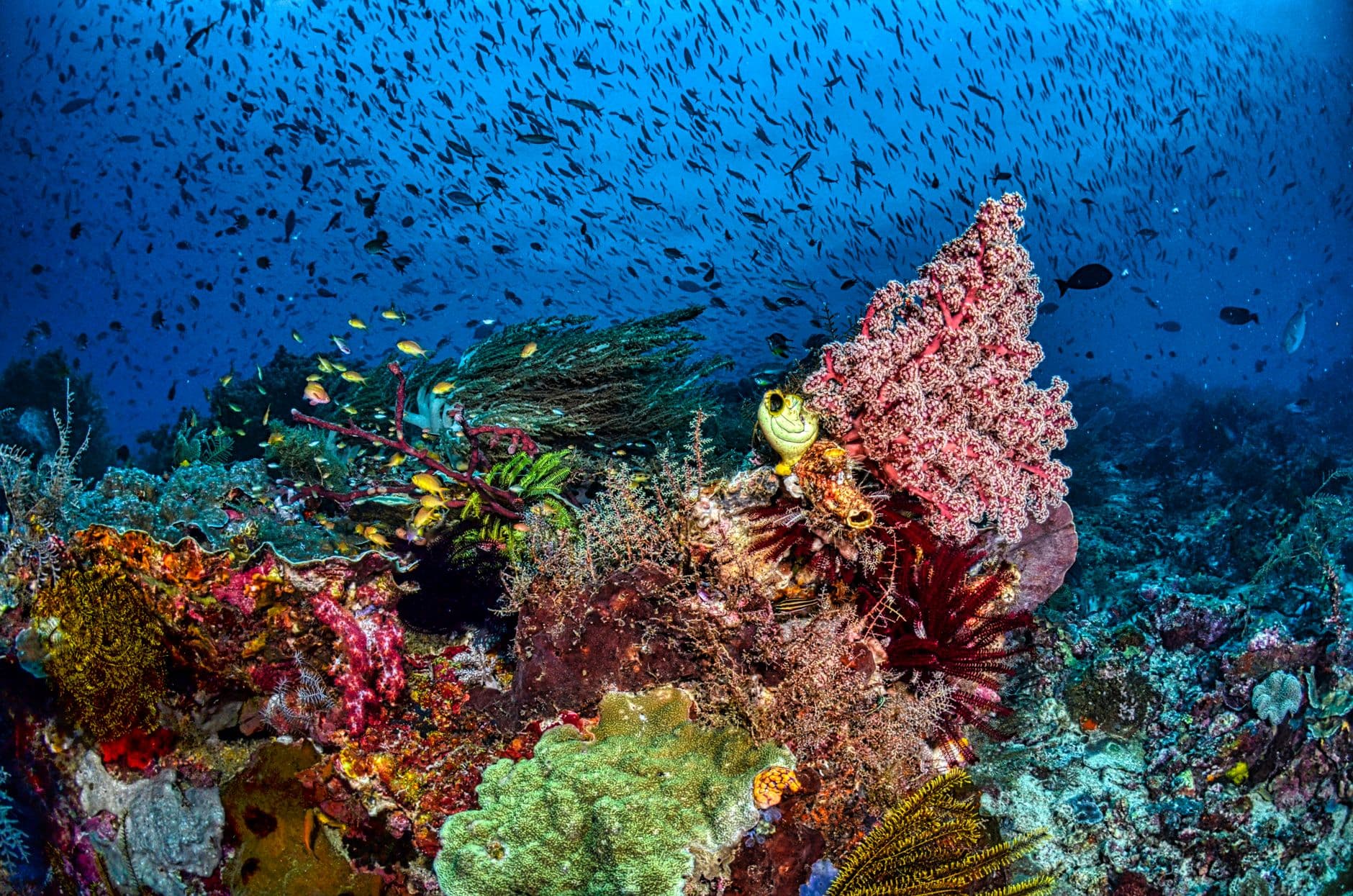
5. Angel's Window — Lembeh's Signature Reef Site
Type: Reef (coral pinnacle) | Depth: 5–30m | Current: Mild–Medium | Visibility: 15–25m | Skill: Intermediate–Advanced
Angel's Window is the change of pace every Lembeh diver needs. A twin-peaked coral pinnacle with a cave swim-through at 22-25m where morning sunlight streams through, creating the "window" effect. This is Lembeh's only dedicated swim-through site.
Why it's #5: If your dive buddy is getting tired of black sand, Angel's Window delivers the reef experience — vast soft corals, pinnacle structure, and pelagic visitors. Pygmy seahorses (both Bargibanti and Pontohi) are essentially guaranteed at the sea fans.
Key species: Pygmy seahorses — Bargibanti and Pontohi (guaranteed), twin-spot lionfish, robust ghost pipefish, hairy shrimp, red octopus, nudibranchs, pinnate batfish, huge stonefish, anthias, occasional pelagics.
Pro tip: Go early. Morning sunlight through the swim-through creates spectacular photo conditions. A wide-angle lens for the entry shot and a macro for the pygmy seahorses make this a two-lens dive.
6. Police Pier — The Definitive Lembeh Night Dive
Type: Jetty / Muck | Depth: 5–25m | Current: Mild | Visibility: 5–15m | Skill: Beginner–Advanced
Police Pier is the single most famous night dive in the muck diving world. Harlequin shrimp, waspfishes, and stargazers are just the start. This is where underwater photographers go when they want to shoot species they've only seen in books.
Why it's #6: No site delivers the same diversity of rare species on a single night dive. Bobbit worms (1m+ ambush predators), starry night octopus, harlequin shrimp pairs, and free-swimming morays are regulars. The pier structure with garbage and "treasures" creates an urban-muck aesthetic that is uniquely Lembeh.
Key species: Harlequin shrimp, cockatoo waspfish, Barramundi cod, Banggai cardinalfish (hundreds), orange painted frogfish, snake eels with cleaner shrimp, stargazers, free-swimming morays, flamboyant cuttlefish, long-arm octopus, finger dragonets, Bobbit worms.
Pro tip: Note that the site has degraded somewhat since 2006 due to cruise ship traffic — but it still delivers. Go with an experienced Lembeh guide who knows the current structure. A narrow-beam torch is essential for picking out eyeshine.
7. Nudi Retreat — Protected Cove with Rare Species
Type: Muck & Reef (protected cove) | Depth: 3–28m | Current: None–Mild (best on slack tide) | Visibility: 5–15m | Skill: Beginner–Advanced
Nudi Retreat is a small protected cove on the Bitung side with a reef slope transitioning to a sandy slope with encrusted boulders. Two mini walls on either side of the cove add structure. The enclosed geography concentrates species.
Why it's #7: This site reliably delivers Coleman shrimp (rare), Pegasus sea moths, and skeleton shrimp — species that photographers travel specifically to find. The electric clam (pulsing red light) is a famous night highlight.
Key species: Pygmy seahorses (Bargibanti, Denise), Pegasus sea moths, Coleman shrimp (rare), frogfish, skeleton shrimp, various gobies, Banggai cardinalfish, nudibranchs (wide variety), cockatoo waspfish, coral catshark.
Pro tip: The electric clam at night is worth the trip alone. It pulses red bioluminescence — a rare sight that only a handful of sites in the world offer. Ask your guide if it has been seen recently.
8. California Dreaming (Pulau Putus) — Three Species of Pygmy Seahorse
Type: Reef (coral garden) | Depth: 5–28m | Current: Mild–Medium | Visibility: 15–25m | Skill: Intermediate
California Dreaming is one of the rare coral sites in Lembeh, named for the gorgeous soft corals at 24-28m. It's the only site in the strait where divers reliably find three species of pygmy seahorse on a single dive: Bargibanti, Pontohi, and Denise.
Why it's #8: Three pygmy seahorse species on one dive is a world-class claim. The soft coral gardens are beautiful enough to make this a recommended change of pace even for divers who don't care about pygmys.
Key species: Pygmy seahorses (Bargibanti, Pontohi, Denise — three species), boxer crabs, colourful reef fish.
Pro tip: Use a torch even on day dives here — the soft corals reveal their full colour with active lighting. A wide-angle shot with a diver silhouette against the coral garden is a classic Lembeh image. The site may have a surcharge from some operators due to the distance.
9. Mawali Wreck (Tanduk Rusa) — WWII Freighter
Type: Wreck | Depth: 15–30m | Current: Mild–Medium | Visibility: 10–20m | Skill: Intermediate–Advanced
Mawali is a 60m Japanese WWII freighter lying on its side, heavily encrusted with crinoids, black coral, and soft corals. It is the best wreck in the strait and a reliable change from the muck-and-reef rotation.
Why it's #9: Lembeh rarely gets full credit for its wreck diving. Four wrecks within recreational limits is unusual for a muck destination. Mawali delivers a genuine wreck experience — structure, marine growth, and macro life on the hull.
Key species: Large scorpionfish, lionfish, spotted barramundi cod, crabs, nudibranchs, pipefish. The buoy line is covered in life — a great safety stop.
Pro tip: The wreck is on its side, so orient yourself to avoid disorientation. The hull is heavily encrusted — spend time scanning it for macro life before moving to the open structure.
10. Makawidi 1 & 2 — Rhinopias Central
Type: Mixed (muck & reef) | Depth: 5–29m | Current: None–Mild | Visibility: 10–20m | Skill: Beginner–Advanced
Makawidi sits between Jahir and Nudi Retreat, with hard and soft corals in the shallows transitioning to a deep sandy slope with rubble. It's the most reliable rhinopias site in the strait.
Why it's #10: Rhinopias scorpionfish — the elaborately camouflaged "devil fish" — are the holy grail for many macro photographers. Makawidi produces regular sightings, including the rare purple and yellow varieties. The site also offers lacy scorpionfish that can stay in one spot for 6-7 months.
Key species: Rhinopias (prefers cold water), lacy scorpionfish (purple & yellow varieties), reef octopus, blue-ringed octopus, wonderpus, hairy octopus, flamboyant cuttlefish, many nudibranchs (especially Bullocki — purple body, yellow gills), hairy/painted frogfish, red seahorses, ornate ghost pipefish, black coral crabs, Pontohi pygmy seahorse on sea whips.
Pro tip: Visit in August–October (coolest water) when rhinopias are most reliably found. Your guide will know which resident specimens are present — the lacy scorpionfish "purple and yellow" pair at Makawidi stayed in the same spot for 6-7 months.
Honorable Mentions
- Aer Perang 1-3 — WWII warship blast-hole history; excellent night dive with stargazers and bubble shells
- Critter Hunt — Blue-ringed octopus and ornate ghost pipefish in an open sand plain setting
- Serena Patah — Strong current on rising tide but produces wonderpus and blue-ringed octopus on the falling tide
- Batu Kapal — Advanced drift dive at the northern entrance; big pelagics, strong current
- Pantai Parigi — The only white sand muck site in Lembeh; unique geology and species mix
- Sondai — Reliable frogfish, scorpionfish, and nudibranch rotation
Planning Your Dive Week
For a 5-7 day stay, aim for this mix:
- Day 1-2: Hairball + Jahir + TK — the classic muck starter pack
- Day 3: Angel's Window + California Dreaming — reef day for a change of pace
- Day 4: Nudi Falls + Nudi Retreat — nudibranch and macro specialist day
- Day 5: Police Pier (night) + Mawali Wreck — night dive and wreck combo
- Day 6: Makawidi + Aer Perang — rhinopias hunt and muck variety
- Night dives: Jahir and Police Pier are essential night dives — book at least two
- Optional: Bunaken day trip (30-60 min boat) for wall diving — the "Walls & Muck Safari"
Work with your resort dive centre to adjust this plan for seasonal conditions, and always ask about recent critter sightings before each dive.