Iceland Silfra Diving: The Ultimate Guide to Diving Between Continents
Silfra is where the Earth reveals its seams.
This Icelandic fissure sits inside Þingvellir National Park, a UNESCO World Heritage Site, at the exact point where the Mid-Atlantic Ridge — the divergent boundary between the North American and Eurasian tectonic plates — cracks the surface. The water in Silfra has been filtered through porous underground lava for 30 to 100 years before reaching the fissure, producing some of the clearest freshwater diving on the planet. Visibility regularly exceeds 100 meters, and on exceptional days reaches 200 meters. The water temperature stays at a constant 2–4 °C (35–39 °F) year-round, fed by glacial melt from Langjökull, Iceland's second-largest glacier.
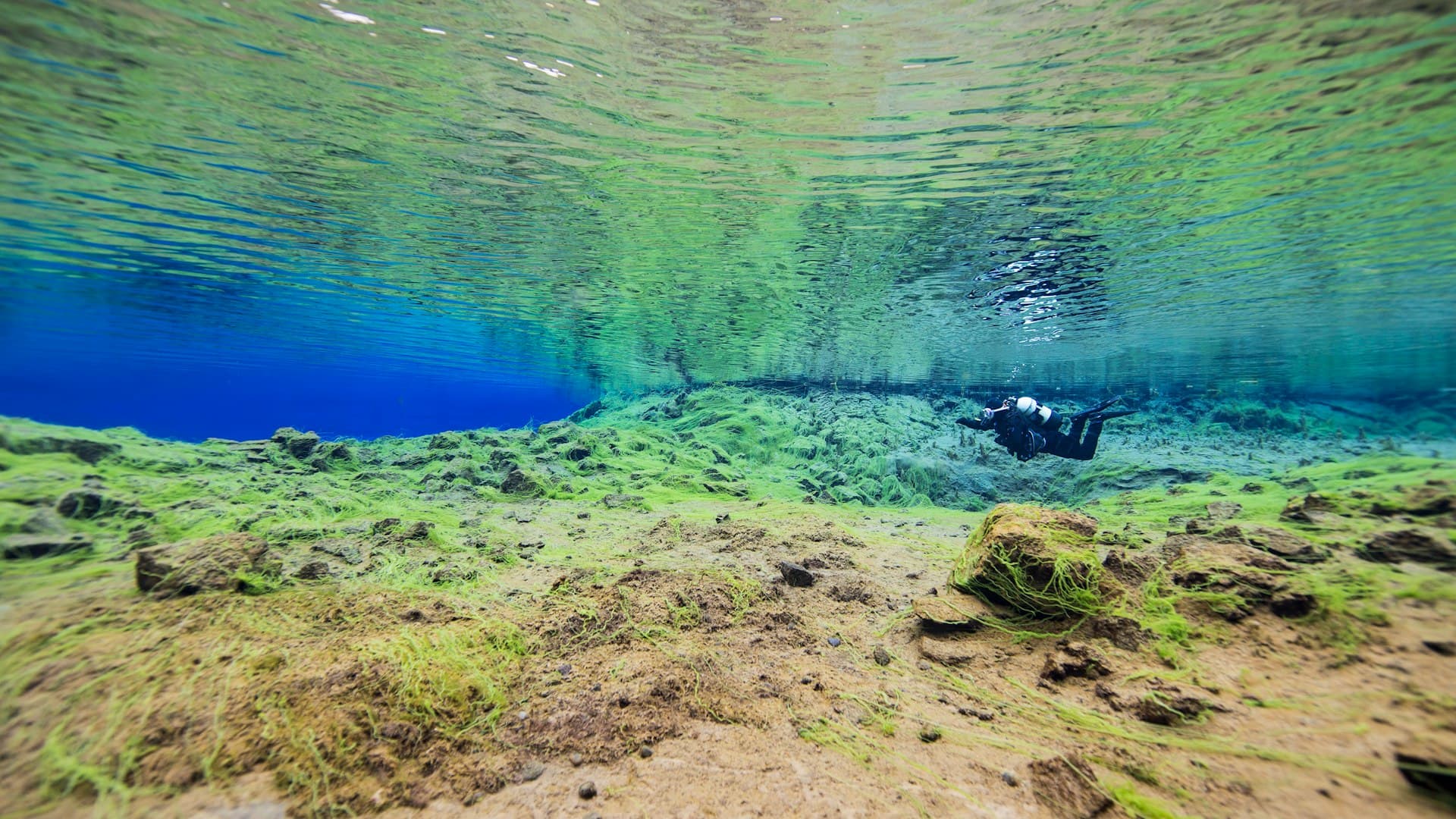
Silfra is not a tropical reef. There are no corals, no colorful fish, no warm water. What Silfra offers is something no other dive destination in the world can provide: the ability to swim along a continental rift, with one hand on the North American plate and the other on the Eurasian plate, in water so pure you could drink it. The underwater landscape is a cathedral of lava rock formations, algae-covered walls, and an otherworldly clarity that makes every dive feel like floating through liquid glass.
What Makes Silfra Unique
The Mid-Atlantic Ridge Underwater
Silfra is the only place in the world where you can dive directly on a continental rift. The fissure was formed by earthquakes that cracked the Earth's crust, and the two plates continue to separate at approximately 2 centimeters per year. As you swim through Silfra, you are literally swimming between continents. The geological significance cannot be overstated — this is a living example of plate tectonics, visible from the surface and fully accessible to divers.
The fissure runs through Þingvallavatn, the largest natural lake in Iceland, which sits at 84 meters above sea level. The lake itself was formed by volcanic activity thousands of years ago, and Silfra is one of the few outlets through which the lake drains. The water's extraordinary clarity comes from its journey: glacial melt from Langjökull travels through underground aquifers and porous lava rock for decades before emerging in the fissure, during which time every particle is filtered out.
The Three Sections: Hall, Cathedral, and Lagoon
The Silfra fissure system is divided into three distinct sections, each offering a different experience:
Silfra Hall is the widest section of the fissure, with lava rock walls that create an impressive underwater corridor. This is the most popular section for guided tours, offering visibility at its best and the widest underwater space. Depth ranges from 10 to 20 meters (33–66 feet), making it accessible to intermediate divers. The entry is via shore access using steps and a platform built into the fissure wall.
Silfra Cathedral is the narrowest and longest section, resembling a gothic cathedral with walls closing in overhead. The light penetration here is exceptional — sunlight filters through the crystal-clear water in dramatic shafts that illuminate the lava rock textures. Depth ranges from 15 to 25 meters (49–82 feet), and this section requires intermediate to advanced diving skills due to the longer swim and potential for silt disturbance.
Silfra Lagoon is the shallowest and widest section, located at the end of the fissure. With a depth of 5 to 15 meters (16–49 feet), this is the most beginner-friendly section and often used for training. The sandy bottom and open space provide a stark contrast to the narrow walls of the other sections.
The Freshwater Environment
Unlike ocean diving, Silfra is a freshwater environment with virtually no marine life. The extreme cold and low nutrient levels mean that only the hardiest algae can survive in the fissure. There are no fish, no invertebrates, no corals. This biological simplicity is precisely what creates the extraordinary visibility — there are no plankton or suspended particles to scatter light. Any biological matter that enters the system gets filtered out by the lava rock almost immediately.
Arctic char (Salvelinus alpinus) and brown trout (Salmo trutta) are native to Þingvallavatn and occasionally move through the clear spring-fed channels connected to the Silfra system, though they are rarely seen inside the fissure itself. These freshwater species add a subtle biological dimension to the dive but are not the primary draw.
Who Silfra Is For
Silfra is not a casual destination. It is a bucket-list dive site that demands preparation, proper equipment, and respect for its fragile environment. The diving is ideal for:
- Bucket-list divers — Silfra is consistently ranked among the top dive sites in the world by international diving publications. It is a once-in-a-lifetime experience that most divers encounter only once.
- Geology enthusiasts — If you are fascinated by plate tectonics, volcanic landscapes, and the raw power of the Earth's crust, Silfra is the ultimate classroom.
- Cold-water divers — The 2–4 °C water temperature requires a drysuit, and the experience of diving in extreme cold is unlike anything in tropical destinations.
- Photographers — The clarity of Silfra water makes it one of the best freshwater dive sites in the world for underwater photography. The light penetration, lava rock textures, and algae formations create stunning images.
Silfra is less suited for divers looking for warm water, colorful marine life, or casual reef diving. The experience is about geology, clarity, and the unique sense of swimming between continents.
The Dive Shops
Diving in Silfra must be conducted with certified guides from authorized operators. Independent diving is not permitted — this is a protected area within Þingvellir National Park, and all diving is strictly regulated to preserve the fragile ecosystem.
DIVE.IS
DIVE.IS is one of the most established operators at Silfra, offering both snorkeling and diving packages. They provide full equipment including drysuits, transportation from Reykjavik, and professional guides. Their Silfra tour page is available at dive.is/tours/silfra.
Extreme Iceland
Extreme Iceland (operated through Adventures.com) offers the Silfra Tectonic Plate Diving experience with comprehensive packages including equipment, transportation, and certified guides. Their tour page is available at extremeiceland.is/tours/silfra-tectonic-plate-diving/.
Other Known Operators
Additional operators include Arctic Adventures (arcticadventures.is/tour/silfra-tectonic-plate-diving/) and Guide to Iceland (guidetoiceland.is/tours/silfra-diving/). All operators require pre-booking and provide equipment, transportation from Reykjavik, and professional guides.
Practical Overview
Silfra is located in Þingvellir National Park, approximately 45–50 minutes drive from Reykjavik. The nearest airport is Keflavík International Airport (KEF), about one hour from the site. Most dive operators provide pickup service from Reykjavik or meeting points at the site.
The currency is the Icelandic Króna (ISK). Credit cards are widely accepted throughout Iceland. English is widely spoken in the tourism industry, and all dive operators provide services in English. The timezone is UTC+0 (Greenwich Mean Time, no daylight saving).
The diving is accessible year-round, but summer months (June–August) offer longer days, milder weather topside, and more tourist activity. Winter months (December–February) bring shorter days, potential surface ice, fewer crowds, and the possibility of seeing the Northern Lights after your dive.
Bottom Line
Silfra is the clearest freshwater dive site in the world and the only place where you can dive directly between two continental plates. The 100–200 meter visibility, the 2–4 °C glacial water, the lava rock formations, and the geological significance combine to create an experience that no tropical destination can match. It is a bucket-list dive that demands preparation — a drysuit is mandatory, and the cold water is no joke — but the reward is swimming through liquid glass between continents in water so pure you could drink it.