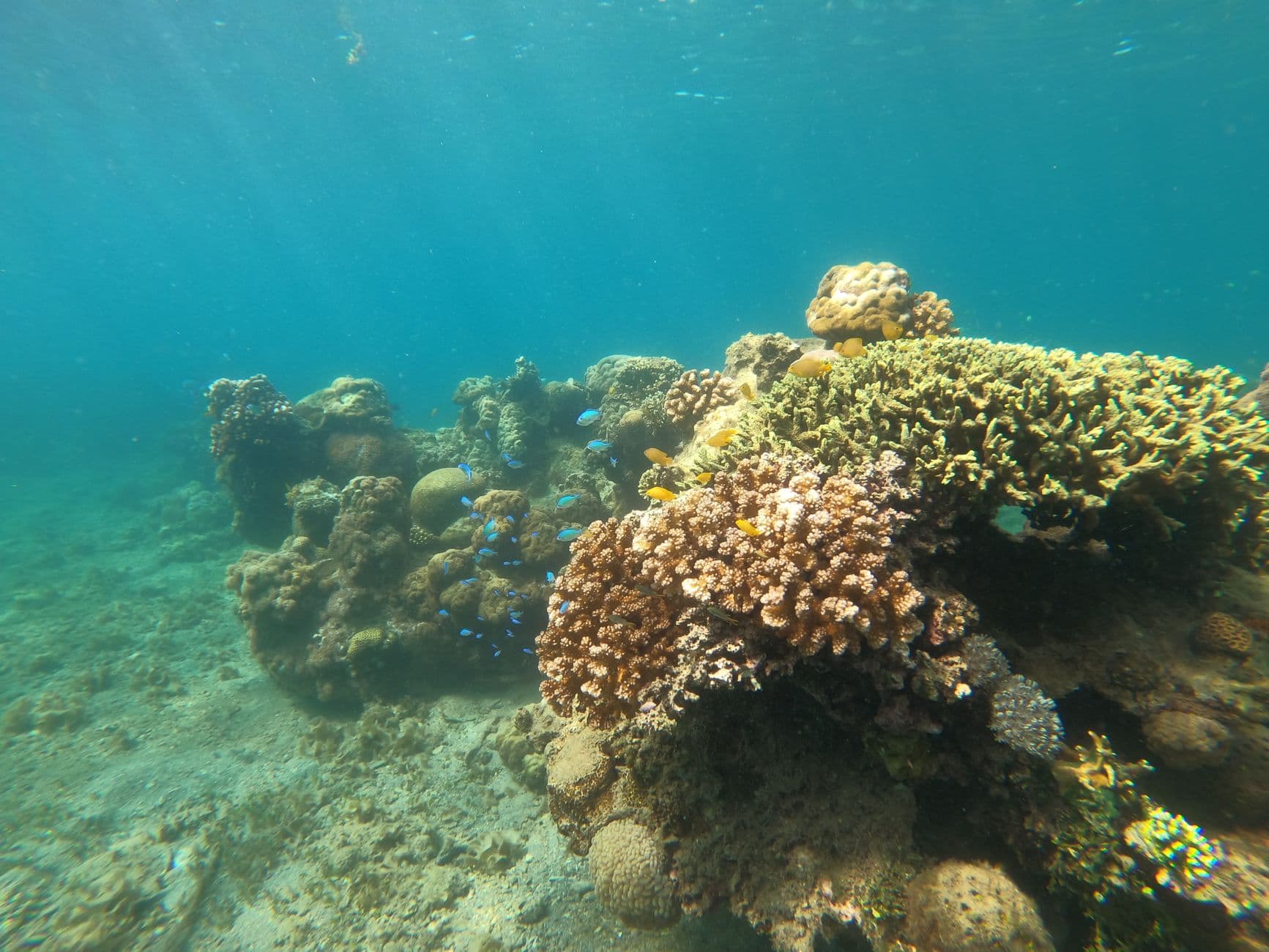
Top 10 Dive Sites in the Gili Islands: Turtles, Sharks, and Drift Diving
The Gili Islands' 22+ documented dive sites ring three small islands in the Lombok Strait, each with distinct characteristics shaped by exposure to tidal currents and proximity to deep water. The islands' small size means no site is more than 20 minutes from any harbour — you can dive three completely different sites in a single morning. This guide ranks the Gili Islands' top dive sites by overall experience, marine life density, and the quality of the underwater landscape.
1. Shark Point
Type: Reef / Drift | Depth: 5–50 m | Access: Boat (northwest Gili T, 10 min) | Difficulty: Beginner–Advanced | Best season: Year-round (peak: April–October for visibility)
The signature dive site of Gili Trawangan and arguably the most reliable shark dive in Indonesia outside of protected marine reserves. A flat sandy bottom gives way to deep parallel canyons and ridges that drop to 50 metres, with shallow seagrass beds and coral bommies hosting large turtle populations between the canyon heads. A tugboat wreck sits at approximately 30 metres on the sand.
Whitetip and blacktip reef sharks are virtually guaranteed — the site earns its name honestly. Green and hawksbill turtles are present on every dive. The highlight, however, is the full moon bumphead parrotfish spawning aggregation: hundreds of Bolbometopon muricatum, each over a metre long, gather in the water column above the canyons in a spectacle that rivals any fish aggregation in the Coral Triangle.
Marine life highlights: Whitetip reef shark (guaranteed), blacktip reef shark (guaranteed), green turtle (guaranteed), hawksbill turtle (common), bumphead parrotfish (full moon), blue-spotted ribbontail ray, giant trevally.
Who should dive it: Every level — the shallow section (5–18 m) is beginner-friendly. The deep canyons (30–50 m) require advanced certification and good air consumption. Most operators run Shark Point as a two-level dive: beginners stay in the shallows while advanced divers drop into the canyons with a separate guide.
2. Halik & Deep Halik
Type: Drift | Depth: 6–40 m | Access: Boat (northwest Gili T, 10 min) | Difficulty: Beginner–Advanced | Best season: Year-round
Halik is the textbook Gili drift dive — the current here is consistent and predictable, running parallel to the reef. Shallow Halik (6–22 m) features rolling coral fields with barrel sponges, gorgonian sea fans, and canyons that channel the current smoothly. Deep Halik (22–40 m) descends into ridgelines and deeper canyons patrolled by eagle rays, giant trevally, and reef sharks.
This is also the premier site for bumphead parrotfish aggregations during full moons. The combination of consistent drift, varied depth, and reliable large-animal encounters makes Halik a close second to Shark Point for overall dive quality.
Marine life highlights: Octopus (common), lionfish (common), moray eels, groupers, bumphead parrotfish (full moon), eagle rays, giant trevally, whitetip reef shark.
Who should dive it: Drift diving experience is helpful but not required — the current is manageable at shallow depths. Deep Halik requires intermediate certification. The full moon aggregation is the single best reason to time a Gili trip around the lunar calendar.
3. Turbo & Deep Turbo
Type: Pinnacle / Drift | Depth: 16–32 m | Access: Boat (northeast Gili T, 10 min) | Difficulty: Intermediate–Advanced | Best season: Year-round (April–October best visibility)
Massive coral pinnacles rising from a sandy bottom, described by divers as "flying through space looking down on the moon." The pinnacle landscape is unlike anything else in the Gilis — enormous coral formations and giant sea fans growing on submerged seamounts that rise from the 1,200-metre-deep Lombok Strait floor. The Venturi effect between pinnacles accelerates the current, making this a pure drift dive with an out-of-this-world visual experience.
Redtooth triggerfish, fusiliers, batfish, and snappers school around the pinnacle tops. Whitetip and blacktip reef sharks patrol the deeper sections alongside the occasional leopard shark. Pygmy seahorses hide on gorgonian fans. Nitrox is recommended for Deep Turbo to maximise bottom time at 22–32 metres.
Marine life highlights: Pygmy seahorse (gorgonian fans), leopard shark (occasional), whitetip reef shark, blacktip reef shark, redtooth triggerfish, fusiliers, leaf scorpionfish, bluespotted ribbontail ray.
Who should dive it: Intermediate and above. Shallow Turbo (5–16 m, adjacent site) is beginner-friendly and makes an excellent night dive.
4. Sunset Reef (Manta Point)
Type: Reef | Depth: 5–22 m | Access: Boat (southwest Gili T, 15 min) | Difficulty: Beginner | Best season: Manta rays December–March; turtles, sharks year-round
A gradually sloping reef on Gili Trawangan's southwest coast famous for sunset surface intervals and the Gilis' best manta ray encounters. Table corals, staghorn corals, and cabbage corals cascade from 5 m to 22 m in a classic fringing reef profile. The site functions as a cleaning station, attracting whitetip reef sharks that rest on sand patches and schooling midnight snappers.
The seasonal draw is the manta ray visitation between December and March, driven by nutrient-rich upwelling during the northwest monsoon — the opposite seasonal pattern from most manta destinations, which means you can combine a Gili Islands trip in January with manta encounters that would be winter-season misses elsewhere. Green and hawksbill turtles are present year-round.
Marine life highlights: Oceanic manta ray (Dec–Mar, occasional), whitetip reef shark, green turtle, hawksbill turtle, midnight snapper (schooling), sweetlips, batfish.
Who should dive it: All levels. The mildest conditions of any top-tier Gili site. Best afternoon dive on Gili T thanks to the sunset surface interval.
5. Bio Rocks (Biorock)
Type: Artificial Reef | Depth: 15–25 m | Access: Boat / Shore (east Gili T, 5 min) | Difficulty: Beginner | Best season: Year-round
The second-largest Biorock coral restoration site on Earth. Over 120 low-voltage metal structures stimulate coral growth at five times the natural rate, creating an artificial reef that has been developing since the early 2000s. Supported by Trawangan Dive and the Gili Eco Trust, this site is a global model for reef restoration and one of the most photographed conservation projects in Indonesia.
Lionfish, sweetlips, batfish, trumpetfish, pufferfish, ornate ghost pipefish, and cuttlefish are drawn to the coral structures. The mild conditions and short boat ride make this an easy add-on to any Gili T dive day. Also accessible as a shore dive from the beach near Trawangan Dive.
Marine life highlights: Ornate ghost pipefish, cuttlefish, lionfish, sweetlips, batfish, trumpetfish.
Who should dive it: Every level, from first-timers to experienced divers interested in restoration science. The closest thing to a "must-do" conservation dive in the Gilis.
6. Meno Wall
Type: Wall | Depth: 5–35+ m | Access: Boat (Gili Meno, 10 min from Gili T) | Difficulty: Beginner–Intermediate | Best season: Year-round
Gili Meno's signature wall dive drops from a shallow reef flat to 35 metres and continues beyond recreational limits. Gorgonian sea fans, barrel sponges, and soft corals cover the wall face, which is oriented to catch the prevailing current and bring plankton-feeding fish into easy range. The wall's proximity to deep water attracts larger pelagic species.
Meno Wall is also one of the Gilis' best night dives — the wall face lights up with feeding crinoids, and hunting cuttlefish, sleeping turtles, and octopus are regularly encountered on sunset-to-dark dives.
Marine life highlights: Green turtle (common), giant moray, cuttlefish, octopus, lionfish, fusiliers, sweetlips, batfish.
Who should dive it: All levels during the day. Night diving experience recommended for the sunset-to-dark dives. A must-do if you are staying on Gili Meno or want a wall dive experience in the Gilis.
7. Hans Reef (Muck Diving)
Type: Muck / Macro | Depth: 5–18 m | Access: Boat (Lombok coast near Gili Air, 15 min from Gili T) | Difficulty: Beginner | Best season: Year-round; peak macro April–October
The Gilis' premier muck diving site, located on the Lombok mainland coast near Gili Air. Dark volcanic sand and rubble substrate host an extraordinary concentration of cryptic marine life. Hans Reef is where underwater photographers come for pygmy seahorses, ornate ghost pipefish, harlequin shrimp, frogfish, nudibranchs, and blue-ringed octopus. The site is shallow enough for extended bottom times and forgiving enough for photographers to hover and compose shots without current stress.
Marine life highlights: Pygmy seahorse (occasional), ornate ghost pipefish, harlequin shrimp (rare), striated frogfish, blue-spotted ribbontail ray, leaf scorpionfish, nudibranchs (multiple species), blue-ringed octopus (rare).
Who should dive it: Macro photographers first and foremost. Beginners with a guide will enjoy the variety. Best dived with an experienced guide who knows where the resident critters live.
8. Bounty Wreck
Type: Wreck | Depth: 8–22 m | Access: Boat (between Gili Meno and Gili Air, 15 min from Gili T) | Difficulty: Beginner | Best season: Year-round
Not a real shipwreck, but Indonesia's most surreal underwater photo gallery. A collapsed wooden pier structure that was deliberately sunk, with coral-encrusted bicycles welded to the framework. The structure has developed into a productive artificial reef with schooling fish, lionfish, and the occasional turtle resting in the shade of the metal beams.
At 8–22 m depth with mild current, this is an accessible, relaxed dive that works as a second or third dive of the day or as an excellent night dive. The best light for photography is midday when the sun angle penetrates through the structure.
Marine life highlights: Schooling fish, lionfish, cuttlefish, green turtle (resting).
Who should dive it: All levels. Unusual photo opportunities. Night diving enthusiasts.
9. Simon's Reef
Type: Reef / Drift | Depth: 12–40 m | Access: Boat (between Gili T and Gili Meno, 15 min) | Difficulty: Advanced | Best season: April–October
A deeper site favoured by advanced divers who want bigger fish encounters. Simon's Reef sits in the channel between Gili Trawangan and Gili Meno where tidal currents concentrate baitfish and the predators that follow. Eagle rays, giant trevally, and reef sharks are reliably sighted. The reef structure features overhangs and swim-throughs that add interest to the drift profile.
The depth and current make this a site for intermediate and advanced divers. Nitrox is recommended for extended bottom time.
Marine life highlights: Eagle ray, giant trevally, whitetip reef shark, blacktip reef shark, barracuda, fusiliers, moray eel.
Who should dive it: Advanced divers comfortable with drift diving in moderate current. Not for beginners.
10. Mentigi (Lombok Coast)
Type: Muck | Depth: 5–15 m | Access: Boat (Lombok coast near Gili Air, 20 min from Gili T) | Difficulty: Beginner | Best season: Year-round
A muck diving and macro photography site on the Lombok coast, similar to Hans Reef but less frequented by the dive crowds. Dark sandy bottom with scattered rubble patches, seagrass beds, and occasional coral bommies. Mentigi is productive for frogfish, leaf scorpionfish, dragonets, pipefish, nudibranchs, and the occasional mimic octopus. The shallow depth means relaxed bottom times and easy photo compositions.
Marine life highlights: Striated frogfish, leaf scorpionfish, pipefish, nudibranchs, blue-spotted ribbontail ray, pipefish.
Who should dive it: Macro photographers who want a quieter alternative to Hans Reef. Beginners gaining buoyancy control — the forgiving shallow depth and mild current make it a relaxed environment.
Summary Table
| # | Site | Depth | Level | Best For |
|---|---|---|---|---|
| 1 | Shark Point | 5–50 m | Beginner–Advanced | Sharks, turtles, bumphead parrotfish |
| 2 | Halik | 6–40 m | Beginner–Advanced | Drift diving, pelagics, full moon aggregation |
| 3 | Turbo | 16–32 m | Intermediate–Advanced | Pinnacles, pygmy seahorses, drift |
| 4 | Sunset Reef | 5–22 m | Beginner | Manta rays (Dec–Mar), sunset, turtles |
| 5 | Bio Rocks | 15–25 m | Beginner | Conservation, coral restoration |
| 6 | Meno Wall | 5–35+ m | Beginner–Intermediate | Wall diving, night dives |
| 7 | Hans Reef | 5–18 m | Beginner | Macro photography, muck diving |
| 8 | Bounty Wreck | 8–22 m | Beginner | Wreck, photo ops, night dives |
| 9 | Simon's Reef | 12–40 m | Advanced | Big fish, eagle rays |
| 10 | Mentigi | 5–15 m | Beginner | Macro, muck, quiet alternative |
Site Selection Tips by Experience Level
First-time visitors: Start with Shark Point (shallow section), Bio Rocks, and Sunset Reef. These three sites cover the Gilis' range: shark/turtle encounters, conservation, and seasonal manta rays — all within beginner depth ranges and mild current conditions.
Experienced divers: Prioritise Deep Turbo, Deep Halik, and Simon's Reef. The pinnacle landscape at Turbo and the consistent large-animal action at Halik and Simon's Reef deliver the depth and current that push recreational limits without crossing into technical territory.
Underwater photographers: Hans Reef and Mentigi for macro, Shark Point and Halik for wide-angle, Bounty Wreck for creative compositions. The Gilis' macro potential punches well above their weight for a non-muck-dedicated destination — the diversity at Hans Reef specifically is comparable to macro sites in Lembeh Strait.