Top 10 Dive Sites in Espiritu Santo
Espiritu Santo's site list is unusual because one wreck contains dozens of distinct dives. The SS President Coolidge alone can support a full week, from an exterior orientation to technical objectives near 70 meters. A useful ranking therefore treats major Coolidge routes separately while preserving room for Million Dollar Point, other wrecks, and the reefs that reveal Santo's living South Pacific character.
The order below balances historical importance, underwater quality, accessibility, and uniqueness. Depths are approximate and route-dependent. Penetration should never be inferred from a site name: follow a qualified local guide and stay within training.
1. SS President Coolidge — Orientation and Cargo Holds
Type: WWII troopship wreck | Depth: about 20-35 m | Access: shore or very short boat | Level: Advanced | Best season: year-round; clearest May-October
This is the essential first Coolidge dive. The approach reveals the scale of a roughly 200-meter ship lying on its side. A guided route may include the bow, cargo holds, military equipment, deck structure, coral growth, resident fish, and a shallower garden during ascent.
Its value is orientation, not simply sightseeing. Divers learn the wreck's angle, reference points, local entry procedure, and how quickly depth accumulates. The route helps a guide assess buoyancy, gas use, comfort, and readiness before offering deeper objectives.
Flashlight fish (Anomalops katoptron) occupy Cargo Hold 2 and become a special night-dive target. Barracuda, trevally, reef fish, and invertebrates use the exterior. Even without penetration, the structure and history justify repeated dives.
2. SS President Coolidge — The Lady
Type: deeper interior wreck route | Depth: commonly 35-45 m | Access: guided Coolidge entry | Level: Advanced/Deep/Wreck | Best season: May-October preferred
The porcelain figure called The Lady is the wreck's iconic interior objective. Reaching it normally involves deeper navigation through historic spaces, with limited time created by depth and overhead conditions. It should follow orientation dives rather than serve as a first descent.
The attraction is not only the statue. Companionways, the dining-room area, fittings, and the transition from tropical daylight to a wartime interior create a powerful sense of place. Good trim and disciplined light use protect visibility. Divers should never touch or pose by moving historical objects.
3. Million Dollar Point
Type: WWII equipment dump/artificial reef | Depth: roughly 15-28 m | Access: shore or boat | Level: Open Water to Advanced | Best season: year-round
Million Dollar Point is where discarded machinery became habitat. Vehicles, cranes, boats, engines, and fragmented equipment create an underwater industrial landscape. Unlike a single intact ship, the site spreads objects across the slope, allowing each diver to choose wide historical scenes or close macro work.
Nudibranchs, feather stars, juvenile fish, and other small animals occupy the metal. Its shallower profile makes it an excellent complement to a Coolidge morning, but divers should still monitor sharp edges, unstable objects, and cumulative nitrogen loading.
4. USS Tucker
Type: broken WWII destroyer | Depth: about 17-22 m | Access: boat | Level: Open Water/Advanced | Best season: May-October, often year-round
The USS Tucker offers a relaxed wreck profile compared with the Coolidge. The destroyer lies in sections, exposing boilers, propellers, hull fragments, and sandy channels. Soft corals and sea fans cover parts of the wreck, while snapper, jacks, glassfish, batfish, angelfish, and coral trout animate the structure.
It is particularly useful as a second dive or for travelers who want wartime history without deep penetration. Boat time and channel conditions vary, so the operator determines the exact route.
5. Cindy's Reef
Type: coral garden and slow drift | Depth: about 5-35 m | Access: boat near Aore | Level: beginner to advanced | Best season: May-October
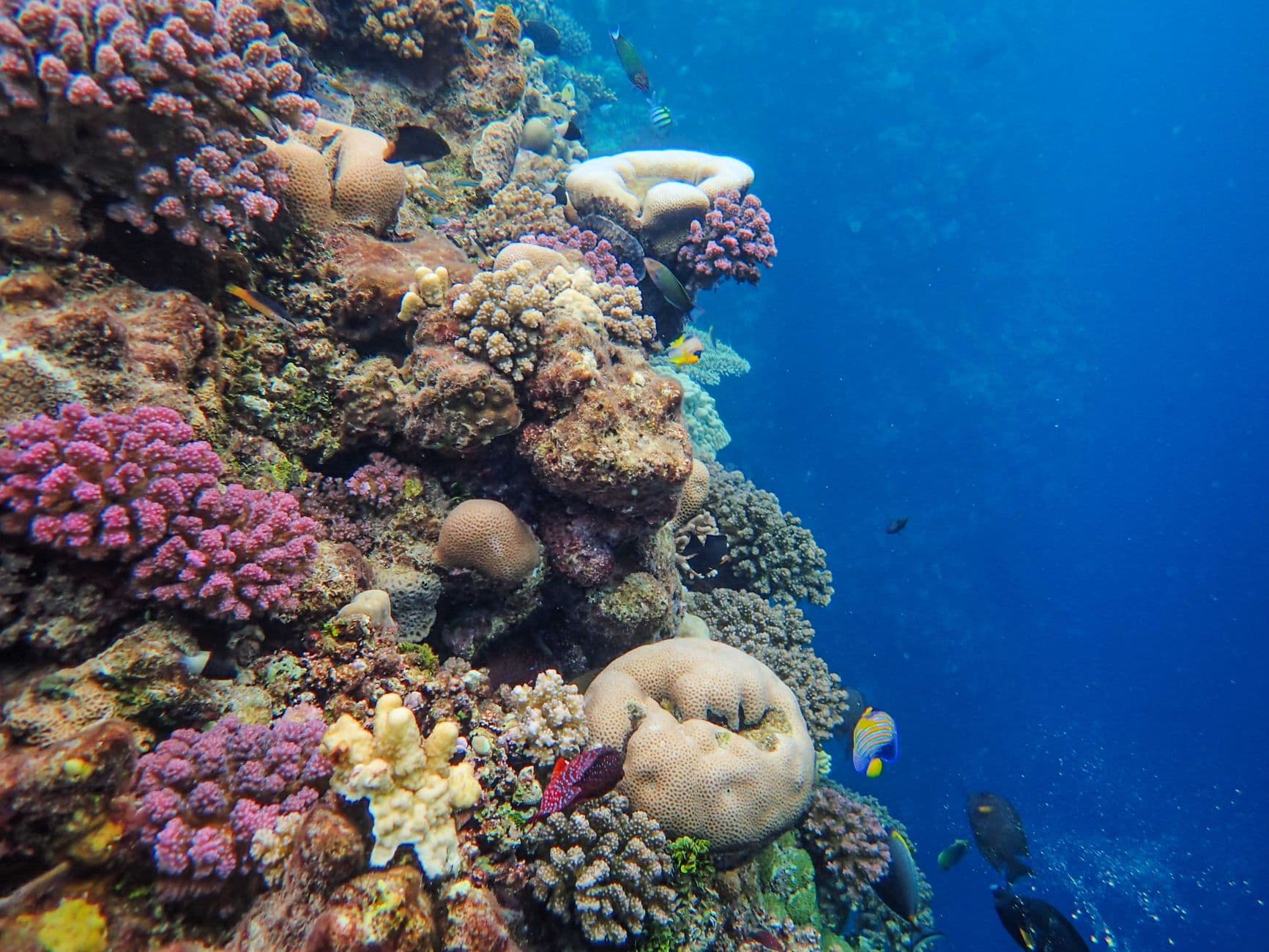
Cindy's Reef proves Santo is not only rust. Shallow coral gardens, bommies, anemones, fusiliers, anthias, nudibranchs, mantis shrimp, pipefish, and rays create a colorful, slower dive. Photographers can work wide coral scenes or macro subjects without the darkness and depth of a wreck.
Current can turn the route into a gentle drift. Beginners should stay on the shallower section, while experienced divers can follow the slope toward the drop-off. A reef day here provides useful recovery between deep wreck profiles.
6. Aore Wall and Fan Garden
Type: wall/drift reef | Depth: commonly 5-25+ m | Access: boat or short resort transfer | Level: Open Water to Advanced | Best season: May-October
Aore Wall is known for large gorgonian fans, anemones, nudibranchs, mantis shrimp, turtles, and reef fish. Current carries divers along the wall, making buoyancy and group positioning more important than fin power.
The sheltered channel setting means it may operate when outer islands are less comfortable, but pickup procedures and SMB readiness still matter. Scan the sand and blue-water edge for eagle rays or reef sharks while keeping distance from fragile fans.
7. MV Henry Bonneaud
Type: coastal-trader artificial reef | Depth: to about 45 m | Access: boat | Level: Advanced/Deep/Wreck | Best season: May-October
The deliberately sunk trader offers another substantial wreck without duplicating the Coolidge. Chambers, swim-throughs, corals, sponges, anemonefish, morays, and schooling fish provide both structure and life. Turtles and reef sharks are possible.
Its deeper sections demand gas and no-decompression planning. Ask whether the day's route remains recreational or includes penetration. A shallower exploration can be satisfying without chasing the maximum depth.
8. Bokissa Reef
Type: shallow reef/drift | Depth: roughly 5-18 m | Access: boat | Level: beginner/intermediate | Best season: May-October
Bokissa offers plate and staghorn corals, clear water, turtles, barracuda, trevally, tuna, and possible reef sharks. Its shallow range makes it a useful second dive and a good site for longer observation of coral behavior and reef-fish interactions.
A drift pickup may be used. Follow the guide, keep a safe distance above coral, and avoid dropping onto the reef while preparing a camera. On clear days, the site provides the bright tropical imagery many visitors do not expect from a wreck-focused destination.
9. Tutuba Point and Mal Mal Reefs
Type: outer reef, caves, canyons, walls | Depth: about 6 to 35+ m | Access: boat | Level: intermediate/advanced | Best season: dry season
Tutuba and the Mal Mal area add swim-throughs, plate corals, lobster, barracuda, trevally, dogtooth tuna, rays, turtles, and reef sharks. The water is more exposed than the Coolidge basin, so the quality of the day depends on wind, current, and boat conditions.
These are excellent choices when a group wants blue-water wildlife and topography after several wreck dives. Maintain contact with the reef and guide rather than following a pelagic into open water.
10. Araki and the Outer Wall Set
Type: deep wall/outer reef | Depth: approximately 6-60 m | Access: weather-dependent boat | Level: advanced | Best season: May-October
Araki represents Santo's more ambitious reef side: vertical terrain, caves or swim-throughs, deep blue edges, and reported visibility that can exceed 40 meters. The wall offers opportunities for reef sharks, rays, tuna, trevally, and schooling fish.
The maximum depth is not a target. Agree on a recreational limit or technical plan, carry an SMB, and stay within pickup procedures. Because access is weather-dependent, schedule this site early enough that it can move to another day.
Bonus Coolidge Routes for Qualified Divers
The ABC Decks provide a multi-level tour of corridors, structure, artifacts, reef fish, and invertebrates around roughly 25-45 meters. The medical stores and doctor's office route can reach 30-50 meters and adds low-light historic detail. The engine room, swimming pool, and deep stern descend into technical profiles around 45-70 meters and require appropriate certification, gases, redundancy, and decompression support.
A Coolidge itinerary should progress based on performance rather than a checklist. A diver who is cold, consuming gas quickly, or struggling with trim should repeat a shallower route or take a reef day instead of escalating.
Quick Comparison
| Site | Depth | Access | Level | Best for |
|---|---|---|---|---|
| Coolidge orientation | 20-35 m | Shore/short boat | Advanced | Scale, history, first wreck route |
| The Lady | 35-45 m | Guided wreck | Adv/Deep/Wreck | Iconic interior objective |
| Million Dollar Point | 15-28 m | Shore/boat | OW-Advanced | Machinery, macro, history |
| USS Tucker | 17-22 m | Boat | OW-Advanced | Shallower WWII wreck |
| Cindy's Reef | 5-35 m | Boat | All levels | Coral and photography |
| Aore Wall | 5-25+ m | Boat | OW-Advanced | Sea fans and drift |
| Henry Bonneaud | to 45 m | Boat | Advanced | Artificial reef wreck |
| Bokissa | 5-18 m | Boat | Beginner/intermediate | Shallow coral and turtles |
| Tutuba/Mal Mal | 6-35+ m | Boat | Intermediate/advanced | Caves and pelagics |
| Araki walls | 6-60 m | Boat | Advanced | Deep walls and blue water |
Choosing by Experience
Newer divers should prioritize Cindy's Reef, Bokissa, and the shallow part of Million Dollar Point under local guidance. Advanced divers with recent deep experience can begin with Coolidge orientation, then consider USS Tucker, ABC Decks, or The Lady after assessment. Technical wreck divers can discuss engine-room and stern routes, but should arrive with current skills rather than expecting vacation training to replace preparation.
Photographers should alternate historical and reef subjects. Use wide-angle equipment on the Coolidge, Tucker, and Million Dollar Point; macro setups work well on machinery, Cindy's, and Aore. Reef lovers should reserve at least one outer-island day instead of spending the entire trip on steel.
Responsible Diving
Do not remove artifacts, touch coral-encrusted metal, or enter overhead spaces without training. Maintain horizontal trim to protect visibility and structure. Give turtles, sharks, rays, dugongs, and whales space. Use established operators with oxygen, first aid, communications, and clear evacuation procedures.
Verify the current hyperbaric pathway before travel because public information has changed between Port Vila and a reported Santo/VESA presence. Insurance should cover evacuation and recompression. In a destination with dives to 70 meters and weather-dependent island transfers, emergency planning is a core piece of site selection.
Bottom Line
The ideal Santo itinerary combines several Coolidge routes with Million Dollar Point, one additional wreck, a channel reef, and an outer-island day. That mix reveals why the destination is exceptional: it is both an underwater WWII archive and a living Pacific reef system. Progress slowly, choose sites that match the weakest member of the team, and let conditions decide when the outer walls are ready.