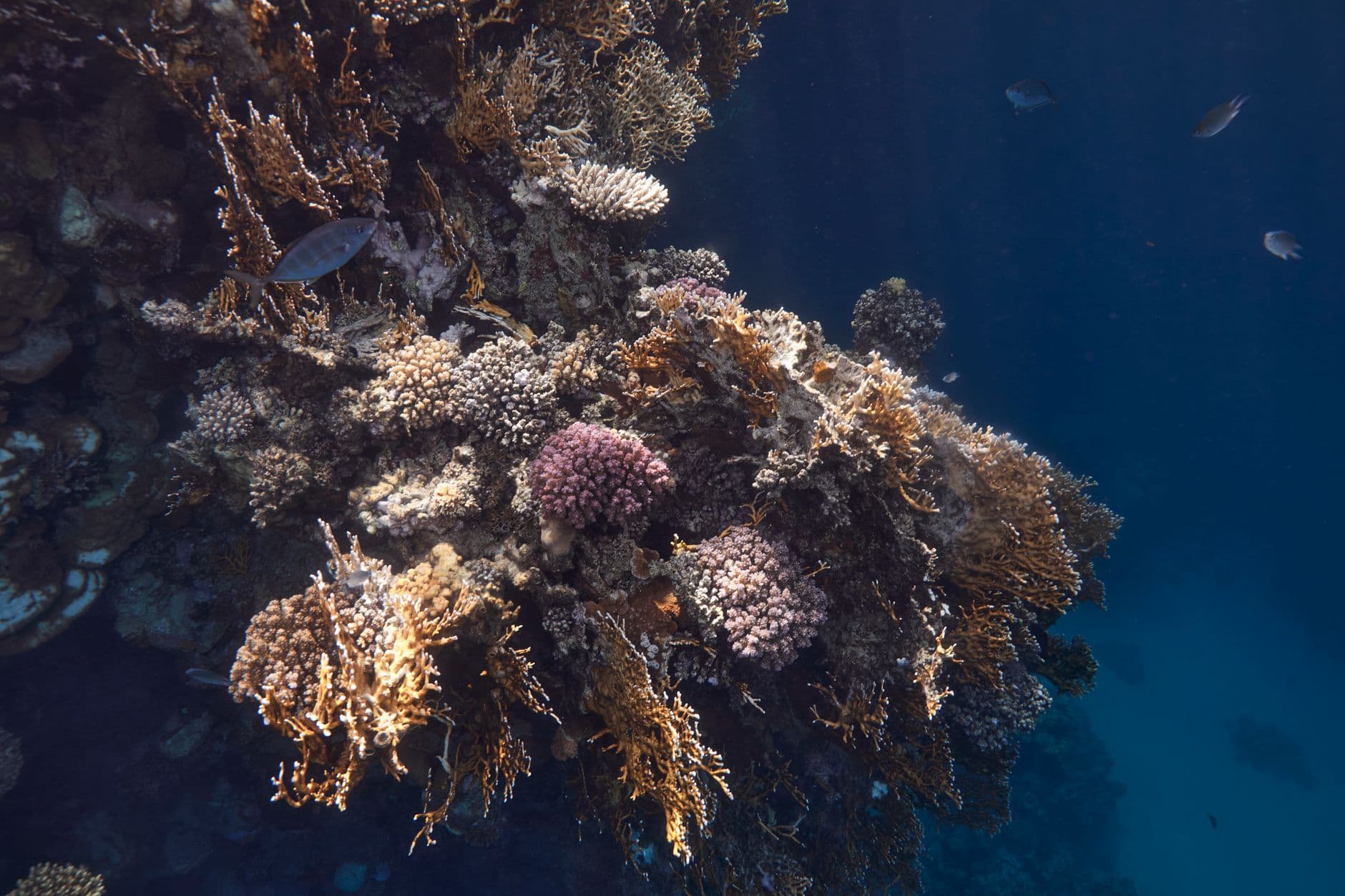
Top 10 Dive Sites in Dahab: From the Blue Hole to Ras Abu Galum
Dahab has 26 documented dive sites along a 15-kilometer stretch of Sinai coastline, and the remarkable thing is that most of them are accessible from shore. You walk into the water from the beach — no boat, no transfer, no morning wait. Each site has its own character, depth profile, and seasonal marine life patterns.
This guide ranks Dahab's top dive sites by overall experience, accessibility, and marine life quality. Every site listed here is verified by local dive operator reports and field guides.
1. Blue Hole
Type: Submarine sinkhole | Depth: 1–6 m (lagoon), 6–100+ m (hole) | Access: Shore (10 min taxi north of town) | Difficulty: Beginner (lagoon/shelf) — Technical (deep/Arch) | Best season: Year-round
The Blue Hole is the most famous dive site in the Red Sea, and arguably the most famous sinkhole dive on Earth. From above, it looks like a perfect turquoise circle cut into the reef plateau. The shallow lagoon inside is only 6 meters deep and perfectly safe — you can snorkel it without any certification. The reef shelf outside the hole sits at 6–9 meters and offers a rich coral garden with clownfish, parrotfish, butterflyfish, and lionfish.
The danger lies at the Arch — a 26-meter tunnel at 56 meters connecting the hole to the open sea. Over 100 fatalities have occurred here, making it the world's deadliest dive site. This is a technical dive requiring decompression training, trimix qualification, and overhead-environment certification. For recreational divers, the lagoon and shelf deliver outstanding diving without any of that risk.
Marine life: Clownfish (two-band anemonefish), masked butterflyfish, parrotfish, lionfish, octopus, moray eels, glassfish, trevallies, occasional whitetip reef sharks.
Why it's the best: It is the most iconic dive site in the Red Sea. The visual of the turquoise hole from above is unforgettable, and the lagoon dive delivers excellent coral and fish life with zero current or boat requirement.
Practical tips: Go early (before 9 AM) to avoid the crowds. The lagoon is shallow enough for a 90-minute dive on a single tank. Bring a guide for the first visit — the site layout is more complex than it looks from the parking area.
2. The Canyon
Type: Underwater canyon/swim-through | Depth: 5–55 m | Access: Shore (10 min north of Blue Hole) | Difficulty: Beginner–Advanced | Best season: March–November
The Canyon is a fossilized coral reef that fractured and collapsed into an underwater swim-through system with walls up to 10 meters high. You enter through a shallow sandy lagoon, swim through a narrow opening, and descend into the canyon proper. The canyon meanders for roughly 30 meters, opening onto a sandy bottom at 55 meters.
The canyon is divided into three sections: Upper Canyon (6–18 meters, wide and well-lit), Middle Canyon (18–30 meters, narrow swim-through with dramatic walls), and Deep Canyon (30–55 meters, opens to sandy bottom). Large schools of glassfish fill the canyon year-round, creating stunning light effects when sunlight hits the school from above.
Marine life: Glassfish (thousands), lionfish, scorpionfish, moray eels, masked butterflyfish, bluespotted ribbontail rays on the sandy floor.
Why it's the best: There is nothing else like the Canyon in the Red Sea. The sensation of swimming through a collapsed fossil reef with walls towering above you is unique. The glassfish aggregation makes every visit feel dramatic.
Practical tips: The canyon can be silty — fin carefully to avoid reducing visibility. Bring a dive light for the middle and deep sections. Combine with the Fish Bowl (adjacent shallow basin, 3–12 meters) as a second dive.
3. The Bells
Type: Chimney/wall dive | Depth: 1–55+ m | Access: Shore (850 m walk from Blue Hole parking) | Difficulty: Intermediate–Advanced | Best season: March–November
The Bells is named for the bell-shaped chimney that divers descend through to reach the outer reef wall. The entry is a narrow vertical crack in the reef plateau — roughly 1–2 meters wide — that opens into a chimney dropping to roughly 30 meters. From the chimney exit, you emerge onto a steep drop-off wall that plummets into the Gulf of Aqaba.
The standard dive profile is a drift from the Bells to the Blue Hole — roughly 500 meters along the wall with minimal effort. The wall features large gorgonian sea fans, overhangs, and rich coral cover. This is widely considered the best wall dive in Dahab.
Marine life: Grey reef sharks (common at 15–30 meters), spotted eagle rays, whitetip reef sharks, large schools of anthias and glassfish, turtles.
Why it's the best: The chimney descent is Dahab's most dramatic entry point. The drift to the Blue Hole along the pristine outer wall is the signature Dahab experience — flying along a coral wall with the Gulf of Aqaba dropping away beneath you.
Practical tips: Good buoyancy control is essential for the chimney descent. The chimney narrows at certain points — keep your arms close. Combine with a Blue Hole lagoon dive for a classic Dahab morning.
4. Lighthouse
Type: Fringing reef / house reef | Depth: 1–55 m | Access: Shore (5 min walk from town center) | Difficulty: Beginner–Intermediate | Best season: Year-round
Lighthouse is Dahab's house reef — the most popular and busiest dive site in town, located in Ghazala Bay directly in front of the lighthouse. The site features a shallow sandy training area (1–6 meters), a gentle slope to the fringing reef drop-off at 12 meters, and a wall descending to 55 meters.
The coral is excellent: table corals, brain corals, and fire corals cover the reef face. The fish life is diverse and abundant. Lighthouse is also one of the best night dives in the Red Sea — octopus, moray eels, lionfish, and crabs emerge after dark on every visit.
Marine life: Clownfish (two-band anemonefish), masked butterflyfish, parrotfish, surgeonfish, lionfish, octopus (night dives), moray eels, garden eels in the sandy areas.
Why it's the best: It is the most convenient, reliable, and consistent dive site in Dahab. You walk from your hotel to the dive center, gear up, and enter the water steps from the shop. Night dives here are world-class.
Practical tips: Expect other dive groups — Lighthouse is busy. Go early or for a late afternoon dive for fewer crowds. The night dive is a must-do: octopus sightings are almost guaranteed.
5. Eel Garden
Type: Sandy slope / reef edge | Depth: 6–18 m | Access: Shore (5 min taxi or 15 min walk north of Lighthouse) | Difficulty: Beginner | Best season: March–November
Eel Garden is named for the thousands of garden eels that carpet the sandy bottom at 6–18 meters. The eels — Heteroconger hassi, the Red Sea garden eel — emerge from their burrows to feed in the current, creating a swaying underwater "garden" that shifts with the water movement.
Beyond the eel bed, the site transitions to a fringing reef edge with good coral cover and reef fish. The sandy area is excellent for macro photography — rays, goatfish, and small crustaceans are common. A popular drift route runs from Eel Garden south to Lighthouse.
Marine life: Garden eels (thousands), bluespotted ribbontail rays, spotted eagle rays, goatfish, masked butterflyfish, nudibranchs.
Why it's the best: There is no dive site quite like Eel Garden anywhere else in Dahab. The garden eel display is mesmerizing — thousands of eels swaying in the current creates an underwater landscape you will not see anywhere else in the Red Sea.
Practical tips: Approach the eel bed slowly — quick movements make the eels retract into their burrows. Stay at the sandy edge to avoid damaging the eel colony. Best light for photography is mid-morning.
6. Golden Blocks
Type: Drift dive / block coral formations | Depth: 5–30 m | Access: Shore (short taxi south of town) | Difficulty: Intermediate | Best season: March–November
Golden Blocks is named for the massive golden block corals — ancient Porites formations — that dominate the site. The blocks create sandy channels between them, home to stingrays, garden eels, and goatfish. The site is a moderate drift dive with current running north to south.
The block coral formations here are genuinely ancient, some estimated to be several centuries old. The channels between the blocks create a maze-like terrain that is excellent for exploration. This is one of Dahab's best drift dives for intermediate divers looking to practice drift technique in moderate conditions.
Marine life: Bluespotted ribbon tail rays, spotted eagle rays, garden eels, goatfish, giant moray eels, lionfish, masked butterflyfish.
Why it's the best: The ancient block corals are a unique geological feature. The drift route from Golden Blocks to Moray Garden is one of Dahab's most enjoyable moderate-current dives.
Practical tips: Start your dive at the northern end of the blocks and drift south to Moray Garden. Carry an SMB — the drift can carry you past Moray Garden if the current is stronger than expected.
7. Moray Garden
Type: Reef slope / moray eel aggregation | Depth: 3–25 m | Access: Shore (south of Golden Blocks) | Difficulty: Intermediate | Best season: March–November
Moray Garden has the highest density of moray eels of any dive site in Dahab — a single dive can reveal 6–8 individuals. Giant morays (Gymnothorax javanicus) and honeycomb morays (Gymnothorax favagineus) are the primary residents, living in the cracks and crevices of the reef slope.
The reef here is rich in invertebrate life — cleaner shrimp stations are common, where morays open their mouths to allow shrimp to clean parasites from their teeth. Spotted eagle rays are frequently seen cruising the sandy areas adjacent to the reef.
Marine life: Giant moray eels, honeycomb moray eels, spotted eagle rays, bluespotted ribbontail rays, cleaner shrimp, lionfish, turtles.
Why it's the best: The concentration of moray eels is unmatched in Dahab. The cleaning station behavior — morays with open mouths being serviced by shrimp — is a photographer's dream.
Practical tips: Move slowly — the morays are used to divers and will stay visible if you do not startle them. The site is often the terminus of the Golden Blocks drift dive. Plan for a shore entry if you are not drifting from Golden Blocks.
8. Islands
Type: Coral pinnacles | Depth: 3–20 m | Access: Shore (walkable from Lighthouse area) | Difficulty: Beginner–Intermediate | Best season: Year-round
Islands features three large coral pinnacles (the "islands") rising from the sandy bottom at 12–20 meters. The pinnacles create a maze of shallow lagoons, channels, and coral gardens that are excellent for reef fish photography and relaxed exploration.
The water between the pinnacles is calm and sheltered — the formation blocks current and swell, making this one of the most relaxed dive sites in Dahab. The pinnacles are covered in soft corals, anemones, and reef fish.
Marine life: Clownfish (two-band anemonefish), masked butterflyfish, parrotfish, surgeonfish, anthias, fusiliers, lionfish, octopus.
Why it's the best: The pinnacle terrain is unique among Dahab's sites. The sheltered channels between the pinnacles make this an excellent site for beginners and photographers.
Practical tips: This is a great second dive after Lighthouse or Eel Garden. The shallow depths allow for long bottom times. Good for afternoon dives when northern sites are wind-affected.
9. Bannerfish Bay
Type: Shallow reef slope | Depth: 2–18 m | Access: Shore (walkable from town) | Difficulty: Beginner | Best season: Year-round
Bannerfish Bay is named for the abundance of Red Sea bannerfish (Heniochus intermedius) and other butterflyfish that inhabit this shallow, gently sloping reef. The site features flat sandy areas interspersed with coral patches, creating an ideal environment for beginner training, snorkeling, and photography.
Conditions here are always calm — the site is sheltered from wind and swell by the reef topography. This makes Bannerfish Bay the go-to site for check-out dives, refresher courses, and introducing new divers to the Red Sea.
Marine life: Red Sea bannerfish, masked butterflyfish, clownfish, parrotfish, sergeant majors, lionfish, octopus (night dives).
Why it's the best: It is the most beginner-friendly dive site in Dahab. If you are learning to dive or introducing someone to the sport, Bannerfish Bay is the right choice.
10. Ras Abu Galum
Type: Marine reserve / fringing reef | Depth: 5–40 m | Access: Camel, speedboat, or 4x4 (Nabq Protected Area) | Difficulty: Intermediate–Advanced | Best season: March–June, September–November
Ras Abu Galum is Dahab's northernmost dive area, part of the Nabq Protected Area. This is Dahab's most remote and pristine reef — the coral condition here is significantly better than town sites due to the distance from Dahab and the protected area status.
Access is part of the adventure: you can ride a camel along the coast (roughly 1 hour) or take a speedboat from the Blue Hole road. The reef features large coral heads, a turquoise lagoon, and excellent pelagic life. The Bedouin beach camps at Ras Abu Galum offer a unique experience — dive, eat Bedouin lunch on the beach, and ride back on a camel.
Marine life: Turtles (year-round), eagle rays (November–May), occasional reef manta rays, bottlenose dolphins (common on boat dives), whitetip reef sharks.
Why it's the best: It is the closest thing to an untouched Red Sea reef accessible from Dahab. The combination of pristine coral, remote setting, and the camel diving experience is unique.
Practical tips: Bring cash for the Nabq Protected Area entrance fee (~EGP 100–200). Arrange transport in advance — the camel ride takes 1 hour each way. Best combined with a half-day or full-day excursion.
Summary Table
| Rank | Site | Depth | Access | Difficulty | Best Season |
|---|---|---|---|---|---|
| 1 | Blue Hole | 1–100+ m | Shore | B–T | Year-round |
| 2 | The Canyon | 5–55 m | Shore | B–A | Mar–Nov |
| 3 | The Bells | 1–55+ m | Shore | I–A | Mar–Nov |
| 4 | Lighthouse | 1–55 m | Shore | B–I | Year-round |
| 5 | Eel Garden | 6–18 m | Shore | B | Mar–Nov |
| 6 | Golden Blocks | 5–30 m | Shore | I | Mar–Nov |
| 7 | Moray Garden | 3–25 m | Shore | I | Mar–Nov |
| 8 | Islands | 3–20 m | Shore | B–I | Year-round |
| 9 | Bannerfish Bay | 2–18 m | Shore | B | Year-round |
| 10 | Ras Abu Galum | 5–40 m | Camel/Boat | I–A | Mar–Jun, Sep–Nov |
Choosing Your Dahab Dive Adventure
Dahab offers a remarkable range of diving in a small area. Here is a quick guide to matching the sites to your skill level:
- Beginner (Open Water, 0–20 dives): Start with Lighthouse, Bannerfish Bay, Islands, and the Blue Hole lagoon. These sites are shallow, calm, and forgiving.
- Intermediate (20–50 dives): Add the Canyon (upper section), Eel Garden, Golden Blocks drift, and Moray Garden. Practice drift technique and buoyancy on wall sites.
- Advanced (50+ dives): Add the Bells-to-Blue-Hole drift, the Canyon (deep section), and Ras Abu Galum. Strong current awareness and buoyancy control are essential.
- Technical: The Blue Hole Arch requires decompression training, trimix certification, and overhead-environment experience. Plan with a dedicated technical dive center like Shams Hotel & Dive Centre.
Bottom Line
Dahab's dive sites are among the most accessible and diverse of any shore-diving destination in the world. The combination of the legendary Blue Hole, the dramatic Canyon, the signature Bells drift, and the reliable town sites like Lighthouse and Eel Garden — all walkable from the beach — makes Dahab a destination where you can spend two weeks diving a different site every day without repeating the same dive profile. Every diver should experience this coastline at least once.