Comoros Dive Guide: The Indian Ocean's Last Frontier
The Union of the Comoros sits in the Mozambique Channel between Mozambique and Madagascar, a volcanic archipelago where three islands rise from some of the least-dived waters on Earth. It is the sixth least-visited country in the world by annual tourist arrivals. Its reefs hold 314+ coral species, its deeper caves shelter a fish unchanged for 300 million years, and Itsamia beach on Mohéli records the second-largest green turtle nesting population in the entire Indian Ocean. All of it is served by exactly two dive operators.
If you are looking for a resort with a pool bar and a dive locker full of rental gear that was serviced last week, this is not your destination. If you want to descend onto a reef that has never seen another diver that day — or that week — and log encounters with species most divers only read about, Comoros is the real thing.
Who This Destination Is For
Comoros is an expedition dive destination for intermediate and above divers who plan their own logistics, carry their own gear, and treat isolation as a feature rather than a problem. There are no dive resorts with multi-language dive briefings, no house reefs with submerged line markers, no hyperbaric chamber on any island — the nearest is 1,400 km away on Réunion. DAN insurance with evacuation coverage is not a recommendation here. It is mandatory.
That said, the diving itself is accessible. Shallow reefs at Laka Lodge (2–20 m), Itsandra Bay (5–20 m), and Trou du Prophète (10–25 m) are suitable for beginners. Advanced divers head to Bird Island Mchaco (10–40 m, strong current), Banc Vailheu (20–55 m, pelagic channel), and the deeper walls around Grande Comore. The real prize — seeing a coelacanth — requires technical diving or a submersible below 100 m, but the Coelacanth Hotel Site off Moroni offers multi-level topography from 5 to 45 m where the chance encounter is not impossible.
Island by Island
Grande Comore (Ngazidja)
The largest island is the gateway. Flights arrive at Prince Said Ibrahim International Airport (HAH) near the capital, Moroni. The island is dominated by Mount Karthala, an active shield volcano with a 4 km-wide caldera — one of the world's largest — whose 1977 lava flow created a unique underwater landscape at Singani (Front de la Coulée). The primary dive center is Comoros Plongée at Itsandra Beach, operated by Nazir Farid, who offers guided dives for around €60 per session. Facilities are basic — no showers, no running water — but the reefs are healthy, private, and the visibility runs 20–40 m in the dry season. Sites include the Massiwa wreck (20–40 m, 80 m cargo ship upright on the bottom), Dolphin Bay (reliable spinner dolphin encounters), and the deep pelagic bank of Banc Vailheu where grey reef sharks, tuna, and manta rays aggregate in the current.
Mohéli (Mwali)
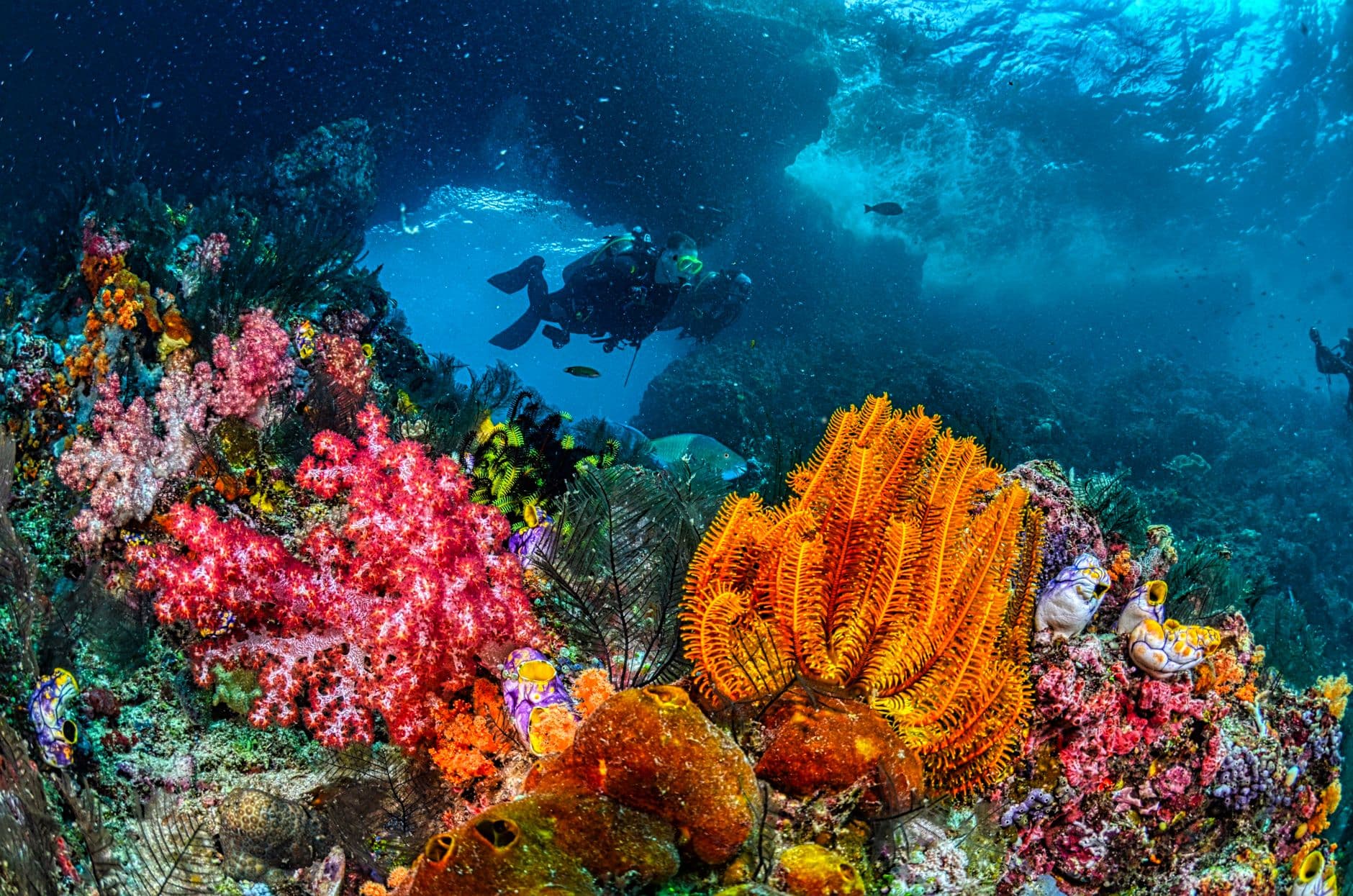
This is the diving heart of the archipelago. The southern coast is protected by Mohéli Marine Park (est. 2001, 400+ km²), a community-managed reserve praised by the IUCN in 2022 as a "shining example" of local marine conservation. The park has banned net fishing, spear fishing, and dynamite fishing since its founding, and the results are visible the moment you drop below the surface. Laka Lodge, an eco-resort near Nioumachoua with eight solar-powered bungalows, operates its own dive center with PADI-affiliated instructors. From July to October the lodge runs up to three dives per day across roughly 15 explored sites — plus many more that are still undocumented. Marine biologists visiting the park report encountering new species "almost every dive." The house reef starts at the shoreline at 2 m and drops to 20 m across an algae meadow where green turtles rest and feed at dawn and dusk. Magic Rocks delivers two coral-covered volcanic pinnacles at 15–35 m, excellent for night dives with cuttlefish, Spanish dancers, and sleeping turtles. Bird Island Mchaco at the eastern tip is an advanced site — open Indian Ocean, strong currents, large schools of tuna and trevally, and the occasional Napoleon wrasse.
Anjouan (Nzwani)
The "Perfume Island" produces 80% of the world's ylang-ylang essence and has the least-developed dive infrastructure of the three islands — zero dive shops. Its waters hold Bimbini National Park, a designated area with coral reefs, seagrass beds, and known coelacanth habitat in deeper water. Diving here requires private arrangements through local boat owners or an expedition operator. The reefs are untouched but the logistics are genuinely difficult.
Practical Realities
Getting there: Kenya Airways via Nairobi, Ethiopian Airlines via Addis Ababa, or Air Tanzania via Dar es Salaam. No direct flights from Europe or the Americas.
Visa: €30 on arrival at HAH Airport. Have cash ready in euros.
When to go: July through November is the prime window — visibility 25–40 m, humpback whales August–October, manta rays June–July, and whale sharks returning in October. Whale shark peak runs October–April during plankton blooms. Water temperature ranges 26–30°C year-round; a 3 mm wetsuit works for most of the year, 5 mm if you are sensitive to cold on deeper dives below the thermocline.
Dive operators: Comoros Plongée (Grande Comore) and Laka Lodge Diving (Mohéli) are the only two dedicated dive centers in the country. Book weeks — or months — in advance.
Safety: No hyperbaric chamber in Comoros. DAN insurance with evacuation is mandatory. Emergency phone: 17. Nearest chamber is on Réunion (~1,400 km).
Currency: Comorian Franc (KMF). Euros are widely accepted at hotels. ATMs are scarce — bring sufficient cash for your entire stay.
Language: French is the operational language for diving and tourism. English is spoken by Nazir Farid (Comoros Plongée) and some Laka Lodge staff but is not widely used outside those contexts. A basic French phrasebook is genuinely useful here.
Why Comoros Matters
The Comoros represent something increasingly rare in the dive world: a place where you are not following someone else's Instagram feed. The reefs are healthy — minimal bleaching compared to the Maldives or the Great Barrier Reef — because they have never had enough visitors to degrade them. The Coelacanth Hotel Site off Moroni offers multi-level reef with shallow plateaus and deeper walls. Itsamia Turtle Sanctuary on Mohéli has gone from near-zero turtles in the 1980s to 20,000 nests per year because the local community chose to protect them. That is the kind of diving that leaves a mark.
If you want crowds and convenience, go to Cozumel or the Maldives. If you want to be the first diver of the day, every day, on a reef that has rarely seen a fin, start planning Comoros.