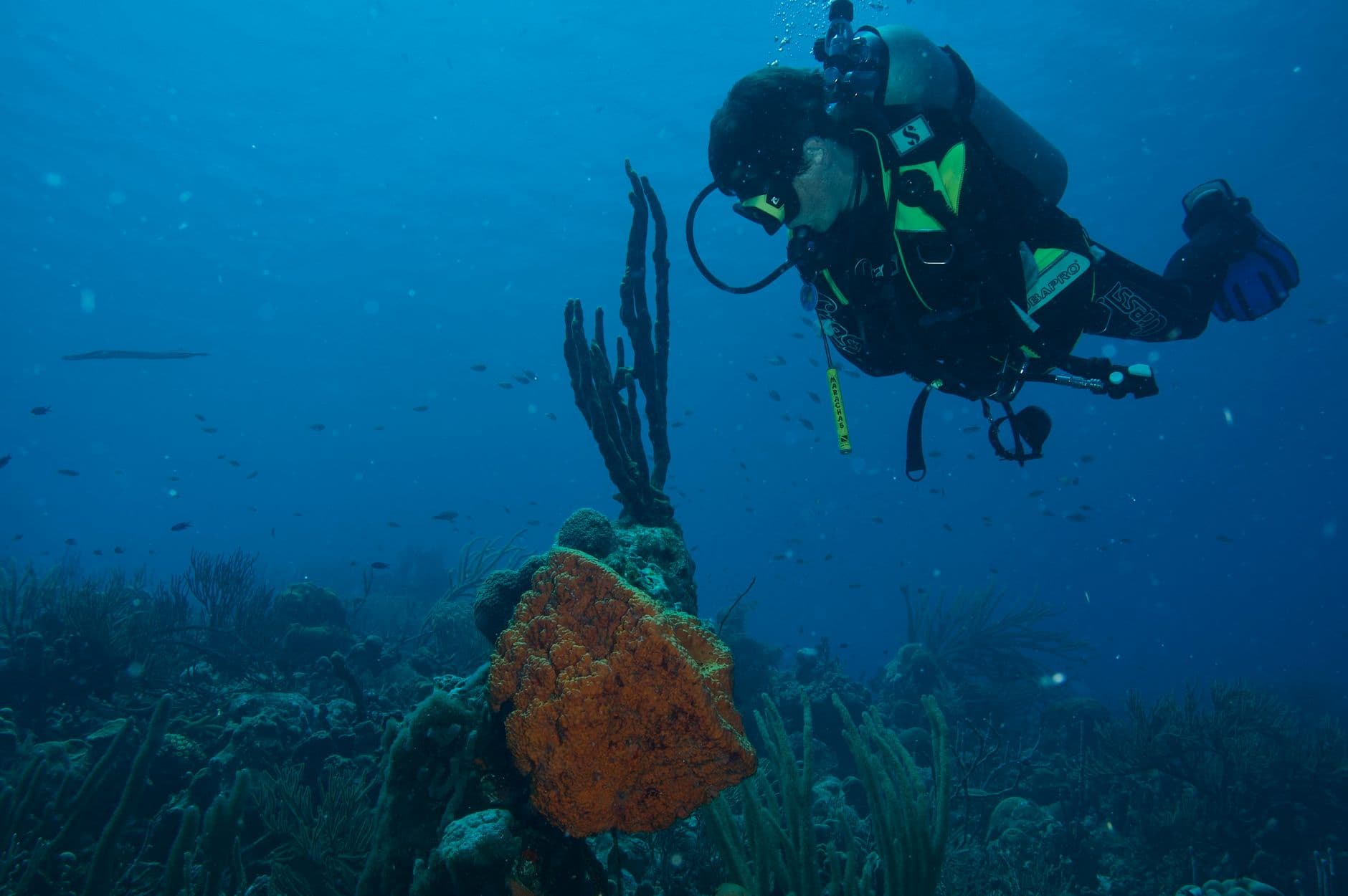
Top 7 Dive Sites in Bonaire: Shore Diving at Its Best
Bonaire's diving is defined by simplicity. You choose your site from a numbered list on the STINAPA dive map, drive your rental truck to a yellow stone marker, and walk into the ocean. Within 30 meters, you're on a pristine fringing reef — no boat schedule, no group diving, no surface intervals dictated by anyone else.
The island has 97 numbered dive sites, 88 of them currently active. Most are shore-accessible from the west coast, which stretches 38 kilometers and is lined with stone entry steps, drop-offs, wall dives, and cleaning stations. Klein Bonaire — a small uninhabited islet 2 km off the west coast — adds 26 more lettered sites (A–Z), all boat-accessible, that deliver even deeper wall dives and the clearest water in the Caribbean.
This guide covers the top 7 dive sites across Bonaire's west coast and Klein Bonaire so you can plan a route that matches your interests. Every site listed here is one of the 80 active, officially designated sites — verified by STINAPA and used daily by local dive operators.
1. The Hilma Hooker
Type: Artificial wreck | Max depth: 44 m (bottom) | Accessible from: Shore (Site 28 area) | Difficulty: Intermediate–Advanced | Best season: Year-round
The Hilma Hooker is Bonaire's most famous single dive site and the Caribbean's premier shore-accessible wreck. This 70-meter cargo ship was seized by U.S. authorities in 1983 carrying a $4.7 million cocaine shipment. After years of legal proceedings, the ship was intentionally towed to its current location and sunk by U.S. Navy commandos in 2006 as an artificial reef.
The wreck sits at 28 m depth, with the bow at 10 m and the stern at 44 m. It rests on its starboard side, creating an almost vertical wall structure that divers can swim around and explore. The bridge deck is accessible at 12–15 m, the main deck at 18–22 m, and the engine room deeper still. The entire structure is now covered in living coral, sponges, and sea fans — the ship has become a thriving artificial reef ecosystem.
Marine life around the Hilma Hooker is exceptional. Large jacks circle the structure in dense schools. Eagle rays patrol the sandy bottom near the wreck. Octopus makes its home in the wreck's interior compartments. Angelfish, barracuda, parrotfish, and snappers swarm around every surface. At night, the wreck transforms — octopuses become active, tarpon patrol the perimeter, and nocturnal crustaceans reveal themselves in the beam of your dive light.
Access: Shore entry from the 28th Palm site area. Drive north along the east coast road and look for the yellow stone marker. The entry is across a shallow reef flat — about 10 meters of walking before the drop. The drift current runs north-to-south along the reef, so plan your entry from the north side to follow the current toward the wreck.
Target species: Large jacks, eagle rays, octopus, angelfish, barracuda, parrotfish, snappers, moray eels, night diving species.
Dive profile: Follow the reef slope down to 28 m, explore the wreck on both the inside and outside. The current can be moderate at depth — use the reef wall as an reference point. Allow extra bottom time; the wreck rewards slow, thorough exploration.
Why it's the best: It's the only major wreck dive in Bonaire, and it's accessible from shore — no boat required. The combination of history (a seized drug-running ship turned reef), accessibility (walk in from the beach), and marine life (spectacular reef fish aggregations) makes this an iconic Caribbean dive experience.
Practical tips: Visit during the day for the full wreck exploration, and return for a night dive to see the octopus, tarpon, and nocturnal creatures. The wreck's structure creates its own micro-currents, so position yourself near the reef wall to avoid being pushed away. Bring a dive light — the interior of the wreck is shadowy, and your light reveals a world of critters the day divers might miss.
2. Klein Bonaire — Site J (Mooi Four)
Type: Wall dive | Max depth: 38 m | Accessible from: Boat | Difficulty: Intermediate | Best season: Year-round
Klein Bonaire is a small, uninhabited islet located 2 km off Bonaire's west coast, and it surrounds the island with 26 officially designated dive sites (A–Z). Among these, Site J — commonly known as Mooi Four — is one of the most iconic and consistently rewarding dives in the entire Caribbean.
The site features a dramatic vertical wall that drops from 10 m straight to 38 m. The wall face is covered in massive sea fans, brain coral, elkhorn coral, and fire coral — a colorful tapestry of Caribbean reef life. Cleaning stations at 15–20 m attract eagle rays, moray eels visit the wall crevices, and large pelagics cruise the deep blue beyond the wall drop.
The water clarity around Klein Bonaire is the best in the entire Caribbean — visibility routinely exceeds 35 m and frequently hits 40 m. The island's isolation from the mainland means less runoff, less wind-driven sediment, and more stable water conditions. On a clear day at Mooi Four, you can see the wall stretching endlessly below you into the deep blue.
Access: Boat access only. Most dive shops on the main island offer half-day or full-day trips to Klein Bonaire. Boat rides are 15–25 minutes from west-coast departures. Sites A–F are closer to the main island and easier for beginners; sites G–M are the heart of the wall dives.
Target species: Sea fans, brain coral, elkhorn coral, eagle rays, moray eels, large pelagics (jacks, tuna, wahoo), reef fish schools, occasional manta rays and turtles.
Dive profile: Descend along the wall to 38 m, following the colorful reef face. Explore the wall crevices, swimming in and out of coral overhangs. Ascend along the wall face, which gives you an incredible visual of the reef tapestry from top to bottom.
Why it's great: The wall dives of Klein Bonaire are among the most visually stunning in the Caribbean. The combination of pristine coral coverage, exceptional visibility, and abundant marine life makes sites like Mooi Four the reason many divers choose Bonaire specifically.
Practical tips: Klein Bonaire sites are best done on calm days — the small boat ride can get choppy in strong winds. Most operators visit 2–3 Klein Bonaire sites per trip, so plan for a half-day minimum. The deep wall sites require good buoyancy control — the reef wall is sensitive and close kicks can damage coral.
3. Tori's Reef (Cleaning Station)
Type: Reef plateau / cleaning station | Max depth: 25 m | Accessible from: Shore (Site 38 area) | Difficulty: Beginner–Intermediate | Best season: Year-round
Cleaning stations are one of Bonaire's most beloved diving features — designated reef areas where smaller fish remove parasites from larger visitors like eagle rays, groupers, and occasionally manta rays. Tori's Reef is the most famous and reliably active cleaning station on the west coast.
Located at Site 38 along the south-central section of the west coast, Tori's Reef is a broad, shallow reef plateau that slopes from 5 m to 25 m. The reef is covered in branching coral, sea fans, and colorful encrusting sponges. At 15–18 m, there's a natural cleaning station where eagle rays arrive on a predictable schedule — often daily — to be "cleaned" by smaller fish like cleaner wrasse and cleaner shrimp.
The experience of watching an eagle ray descend to a cleaning station, position itself carefully, and let tiny fish work over its wings is one of the most magical underwater experiences in the Caribbean. The rays are remarkably patient and gentle, often staying at the station for 15–30 minutes. Groupers visit too, hovering at the edges while the smaller fish swarm over their bodies.
Access: Shore entry from the 38th Palm site. Drive along the west coast road to the yellow stone marker — it's well-signed and easy to find. The entry is over a shallow reef terrace of about 10 meters, then the reef drops off.
Target species: Eagle rays (daily at cleaning station), cleaner wrasse, cleaner shrimp, groupers, moray eels, reef fish schools, occasional manta rays, sea turtles, octopus.
Dive profile: Explore the shallow reef terrace at 5–12 m first, enjoying the branching coral and reef fish. Then descend to the cleaning station at 15–18 m. Spend time observing the eagle ray visit — it's a free underwater show. The wall beyond the plateau drops to 25 m, offering a deeper exploration phase.
Why it's great: The cleaning station encounters are repeatable and predictable — you don't need luck or a dive guide to see them. On any given dive at Tori's Reef, there's a very high probability of eagle ray contact. Combined with the excellent reef biodiversity on the plateau, this site is a Bonaire staple.
Practical tips: Visit during the morning hours when eagle ray activity is highest. Stay still and patient at the cleaning station — sudden movements will scare the rays away. The shallow reef terrace is perfect for new divers or snorkelers to enjoy before or after the deeper wall section.
4. Reef Encounter (Site 20)
Type: Reef wall | Max depth: 35 m | Accessible from: Shore (Site 20 area) | Difficulty: Beginner–Intermediate | Best season: Year-round
Site 20 — known as Reef Encounter — is one of Bonaire's most popular shore dives and a perfect example of why the island is the world's shore diving capital. The site features a dramatic reef wall that begins at 6 m and drops continuously to 35 m, lined with sea fans, coral gardens, and colorful reef life from top to bottom.
The reef at Site 20 is particularly impressive because of its diversity — you'll encounter multiple species of brain coral, massive sea fans that reach 2+ meters in diameter, and a dense carpet of branching coral across the shelf. The wall is covered in vertical hanging sea rods and anemones, creating a living curtain of marine life.
One of the most distinctive features of Site 20 is its excellent visibility even on less-than-perfect days. The site's orientation and the reef's sheltered position help it maintain clarity when other sites show slight reduction from surface conditions. This makes it a reliable fallback dive and a consistently good introduction to Bonaire's reef system.
Access: Shore entry from the 20th Palm site. The yellow stone marker is located on the west coast road. Entry is straightforward — walk down the stone steps, turn left along the reef terrace, and the wall face rises up on your right.
Target species: Sea fans (multiple species), brain coral, elkhorn coral, parrotfish, angelfish, butterflyfish, moray eels, lionfish, octopus, reef fish schools.
Dive profile: Enter from the shallow reef terrace at 6–10 m and follow the wall down to 35 m. The wall offers a continuous vertical spectacle — spend time exploring the coral formations at each depth level. The shallow shelf provides a calm, warm area for buoys or for less-experienced divers to stay near the entry.
Why it's great: Reef Encounter is consistently one of the most reliable dive experiences on the west coast. The reef structure is dramatic, the biodiversity is high, the visibility is excellent, and it's fully accessible from shore. It's the kind of site that makes you forget you don't need a boat to dive Bonaire.
Practical tips: Site 20 is one of the most frequently used shore sites, so expect occasional other divers at the reef. Go early morning (first dive of the day) or late afternoon (last dive) for the most solitude. The shallow reef is home to the three species of seahorses that Bonaire is famous for — keep your eyes on the coral branches.
5. White Hole
Type: Rock pinnacle / cave | Max depth: 25 m | Accessible from: Shore (Site 17 area) | Difficulty: Beginner–Intermediate | Best season: Year-round
White Hole is one of Bonaire's most photographed dive sites, and for good reason. This narrow vertical rock formation rises from the sandy bottom at 18 m and extends to just 6 m below the surface, creating a tunnel-like passage that funnels sunlight into spectacular underwater beams.
The site is named for the white calcareous algae that covers the rock face, which glows brilliantly in sunlight. The pinnacle is surrounded by a sandy bottom at 20–25 m, where groupers, barracuda, and eagle rays patrol. During the day, White Hole is a kaleidoscope of light beams and shimmering parrotfish colors. At night, it transforms into a nocturnal hunting ground — octopuses emerge from the rock crevices, tarpon patrol the sandy perimeter, and webs of lanternfish create a milky-blue glow around the pinnacle.
The cave-like formations at White Hole add a sense of exploration that many Bonaire reef sites lack. Small tunnels and overhangs give you places to peek inside, and the rock face is covered in encrusting sponges and small anemones that reward close observation with macro life.
Access: Shore entry from the 17th Palm site area. The entry is over a gentle reef slope, and the pinnacle is visible from the surface on clear days. Walk into the water and the white rock face is unmistakable.
Target species: Groupers, barracuda, eagle rays, lionfish, octopus, nocturnal species (night dive), lanternfish, reef fish schools, moray eels, parrotfish.
Dive profile: Explore the pinnacle from bottom (18 m) to top (6 m), swimming through the tunnel-like openings. Investigate the sandy bottom around the base for reef fish. For night dives, bring a strong light — the nocturnal wildlife at White Hole is spectacular.
Why it's great: White Hole offers something rare in Bonaire's predominantly reef-floorscape: a dramatic vertical rock feature that invites exploration. The day dives are beautiful for the light shows, but the night dives are truly exceptional — one of the best nocturnal dive sites in the entire Caribbean.
Practical tips: The site is shallow enough that even beginner divers can enjoy it, but the pinnacle's tunnel openings can feel claustrophobic to some divers — dive at your comfort level. Night dives are available through most dive shops or can be arranged independently. Visit during the day first, then return for night — the site is completely different experience.
6. Salt Pier (Site 1)
Type: Pier structure / reef | Max depth: 18 m | Accessible from: Shore | Difficulty: Beginner | Best season: Year-round
Salt Pier — officially Site 1 — is located at the north end of Bonaire's west coast, near the small fishing village of Soualiga. The site is named for the old wooden pier structure that sits partially underwater, creating an artificial habitat that has become home to one of Bonaire's most famous diving residents: a single green turtle that has made the pier area its home for years.
The reef at Salt Pier is relatively shallow, ranging from 3 m to 18 m, making it one of the most accessible dive sites in Bonaire. The pier structure itself is covered in barnacles, small crabs, coral, and anemones. The surrounding reef features a mix of soft coral, hard coral, and sandy patches that support diverse fish life.
The resident green turtle is the star attraction. It's a large, adult female that comes to the pier area nearly every day to rest and feed on nearby seagrass. Divers who visit Salt Pier have an excellent chance of swimming alongside her — she's generally calm around divers and will often hover near the pier structure while divers observe from a respectful distance.
Access: Shore entry from the 1st Palm site at the northernmost point of the west coast. The entry is across very shallow water (1–3 m) and the pier structure is clearly visible. Perfect for beginner divers, snorkelers, and families.
Target species: Green turtle (resident, daily), barnacles, crabs, small reef fish, parrotfish, angelfish, anemones, sea urchins, occasional ray visits.
Dive profile: Explore the shallow pier area at 3–8 m first, observing the resident turtle. Then follow the reef out to 18 m, enjoying the soft and hard coral formations. The site is shallow enough that most of the action happens in the 3–12 m range — perfect for introductory divers.
Why it's great: Salt Pier is Bonaire's best site for guaranteed turtle encounters. The resident green turtle is one of the most reliable wildlife sightings in Caribbean diving. The shallow depth makes it accessible to all skill levels, including non-diving family members who can snorkel the site.
Practical tips: The site is very popular with tourists and beginners, so expect other divers and snorkelers. For the best turtle encounter, go early morning when the turtle is most active at the pier. Be respectful of the turtle — maintain a 1-meter distance and do not attempt to touch or ride it.
7. Bari Reef
Type: Reef plateau / macro site | Max depth: 22 m | Accessible from: Shore (Site 2 area) | Difficulty: Beginner–Intermediate | Best season: Year-round
Bari Reef — Site 2 at the northern tip of the west coast, adjacent to Salt Pier — is Bonaire's premier destination for macro photography and quiet, contemplative reef diving. The site features a broad, shallow reef plateau at 6–12 m that is exceptionally rich in small, colorful invertebrates, and the reef slope beyond it that offers good wall diving to 22 m.
What makes Bari Reef special is the concentration of macro life. The reef is home to three species of seahorses, a diversity of frogfish (including the famous cryptic variety that blends perfectly with its surroundings), and an extraordinary range of nudibranchs — colorful sea slugs that are a photographer's dream. The reef's texture — rough, encrusted, and full of crevices — provides ideal habitat for these small creatures.
The night dives at Bari Reef are legendary. The reef transforms after dark: octopuses emerge from their daytime hiding spots, tarpon patrol the sandy edges, and hundreds of nocturnal reef fish — goby, blenny, and lizardfish — become active in the beam of your dive light. The small invertebrates you might miss during the day become much more visible in the dark, creating a completely different ecosystem.
Access: Shore entry from the 2nd Palm site. The entry is a gentle reef slope — walk in and the macro-rich reef is immediately accessible. The pier structures at Salt Pier (Site 1) are visible to the north.
Target species: Seahorses (three species), frogfish, nudibranchs, goby, blenny, octopus, tarpon (night), reef fish schools, moray eels, crabs, small reef invertebrates.
Dive profile: Spend time slowly scanning the reef surface at 6–12 m for macro life. Use a dive light during the day — it helps reveal the tiny creatures hiding in coral crevices. The reef slope beyond the plateau drops to 22 m for a secondary wall dive. Night dives follow the same shallow plateau but reveal the nocturnal inhabitants.
Why it's great: Bari Reef is the only site in Bonaire that consistently delivers three species of seahorses on a single dive. The combination of daytime macro, wall diving, and spectacular night dives makes it a versatile and rewarding site that's worth multiple visits.
Practical tips: Macro diving requires patience and slow swimming — don't rush the reef. Use a dive light even during the day to illuminate the crevices where macro life hides. Book a night dive at Bari Reef during your trip — it's one of Bonaire's signature experiences.
Summary Table: Bonaire Top Sites
| Rank | Site | Type | Max Depth | Difficulty | Best For |
|---|---|---|---|---|---|
| 1 | Hilma Hooker | Wreck | 44 m | Int–Adv | Iconic shore-accessible wreck, night dives |
| 2 | Klein Bonaire Site J | Wall | 38 m | Intermediate | Deep wall dives, best Caribbean visibility |
| 3 | Tori's Reef | Cleaning station | 25 m | Beg–Int | Eagle ray cleaning station encounters |
| 4 | Reef Encounter (20) | Reef wall | 35 m | Beg–Int | Reliable reef wall, seahorses, biodiversity |
| 5 | White Hole | Rock pinnacle | 25 m | Beg–Int | Light beams, night diving, tunnel exploration |
| 6 | Salt Pier (1) | Pier/reef | 18 m | Beginner | Resident green turtle, beginner-friendly |
| 7 | Bari Reef | Reef plateau | 22 m | Beg–Int | Macro photography, seahorses, night dives |
Planning Your Bonaire Dive Route
Bonaire's shore-diving format means you can design your own dive days without waiting for boat schedules. A typical independent diving day looks like this:
Morning: Rent a truck, check the STINAPA dive map, and drive to your first site (recommended: northern sites like Salt Pier or Bari Reef before the wind picks up). Do 1–2 shore dives before lunch.
Afternoon: Drive south along the west coast, stopping at sites that catch your interest. The Hilma Hooker at Site 28, Tori's Reef at Site 38, and Reef Encounter at Site 20 are all within a few kilometers of each other and make a natural cluster.
Klein Bonaire days: Dedicate a full day to the island. Most dive shops run 3–4 Klein Bonaire dives per trip. Sites J (Mooi Four), K, and L are consistently the best wall dives.
Night dives: Most dive shops offer organized night dives at White Hole and Bari Reef. These are the most magical Bonaire dives and worth prioritizing if you're staying for 3+ days.
Bottom Line
Bonaire is the dive destination that lets you walk from your truck directly onto some of the Caribbean's most pristine coral reefs. The top 7 sites — from the Hilma Hooker wreck to Klein Bonaire's deep walls, from eagle ray cleaning stations to the seahorse-rich macro dives at Bari Reef — represent the diversity and quality that make Bonaire the world's shore diving capital. You don't need to choose between reef wall, wreck, macro, or wildlife encounters. On Bonaire, you can do all of them before lunch and still have time for a night dive.