Bonaire Diving Conditions: Visibility, Temperature, Currents, and Seasons
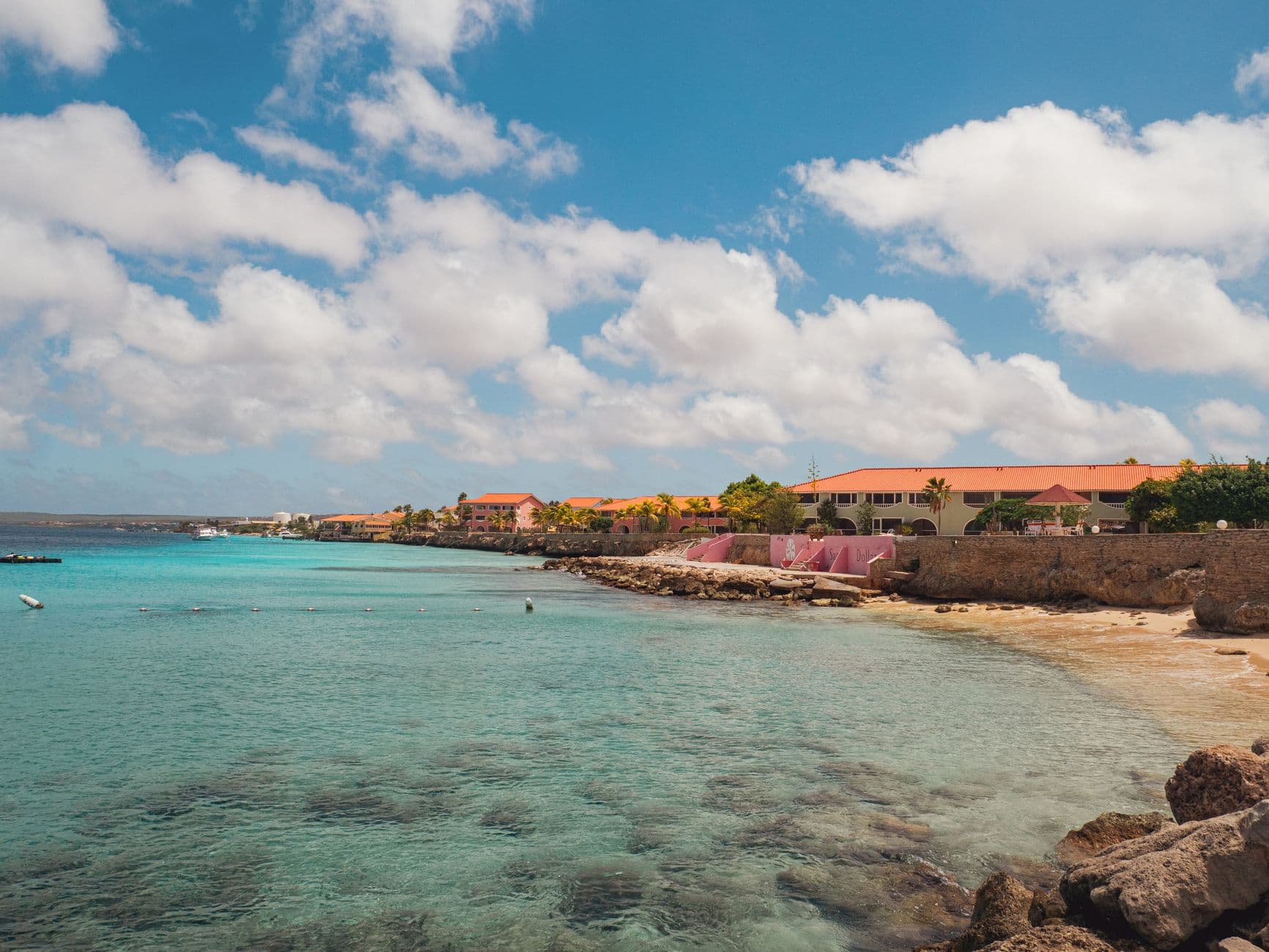
Planning a trip to Bonaire is straightforward — there is no wet season, no hurricane season, and no time of year when the diving shuts down. The island sits 29 kilometers north of Venezuela's Paraguaná Peninsula, comfortably south of the hurricane belt in the southern Caribbean, and its waters maintain a comfortable 26–29 °C (78–84 °F) temperature year-round. Visibility averages 20–35 meters and frequently exceeds 35 meters, making Bonaire one of the most predictably clear-water dive destinations on Earth.
If Bonaire has one weather challenge, it is the wind. The island experiences steady trade winds from the northeast at 15–25 km/h (9–15 mph), and on stronger days gusts can exceed 40 km/h. The wind drives surface chop — especially on the north and east coasts — which can affect boat launches and the few east-facing shore sites. But the wind also drives the water clarity. The trade winds keep surface water mixing, limiting algal blooms and contributing to the consistently excellent visibility that Bonaire is famous for.
This guide covers the real numbers — temperature by month, visibility patterns, current behavior, seasonal species, and what conditions feel like at different times of year — so you can plan your Bonaire dive trip with confidence.
The Numbers That Matter Most
Water temperature: 26–29 °C (78–84 °F) year-round. The island's proximity to the equator and its location south of the hurricane belt mean the water temperature barely fluctuates across the calendar. The warmest months (August–October) reach 28–29 °C (82–84 °F), and the coolest (January–February) still hold 26–27 °C (79–81 °F). You never need more than a 3 mm wetsuit in Bonaire, and many divers prefer to dive in just a rash guard or swimsuit.
Visibility: 20–35 m (65–115 ft) on average, often exceeding 35 m around Klein Bonaire. The fringing reef system along Bonaire's west coast typically delivers 20–30 m visibility, while the waters around Klein Bonaire — more exposed to open-ocean circulation — regularly produce 30–40 m. Wind-driven surface chop is the only real factor limiting visibility; on a calm day even west-coast sites can push past 30 m.
Current: Generally mild to moderate. Most Bonaire shore sites feature gentle currents of 0.5–1.5 knots, driven by the prevailing trade winds and the island's reef geometry. The reef terrace at 3–8 meters drops gently to the reef slope at 15–25 meters, then the wall descends to 30–45 meters. Currents along the wall are typically mild but can strengthen on exposed sites. Sites 35–63 along the main island's west coast experience slightly stronger flow than the more sheltered northern sites. Klein Bonaire's lettered sites can experience moderate currents at deeper wall sections.
Thermoclines: Bonaire does not have thermoclines. Unlike tropical destinations where a warm surface layer gives way to a distinct cold layer at 20–30 meters, Bonaire's water temperature is nearly uniform from surface to bottom. The entire water column stays within a 2–3 °C range at any given time. This means your wetsuit choice is the same whether you're diving at 10 meters or 35 meters.
Depth range by site type: Shore dives range from 6–30 m (20–100 ft), with most sites accessed from a shallow reef terrace at 3–5 m. Wall dives run 25–45 m (80–150 ft). The Hilma Hooker wreck sits at 28 m and extends from 10 to 44 meters. East-coast and south-coast shore sites tend to be shallower (6–18 m) and are ideal for beginner divers and snorkelers.
Best season overall: Bonaire has no bad season. However, the absolute best conditions — warmest water, calmest seas, peak visibility — run from August through October. The trade winds are typically slightly weaker during these months, and marine activity is consistently high.
Month by Month
January – March: Warm Water, Clear Seas, Quiet
Winter in the Caribbean is peak season for Bonaire. While North America and Europe are locked in cold weather, Bonaire delivers 26–27 °C (79–81 °F) water, 25–35 m visibility, and steady sunshine. This is when the island's dive shops are busiest, attracting divers from northern climes seeking reliable tropical diving.
Conditions during these months are generally excellent. The trade winds are moderate (15–20 km/h), seas are calm to slight, and visibility is consistently good. The north coast can experience slightly stronger wind chop, but the west coast — where nearly all of Bonaire's famous shore sites are located — remains sheltered and swimmable.
Marine life during winter includes resident green turtles, eagle rays visiting cleaning stations, and occasional whale shark sightings. Sea turtle nesting runs along Klein Bonaire's beaches from February through April. Night dives at Bari Reef and White Hole add tarpon, octopus, and nocturnal crustaceans to the experience.
Wetsuit: 3 mm full suit or rash guard. Most divers are comfortable in a swimsuit or rash guard alone, but a thin 3 mm suit adds comfort on early-morning dives when the water feels slightly cooler and you spend more time in the truck getting to sites.
Target species: Green turtles, eagle rays, seahorses (three species), frogfish, parrotfish, angelfish, bannerfish, barracuda, occasional whale sharks.
Best sites: Nearly all shore sites are ideal. The north-facing sites (like Haven's Peak and 27 Palm) may see slightly more surface chop but are still excellent. The western sites from 18th Palm through 45th Palm are particularly calm.
April – June: Building Toward Peak Season
April through June marks the transition from peak-season comfort toward optimal conditions. Water temperature climbs to 27–28 °C (81–82 °F), and visibility begins its annual ascent toward the 35+ meter marks that Bonaire is famous for.
April and May see an increase in marine activity. Sea turtle nesting on Klein Bonaire peaks from April through June, and nests hatch from May through July. The number of manta rays and eagle rays visiting cleaning stations rises as water temperatures warm. This is also when you're most likely to encounter large pelagics — sailfish, mahi-mahi, and occasionally marlin — cruising the deeper channels beyond the reef wall.
By June, the trade winds begin to shift slightly, and surface conditions stabilize. June is when Bonaire's most popular shore sites start hitting their peak clarity and animal activity levels. The weather is reliable enough that even last-minute trip planners can count on good conditions, though booking a rental truck and dive insurance in advance remains essential.
Wetsuit: 3 mm full suit or rash guard. The water is warm enough that minimal thermal protection is the norm. Most divers bring a 3 mm suit for early-morning comfort and a few extra dives at deeper wall sections.
Target species: Sea turtles (nesting season), eagle rays, manta rays (increasing), seahorses, frogfish, parrotfish, angelfish, sea fans, gorgonians, moray eels, night-diving species.
Best sites: All sites are in full operation. The deeper wall sites at Klein Bonaire (Mooi Four, Flapjack, Java Reef) deliver exceptional clarity and marine life in June.
July – September: Peak Conditions
July, August, and September are the absolute best months for Bonaire diving, but with one important caveat: these are also the busiest months. The combination of warmest water (28–29 °C / 82–84 °F), calmest seas, and highest visibility (30–40 m at Klein Bonaire) draws the largest number of divers from around the world.
Visibility reaches its peak during these months. The water column is stable, there is minimal runoff or algal bloom activity, and the trade winds are generally lighter than in winter. At Klein Bonaire's lettered sites, 35+ meter visibility is routine. Even the main island's western shore sites consistently deliver 25–35 m.
Marine life is at its most active. Cleaning stations at Tori's Reef, Joanne's Sunchi, and Invisibles attract eagle rays on nearly every dive. Manta ray visits become more frequent, particularly at Jeff Davis Memorial. The three resident seahorse populations — dwarf at Cliff, lined at Salt Pier, and longsnout at Bari Reef — are in their most active and visible condition. The shallow reef sites are packed with life: parrotfish, angelfish, butterflyfish, groupers, and snappers create a living mosaic across the reef terrace.
The busy season comes with practical implications. Rental trucks fill up quickly — you need to book in advance. Dive shop gear rental (if needed) also fills fast. But because Bonaire's diving is primarily shore-based and independent, crowding is minimal. Each site accommodates only a handful of divers at a time, and the 80+ active sites spread divers across the entire island.
Wetsuit: 3 mm full suit, 3 mm shorty, or rash guard. Most divers in summer months are comfortable in just a swimsuit with reef boots for rocky entries.
Target species: All resident species at peak activity — sea turtles, eagle rays, manta rays, seahorses (all three species), frogfish, nudibranchs, reef fish schools, barracuda, moray eels, nocturnal macro life.
Best sites: Every active site is in full operation. Klein Bonaire sites (A–Z) deliver peak clarity. The wall sites from 35th Palm through 63rd Palm are outstanding. The Hilma Hooker wreck is at its most vibrant with surrounding reef fish.
October – December: Excellent Conditions, Fewer Divers
October is the graceful exit from peak season. Water temperatures stay warm at 27–28 °C (81–82 °F), visibility remains excellent at 25–35 m, and the trade winds gradually strengthen. By November, the winds pick up noticeably (20–30 km/h), and some of the more exposed north-facing sites may see surface conditions that make shore entry less comfortable.
The real advantage of diving Bonaire in October and November is the contrast between conditions and crowds. You still get 26–28 °C water, 25+ meter visibility, and excellent marine life — but the dive shops are quieter, truck rentals are more readily available, and you may find yourself at a favorite site with only a handful of other divers.
By December, the trade winds are stronger and the seas can be rougher on the north and east coasts. The west coast remains generally swimmable, but some divers prefer to focus on the most sheltered sites during this period. The water temperature is still a comfortable 26–27 °C (79–81 °F) — there is no cold-water penalty for diving Bonaire in winter.
Sea turtle nesting activity continues on Klein Bonaire through December. October and November also see the last of the seasonal whale shark passages, with occasional sightings documented through November.
Wetsuit: 3 mm full suit becomes more useful as the season progresses. By December, a full 3 mm suit with hood is a comfortable choice for early-morning and wall-site dives.
Target species: Sea turtles (nesting tail-end), eagle rays, seahorses, reef fish, hagfish, octopus, barracuda, occasional whale sharks (October–November).
Best sites: Sheltered west-coast sites dominate: the northern section (18th Palm through 25th Palm) and the protected areas around Klein Bonaire. Avoid the north-facing sites in stronger wind periods.
Reading Bonaire Currents
Bonaire's currents are generally among the mildest in the Caribbean. The island's geography — a flat limestone platform extending into the Caribbean Sea, with a fringing reef that runs along the west coast — creates predictable, gentle flow patterns.
West-coast shore sites: Currents run gently along the reef slope at 0.5–1.5 knots, typically flowing from north to south following the trade wind direction. On most dives, the current is too mild to affect your drift significantly. You can dive in either direction along the wall, and most divers choose the direction that matches the prevailing flow. The current is strongest at deeper wall sections (25–35 m) and mildest on the shallow reef terrace (3–10 m).
Klein Bonaire: The lettered sites around the small island to the west experience slightly stronger currents, particularly at the deeper wall sections. Sites G through M — the heart of Klein Bonaire's dive area — feature wall drops at 10–15 m that produce moderate flow (1–2 knots) at depth. The shallower sites (A–F) are gentler and ideal for beginners.
East and south coasts: These areas are more exposed to open-ocean swell and experience stronger, less predictable current patterns. Most east-coast sites are shallow (6–18 m) and see mild flow, but they are less sheltered from surface wind and waves. South-coast sites like the reef drops at East End have moderate to strong currents and are recommended for more experienced divers.
Wall dives: The deeper wall sections (30–45 m) on both the main island and Klein Bonaire can experience moderate current (1.5–2.5 knots) during certain tidal conditions and wind patterns. Divers should check conditions on entry and turn back if the current exceeds comfortable swim speed. Bonaire's shore-entry format gives you complete freedom to abort and return — there is no boat schedule forcing you to continue in conditions you find uncomfortable.
Weather and Surface Conditions
Bonaire's surface conditions are driven almost entirely by the trade winds. There is no monsoon season, no hurricane risk, and no tropical storm system that threatens to cancel dive trips.
Wind: The dominant northeast trade winds run 15–25 km/h (9–15 mph) on most days, with occasional stronger periods. When wind gusts exceed 35–40 km/h (22–25 mph), surface conditions become rough, particularly on the north and east coasts. The west coast is generally sheltered even in stronger winds.
Sea state: Most days produce slight to moderate seas (0.5–1.5 m). On rare occasions when weather systems pass through, seas can reach moderate heights (1.5–2.5 m), but this is uncommon and typically short-lived.
Rain: Bonaire receives relatively low rainfall for the Caribbean (approximately 500–600 mm annually), and there is no distinct rainy season. Brief showers can occur any month, but they rarely last more than an hour and typically clear quickly. Rain does not significantly reduce underwater visibility because the island has no major rivers or runoff.
Sun: Bonaire enjoys approximately 2,800 hours of sunshine per year. UV levels are high year-round — UV index 10–12 during midday. Reef-safe sunscreen is recommended, and consider a rash guard for extended sun exposure on the surface between dives.
Gear Recommendations for Bonaire Conditions
Wetsuit: 3 mm full suit or rash guard is the standard. Many divers dive in just a swimsuit during summer months. A 3 mm suit is recommended for early-morning dives, deeper wall sections, and multi-dive days when cumulative cold exposure becomes noticeable.
Reef boots: Essential for most shore entries. The stone steps and rocky entries at Bonaire's dive sites are designed to protect the reef, but they are rough on bare feet. Neoprene reef boots prevent cuts and abrasions and are widely available for rent.
Dive light: Useful for reef detail and night dives. The shallow reef terrace is brightly lit at all times, but a dive light reveals the seahorses, nudibranchs, and small reef creatures that are easy to miss in bright conditions. Night dives at Bari Reef and White Hole are highly recommended.
SMB (surface marker buoy): Not strictly necessary for most Bonaire shore dives — the water is clear and your dive site is literally at the beach. However, an SMB is useful for deep wall dives or if you need to signal the dive shop from a remote entry point.
Underwater camera: Bonaire is one of the Caribbean's premier macro photography destinations. The seahorses at Cliff, the frogfish at Something Special, and the nudibranch diversity make it worth bringing macro gear. For wide-angle, the wall dives at Klein Bonaire with 30+ meter visibility are exceptional.
Summary Table
| Month | Water Temp | Visibility | Current | Marine Activity | Best For |
|---|---|---|---|---|---|
| Jan–Mar | 26–27 °C | 25–35 m | Gentle | High (turtles, rays) | Peak season comfort, clear water |
| Apr–Jun | 27–28 °C | 25–35 m | Gentle | Building (nesting, pelagics) | Turtle nesting, improving conditions |
| Jul–Sep | 28–29 °C | 30–40 m | Gentle–Moderate | Peak (all species) | Best visibility, most animal activity |
| Oct | 27–28 °C | 25–35 m | Gentle | High | Shoulder pricing, warm water |
| Nov–Dec | 26–27 °C | 20–30 m | Gentle–Moderate | Moderate | Fewer divers, calm on west coast |
Bottom Line
Bonaire is the most predictably comfortable dive destination in the Caribbean. The water is warm year-round, the visibility is consistently excellent, the currents are mild, and the weather is almost always suitable for diving. If you pick any month — January through December — you can count on 26 °C+ water, 20+ meter visibility, and world-class reef diving. The decision of when to visit Bonaire should be based on your calendar and budget, not on weather concerns. Book a rental truck, buy your STINAPA tag, and walk into the ocean — the reefs are waiting.