Top 10 Dive Sites in the Banda Islands: Ranked Guide for 2026
The Banda Islands have ~25–30 named dive sites across a compact area, with most operators rotating among a proven set of 5–10 core sites. The range is remarkable for such a small archipelago: sheltered volcanic crater lagoons with no current at one end of the spectrum, and open-ocean pelagic walls with 2–3 knot currents and 600-meter dropoffs at the other.
This guide ranks the top 10 dive sites across the Banda Islands by what they offer, who they're for, and when to dive them. The list draws from published operator guides, field reports, and the 40 marine species catalog documented for the destination.
1. Nutmeg Drop (Run Island — Pelagic Wall)
Type: Pelagic wall / drop-off | Depth: 5–600+ m (recreational to 40 m) | Location: Western side of Run Island, ~14 km SW of Banda Neira | Difficulty: Advanced | Best season: September–December (peak hammerheads October–November)
This is the dive that defines Banda. The wall drops from the surface to 600+ meters within 50 meters of shore — one of the steepest reef-to-abyss transitions in Indonesia. You descend into blue water with no visual bottom reference, and the wall face is covered in giant gorgonian sea fans and black coral trees.
The draw: scalloped hammerhead schools of 50–100+ during October–November, with pelagic thresher sharks as an occasional bonus. Chevron barracuda schools, oceanic mantas, mobula rays, and dogtooth tuna patrol the blue. The strong current (2–3 knots) and blue-water ascents make this advanced-only territory — AOWD with 50+ logged dives is the minimum standard, and most operators enforce it strictly.
Conditions: Depth 5–40+ m rec (wall drops to 600 m). Current strong (2–3 knots — drift diving mandatory). Visibility 15–30 m. Water temp 27–29°C (Sep–Dec). SMB and reef hook mandatory.
Marine life: Scalloped hammerheads (peak Oct–Nov), pelagic thresher sharks (occasional), chevron barracuda, hawksbill turtles, manta rays, mobula rays, bumphead parrotfish, giant trevally, dogtooth tuna.
2. Karang Hatta (Hatta Reef)
Type: Submerged reef / wall | Depth: 5–40+ m | Location: Pulau Hatta, ~25 km SE of Banda Neira | Difficulty: Intermediate | Best season: September–December (hammerheads), March–April (corals)
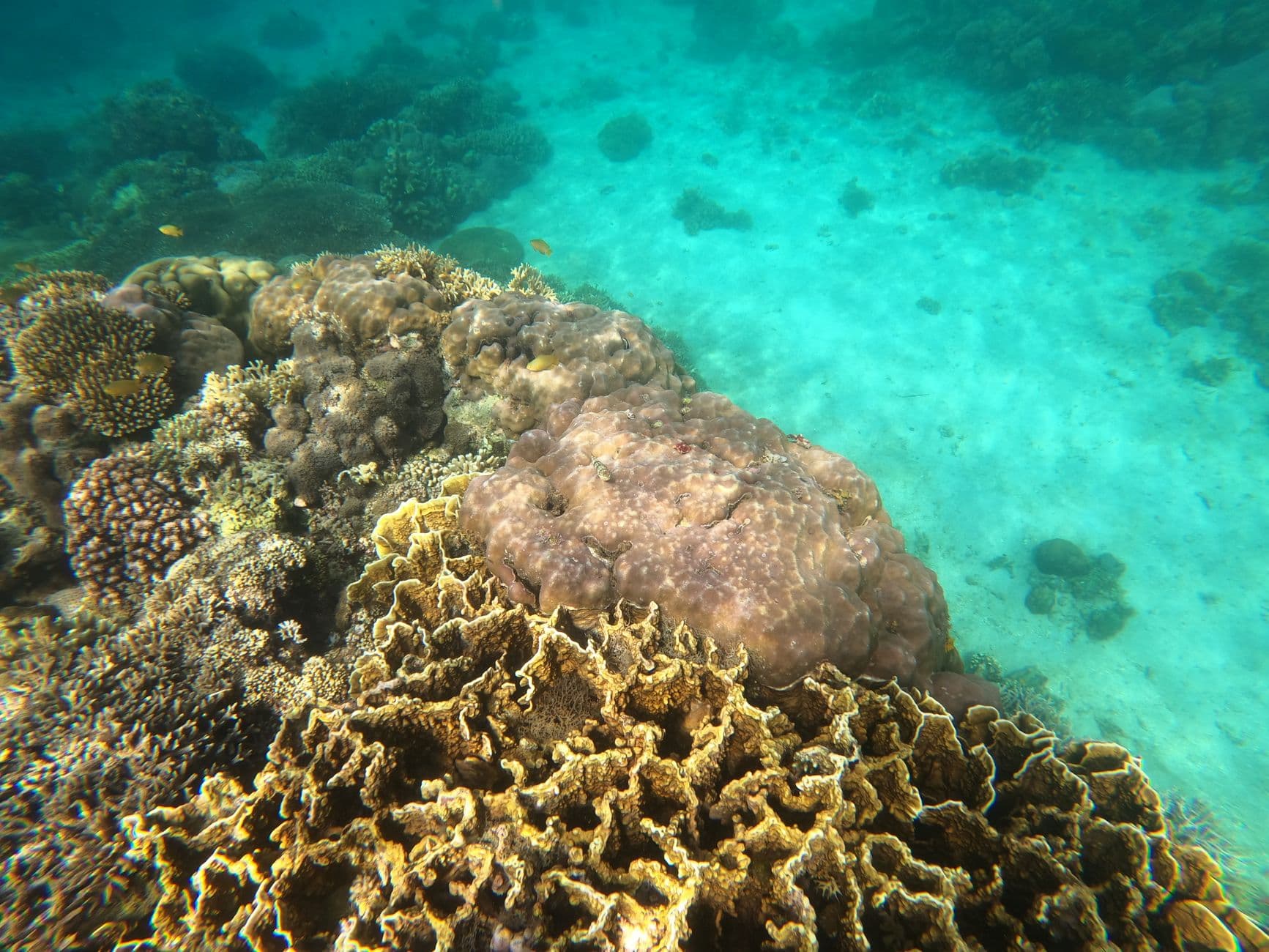
Karang Hatta is a 500-meter-wide submerged reef that delivers the most concentrated biodiversity in the Banda circuit. The southerly current draws thousands of neon fusiliers into a living tornado of blue and yellow — one of the most mesmerising spectacles in the Banda Sea. Massive barrel sponges and dense hard coral cover the reef face, and the coral diversity here is among the highest recorded in Indonesia.
Hammerheads are regular visitors during September–December, cutting through fusilier schools on their patrol routes. Dogtooth tuna, eagle rays, great barracuda, and green turtles are reliably sighted. The reef structure supports a full food chain from macro to megafauna.
Conditions: Depth 5–40+ m. Current moderate (southerly, 1–2 knots). Visibility 15–30 m. A full reef hook and drift-dive comfort are needed. Requires a boat trip of roughly 45–60 minutes from Banda Neira.
Marine life: Thousands of neon fusiliers, scalloped hammerheads (Sep–Dec), dogtooth tuna, eagle rays, great barracuda, green turtles, whitetip reef sharks, bumphead parrotfish, Napoleon wrasse, giant moray.
3. Lava Flow (Gunung Api)
Type: Volcanic reef / lava field | Depth: 3–30 m | Location: Gunung Api volcano, across the harbor from Banda Neira | Difficulty: Beginner–Intermediate | Best season: Year-round (new moon best for mandarinfish)
Lava Flow is the comeback story of Banda's reefs. The 1988 eruption of Gunung Api sent lava cascading into the sea, destroying the entire reef in its path. Within 35 years, table corals 3–4 meters wide — growing 3× faster than normal on the nutrient-rich volcanic substrate — have recolonized the lava field. The result is a unique underwater landscape of black basalt draped in living coral.
The site is also home to one of the most reliable mandarinfish mating displays in all of Indonesia. At dusk during the new moon, dozens of mandarinfish rise from the coral rubble to perform their synchronized dance — a 10-minute window of electric blue and orange flashes. The sheltered crater lagoon means near-zero current, making this the most accessible dive in Banda.
Conditions: Depth 3–30 m. Current mild to none (sheltered). Visibility 20–30 m. Entry by boat, easy return. Perfect for check-out dives, photographers, and divers who need a calm day.
Marine life: Mandarinfish (dusk, new moon reliability), clown triggerfish, Napoleon wrasse, batfish schools, mobula rays (feeding on plankton), dogtooth tuna, broadclub cuttlefish, leaf scorpionfish, harlequin sweetlips, ornate ghost pipefish, giant clams.
4. Batu Kapal (Ship Rock)
Type: Pinnacle series | Depth: 5–34+ m | Location: Northwest of Pulau Pisang | Difficulty: Intermediate–Advanced | Best season: March–April, September–December
Batu Kapal is a series of dramatic pinnacles rising from deep water, encrusted with enormous gorgonian sea fans and barrel sponges. The southeast pinnacle drops to 34 meters with deep purple whip coral fans. This is a current magnet — the nutrient flow around the pinnacle bases attracts grey reef sharks, trevallies, jacks, and schools of midnight snappers.
The site serves as a cleaning station where grey reef sharks present themselves motionless to cleaner wrasse, often hovering for minutes in the current. Pygmy seahorses are occasionally spotted on the larger gorgonian fans. The pinnacle structure creates excellent wide-angle photography opportunities with diver silhouettes against the fan-covered rock.
Conditions: Depth 5–34+ m. Current moderate to strong. Entry by boat. SMB required. Best on neap tides when current is manageable for intermediate divers.
Marine life: Grey reef sharks, whitetip reef sharks, midnight snappers, bigeye bream, potato cod, giant moray, honeycomb moray, yellowtail barracuda, jacks, trevallies, pygmy seahorses (occasional).
5. Batu Wali
Type: Wall / MPA core zone | Depth: 5–40+ m | Location: Western side of northern tip of Banda Besar | Difficulty: Intermediate–Advanced | Best season: March–April, September–December
Batu Wali sits inside the core zone of the Banda Marine Protected Area — no fishing, no collecting, no anchoring on the reef — and the protection shows. The vertical wall features a wide step at 30 meters with massive barrel and green vase sponges. The wall was designated as MPA core in part for its exceptional reef health and as a spawning area for pelagic plectropomus grouper.
The wall attracts bumphead parrotfish, Napoleon wrasse, groupers, emperors, and barracuda. A unique feature is the blood-red bulb-tentacle anemone hosting deep red anemonefish — a color variation rarely seen outside eastern Indonesia.
Conditions: Depth 5–40+ m. Current moderate to strong (channel current). Thermoclines can drop to 23–24°C during June–August SE monsoon. SMB and reef hook recommended.
Marine life: Bumphead parrotfish, Napoleon wrasse, groupers, emperors, barracuda, blood-red anemonefish, peacock mantis shrimp, crown-of-thorns starfish (low density), broadclub cuttlefish.
6. Pulau Run — Run Pelagic Wall (Southern Cape)
Type: Pelagic wall / drift | Depth: 5–40+ m | Location: Southern cape of Run Island | Difficulty: Advanced | Best season: September–November
The southern face of Run Island offers the most aggressive pelagic action in Banda. Where Nutmeg Drop focuses on the western wall's hammerhead aggregations, the southern cape delivers higher-density encounters with multiple predator species — scalloped hammerheads, pelagic threshers, mobula rays, dogtooth tuna, and giant trevally all work the wall.
This site demands strong drift-diving skills. Current consistently runs 2–3 knots, blue-water ascents are the norm, and the boat pick-up requires good SMB deployment. Not a site for divers with any hesitation about drift conditions.
Conditions: Depth 5–40+ m. Current strong (2–3 knots). Visibility 15–30 m. Advanced only — mandatory SMB, reef hook, and blue-water ascent training. Do not dive Jan–Jul (rough seas, fewer sharks).
Marine life: Scalloped hammerheads (50–100+), pelagic thresher sharks, mobula rays, dogtooth tuna, giant trevallies.
7. Pulau Ai — Tanjung Batu Payong
Type: Steep wall | Depth: 5–60+ m | Location: Pulau Ai, northwest of Banda Neira | Difficulty: Intermediate–Advanced | Best season: September–December
Tanjung Batu Payong is the steepest wall on the Ai circuit, dropping to 60+ meters with a superb shallow reef flat covered in expansive hard coral fields. Barrel sponges and gorgonians cover the wall face, and the area attracts whitetip reef sharks and silvertip sharks (seasonal).
The highlight is mobula ray formations — up to 25 individuals cruising the wall in synchronized flight. Eagle rays and turtles are regular sightings. The shallow reef flat (5–12 m) provides excellent light for photography and serves as a reliable safety stop.
Conditions: Depth 5–60+ m. Current mild to moderate. Best visibility Sep–Dec. Intermediate divers can work the shallow reef; advanced divers drop onto the wall face.
Marine life: Whitetip reef sharks, silvertip sharks (seasonal), mobula rays (up to 25 in formation), hawksbill turtles, green turtles, eagle rays, large reef fish.
8. Manuk Island (Banda Sea Region — Distant)
Type: Volcanic walls / black sand slopes | Depth: 5–40+ m | Location: ~100 miles (160+ km) west of Banda Islands | Difficulty: Advanced (heavy drift, blue-water ascents) | Best season: August–October
Manuk Island is an active volcano accessible only by liveaboard — the crossing from Banda Neira takes 8–14 hours. The reward is one of the most unique dives on the planet: hundreds of banded sea kraits hunting in cooperative feeding relationships with giant trevally. The snakes flush prey from volcanic crevices and the trevally catch the escapees.
Geothermal vents warm sections of the wall, creating microhabitats for species not found elsewhere in the Banda circuit. Pelagic activity around the volcano is outstanding — scalloped hammerheads, grey reef sharks, and tuna are regularly sighted. The volcanic black sand slopes at 15–25 m host garden eels and rays.
Conditions: Depth 5–40+ m. Current variable (mild to strong). Visibility 25–40 m. Liveaboard only — not reachable on a day trip from Banda Neira. Best Aug–Oct (SE monsoon). Impossible Jan–Feb (NW monsoon).
Marine life: Hundreds of banded sea kraits, scalloped hammerheads, grey reef sharks, reef sharks, mackerel, tuna, barracuda, fusiliers, seabirds (frigatebirds, boobies).
9. Pulau Ai — Batu Udang (Shrimp Rock)
Type: Gentle slope then steep drop | Depth: 5–55 m | Location: Pulau Ai | Difficulty: Intermediate | Best season: September–December
Batu Udang starts as a gentle slope to 13 m and then drops steeply to 55 m — a profile that makes it accessible for intermediate divers who want access to deeper water without committing to a full wall dive. The site is known for reliable shark and ray encounters.
Whitetip reef sharks are common, eagle rays regularly cruise the slope break, and hawksbill turtles forage on the reef. Hammerheads are seasonal here (Sep–Dec) in smaller numbers than Run Island. The site is also good for macro subjects on the shallow slope.
Conditions: Depth 5–55 m. Current mild. Good for intermediate divers transitioning to deeper water. Accessible as part of a Pulau Ai day trip.
Marine life: Whitetip reef sharks, eagle rays, hawksbill turtles, Napoleon wrasse, scalloped hammerheads (seasonal, Sep–Dec), broadclub cuttlefish, bluespotted ribbontail rays.
10. Banda Neira Harbour (Mandarinfish Site / Muck)
Type: Muck / harbour reef | Depth: 2–15 m | Location: Banda Neira jetty area | Difficulty: Beginner | Best season: Year-round (new moon best)
This is the closest dive to town — shore entry from the jetty — and it serves as Banda's reliable muck diving site. The main attraction is the mandarinfish mating ritual at dusk, which is one of the most predictable displays in Indonesia. Frogfish, Ambon scorpionfish, nudibranchs, cuttlefish, and a variety of juvenile reef fish populate the harbour floor.
The shallow depth (2–15 m) and near-zero current make it ideal for photographers, night dives, and divers who want a relaxed third dive of the day. Bioluminescent plankton is exceptional after dark during the new moon.
Conditions: Depth 2–15 m. Current none to very mild. Shore entry from jetty. No SMB needed. Ideal for night dives and macro photography. New moon timing maximizes the mandarinfish display.
Marine life: Mandarinfish (mating ritual at dusk), frogfish, Ambon scorpionfish, nudibranchs, cuttlefish, octopus, stargazers, bioluminescent plankton (night), juvenile reef fish.
Honorable Mentions
Batu Belanda (Dutch Rock): Western coast of Banda Besar — wall to 24 m known for the rare Lembeh sea dragon (pipefish-seahorse hybrid endemic to Indonesia) hiding among black crinoids. Best Sep–Dec.
Banda Besar Barracuda Wall (East Side): Drift dive along the eastern face of Banda Besar. Schools of 200–400 chevron barracuda hover motionless in the current. Best midday with sun overhead for wide-angle photography. Peak Oct–Mar.
Nusa Laut: "Mini Raja Ampat" fringing reef ~3 hours by liveaboard from Banda. Extremely healthy hard coral, ghost pipefish, frogfish, ribbon eels. Distant — only accessible on multi-day liveaboard itineraries.
Summary Table
| Rank | Site | Depth (m) | Skill | Current | Best Season | Highlight |
|---|---|---|---|---|---|---|
| 1 | Nutmeg Drop | 5–40+ | Advanced | Strong (2–3 kt) | Sep–Dec | 50–100+ hammerheads |
| 2 | Karang Hatta | 5–40+ | Intermediate | Moderate | Sep–Dec | Fusilier tornado, hammerheads |
| 3 | Lava Flow | 3–30 | Beg–Int | None | Year-round | Mandarinfish, coral regrowth |
| 4 | Batu Kapal | 5–34+ | Int–Adv | Mod–Strong | Mar–Apr, Sep–Dec | Pelagics, grey reef sharks |
| 5 | Batu Wali | 5–40+ | Int–Adv | Mod–Strong | Mar–Apr, Sep–Dec | MPA core, barrel sponges |
| 6 | Run Pelagic (S) | 5–40+ | Advanced | Strong (2–3 kt) | Sep–Nov | Multi-species pelagic action |
| 7 | Tg Batu Payong | 5–60+ | Int–Adv | Mild–Mod | Sep–Dec | Mobula formations |
| 8 | Manuk Island | 5–40+ | Advanced | Variable | Aug–Oct | 100+ sea snakes |
| 9 | Batu Udang | 5–55 | Intermediate | Mild | Sep–Dec | Sharks, rays |
| 10 | Neira Harbour | 2–15 | Beginner | None | Year-round | Mandarinfish, muck |