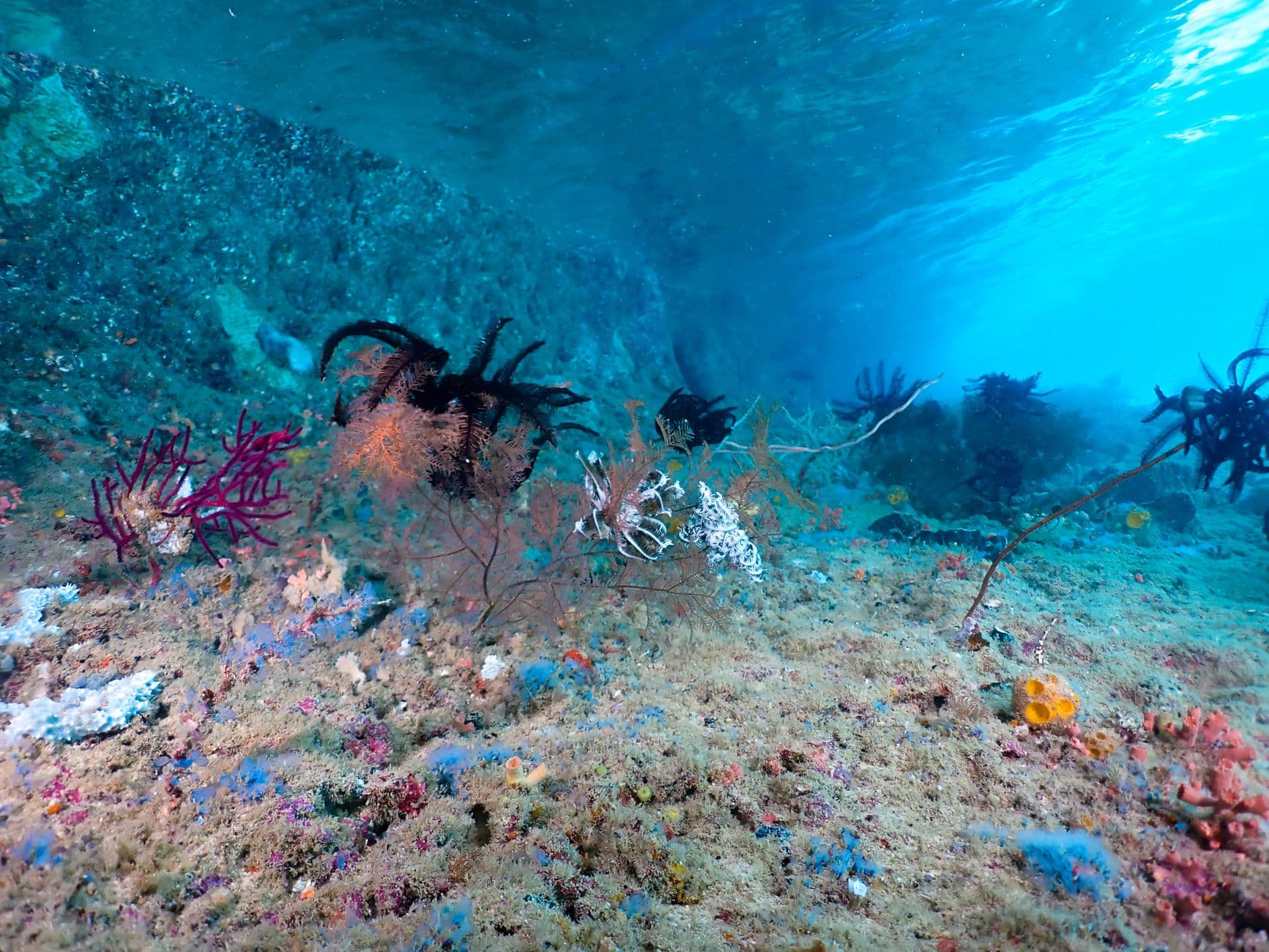
Top 7 Dive Sites in the Azores: A Beginner's Guide
The Azores archipelago stretches 600 km across the mid-Atlantic, and every island has dive sites with wildly different character. Some are sheltered coastal reef dives — calm, shallow, teeming with life. Others are open-ocean seamount expeditions where the seamount summit drops from 32 meters straight into the abyss, and you're swimming past mantas, mobulas, and sharks in crystal-clear water.
This guide ranks the top dive sites across the archipelago so you can pick what fits your skill level, your interests, and your comfort with currents. Every site listed here is verified by local dive operators and supported by field reports.
1. Princesa Alice Bank
Type: Offshore seamount | Summit depth: 32 m | Distance from shore: ~60 km | Difficulty: Advanced | Best season: June–September
The Princesa Alice Bank (Banco Princesa Alice) is the crown jewel of Azores diving — and arguably the most impressive single dive site in the entire Atlantic. This submarine volcano rises from more than 1,500 meters of ocean floor to a summit at just 32 meters below the surface. At its widest point it covers nearly 130 km², and its steep walls create a vertical drop-off that plummets immediately once you cross the reef line.
Every summer, the nutrient-rich currents that flow over the seamount summit trigger an explosion of plankton — and with it, one of the most spectacular aggregations of mobula rays on Earth. Dive operators report 500–1,000+ mobula rays crossing the site in a single dive, with individuals regularly exceeding 3 meters in wingspan. The rays swim in loose schools, climbing the seamount walls in massive spiraling formations that can envelop the entire dive site.
Blue sharks are a regular presence here, especially during Dollabarat expeditions that share the same waters. Mako sharks, sailfish, and dolphins are also frequently sighted. By autumn (late September–October), manta rays (Manta birostris) begin using the bank as a cleaning station, joining the mobulas already present.
Access: Boat expeditions depart daily from Pico (PiçãodaBara), Faial (Horta), and sometimes São Miguel during peak season. A full-day trip, usually 8–10 hours, is required. Boat divers need at minimum an Advanced Open Water certification with open-ocean experience, and good fitness is essential — you're in the water for 2–3 hours, often in strong currents, dealing with 40–50 meter pressure changes on every dive.
Target species: 500–1,000+ mobula rays per dive (June–September), blue sharks, mako sharks, manta rays (September–October), dolphins, sailfish, tunas.
Dive profile: Descend along the reef wall to 32 m, hold bottom on the summit plateaus for 15–30 minutes (current dependent), then ascend along the wall. Dive operators typically run 2–3 dives per boat trip, ending with the shallower coastal sites if time allows.
Why it's the best: The sheer density of mobulas on a single dive is unlike anything else in the world. The combination of warm water (22–25 °C in August–September), extreme visibility (25–40 m), and massive animal abundance makes this the Azores' definitive dive experience.
Practical tips: Book at least 2–3 months in advance for summer travel — the Princesa Alice Bank boat slots fill up very quickly. Wear a 5 mm wetsuit (some divers use 3 mm in peak summer). Bring an SMB — the current can drift you significant distances from the boat. Be prepared for a full-day sea voyage with some potential for motion sickness.
2. Vila Franca do Campo
Type: Protected caldera | Max depth: 29 m | Distance from shore: ~500 m | Difficulty: Open Water | Best season: June–October
Vila Franca is the Azores' most accessible major dive site, and it's one of the most beautiful caldera dives in the world. The site is located in the interior of a flooded volcanic caldera on São Miguel, reachable by a short boat ride from Porto Formoso. The volcanic island — which formed during a subaerial eruption about 6,000 years ago — is now a protected marine reserve, and its lush, tree-covered center creates a genuinely otherworldly underwater experience.
The caldera floor is relatively flat and shallow (8–12 m), with a rim at 29 m. The dramatic vertical walls of the caldera surround you completely — red volcanic rock gives way to green algae and patches of white coralline algae at the shallower depths. The interior harbor is calm enough that even beginner divers feel completely safe.
Visibility at Vila Franca consistently hits 30–40 m, which is extraordinary for a coastal site. The combination of calm conditions, excellent visibility, warm water in summer, and easy access makes this one of the most popular dive sites in the Azores.
Access: Boat dives from Porto Formoso, São Miguel. The ride to the caldera is only about 10–15 minutes. Dive operators run this site year-round, though winter seas make the approach rougher.
Target species: Red and brown algae, garfish, barracuda, groupers, red corals (paramuricea), jellyfish (seasonal), various reef fish. Summer months add sea turtles, manta rays (passing through), and dolphins.
Dive profile: One dive in the caldera (8–29 m). The site is often combined with a second shallow coastal dive. Can be done by any Open Water diver — no special skills required.
Why it's the best: If you want a stunning underwater experience without any technical difficulty or boat expedition demands, Vila Franca is it. It's the perfect site for introductory divers to Azores diving, and even experienced divers find it magical on its own.
Practical tips: The caldera interior is protected from currents entirely, so you don't need to worry about drift. Visit in the morning when the light is best for underwater photography. Keep your camera under water in a dive housing — the lighting conditions inside the caldera are dramatically better than above water.
3. Dollabarat Seamount
Type: Deep offshore seamount | Summit depth: ~50 m (shark feeding zone) | Distance from shore: ~50 km | Difficulty: Experience Required | Best season: June–November
Dollabarat is a submarine mountain about 50 km off Pico's coast that drops from 1,500 meters and has a complex summit plateau with multiple peaks at varying depths. It's most famous among the Azores' dive sites for its blue shark diving — one of the few places in the world where large aggregations of blue sharks can be reliably encountered by recreational divers.
The Dollabarat shark dives operate between July and November, with peak activity in August and September. The process is unique: operators deploy a bait station at 30–40 m to attract sharks, and divers descend to observe the feeding behavior. Blue sharks aggregate in groups of 10–30, with individuals regularly reaching 2.5–3 meters in length. The feeding frenzy creates a spectacle that draws multiple shark species, and mako sharks are frequently sighted in the area.
This is not a guilt-free whale-shark-style experience — the use of bait is controversial among some conservationists. However, Dollabarat remains one of the most powerful large-predator encounters available to recreational divers, and the Azores has established specific regulations around the practice to minimize ecological impact.
Access: Boat expeditions depart from Pico (PiçãodaBara) and Faial (Horta). Full-day trips, 8–10 hours, with typically 1–2 dives. Divers need Advanced Open Water certification, at least 50 logged dives, and explicit comfort with baited shark encounters. Some operators require a minimum of 100 logged dives.
Target species: Blue sharks (10–30 individuals), mako sharks, sailfish, tunas, marlin, dolphins.
Dive profile: Descent to 30–40 m for the bait zone, hold bottom for 20–40 minutes depending on shark activity, then ascend to deeper seamount levels for a second phase of the dive.
Why it's unique: The Dollabarat shark encounter is arguably the most dramatic large-predator diving experience in the recreational scuba world. The number of blue sharks on a single dive is unlike anything else available to recreational divers.
Practical tips: Check current ethical guidelines and operator practices before booking. If shark baiting concerns you, consider this alternative: the Dollabarat waters also produce excellent shark encounters without bait during certain months, and the Dollabarat summit plateau itself is a rewarding site for observing pelagic species at depth.
4. Príncipe Alberto Passage (Príncipe Alberto Channel)
Type: Current channel | Depth: 10–30 m | Distance from shore: Between Pico and Faial | Difficulty: Intermediate–Advanced | Best season: June–September
The Príncipe Alberto Passage (Canal do Príncipe Alberto) is the strait between the islands of Pico and Faial, and it's one of the best spots in the Azores for encountering manta rays (Manta birostris). This narrow channel concentrates currents and nutrients as water flows between the two islands, creating feeding and cleaning stations that attract large manta populations.
Manta ray encounters here are among the most reliable and memorable in the Azores. The rays, which can reach 4–5 meters wingspan, gather in the channel to feed on plankton and visit cleaning stations where smaller fish remove parasites. Divers can observe mantas from close range — sometimes right alongside — as they glide gracefully past.
The channel experience is also rewarding for non-pelagic divers. The rocky bottoms, kelp forests, and colorful reef fish create a rich environment even if you don't get a manta encounter. Groupers, barracuda, and schools of garfish are common.
Access: Boat dives from both Pico (PiçãodaBara) and Faial (Horta). Dives typically last 30–60 minutes. The site is suitable for Advanced Open Water divers and above, though current-dependent dives may require specific training.
Target species: Manta rays (June–September, peak), blue sharks, dolphins, tuna, marlin, garfish, barracuda, groupers.
Dive profile: Descend to 10–30 m, drift with the current along the channel walls, observe manta activity. The channel has variable current depending on tidal cycles and wind conditions.
Why it's best: The Príncipe Alberto Passage offers the best chance of swimming alongside manta rays in the Azores. These are large, majestic creatures, and encounters in the channel are typically very close and unhurried.
Practical tips: Manta rays are seasonal — June to September is the peak window. Currents can be moderate (1–2 knots), so be prepared to adjust your position by kicking and using your trim. Best experienced with a naturalist guide who can read manta behavior patterns.
5. Ilhéus das Cabras
Type: Rocky reef and caves | Depth: 8–32 m | Distance from shore: ~2 km | Difficulty: Intermediate | Best season: May–October
Ilhéus das Cabras (Goat Islands) is a cluster of small rocky islands and underwater rock formations located about 2 km offshore from the southern tip of São Miguel. This site is one of the most biodiverse in the Azores, with a complex underwater landscape of caves, arches, overhangs, and nutrient-rich rocky walls.
The rocky formations create a maze of tunnels and passages that divers can explore. The caves reach depths of 20–30 m, and the narrow openings create dramatic light effects as sunlight filters through. The biodiversity here is extraordinary — macro life includes colorful nudibranchs, sea squirts, and small crustaceans, while larger animals include groupers, octopuses, and occasional sea turtles passing through.
The site is also famous for its large rocky outcrops that attract pelagic species. Blue sharks, tuna, and dolphins are regular visitors, especially during the summer pelagic season.
Access: Boat dives from Ponta Delgada, São Miguel. Boat ride is 15–20 minutes. Suitable for Advanced Open Water divers. Many dive operators offer this site as a day trip.
Target species: Groupers, octopuses, nudibranchs, sea squirts, blue sharks (summer), sea turtles, dolphins, tuna, barracuda, various reef fish.
Dive profile: Explore the caves and rock formations at 8–30 m. The site can be challenging in strong current — dive operators typically run dives in one direction following the natural flow. Usually one dive per site, often combined with a second coastal dive.
Why it's great: The underwater complexity and biodiversity of Ilhéus das Cabras make it one of the most rewarding dive sites in the Azores. The caves and tunnels offer a sense of exploration that's rare in reef diving.
Practical tips: The caves can have restricted visibility if you stir up sediment — use a dive light and move slowly. Current can be strong on the open side — plan your dive with a guide who knows the flow patterns. The site is best in calm seas (May–October) when access is reliable.
6. Formigas Islets Marine Reserve
Type: Marine reserve / rocky reef | Depth: 15–40 m | Distance from shore: ~30 km | Difficulty: Intermediate | Best season: May–October
The Formigas Islets (Ilhéus das Formigas) form a protected marine reserve on the northern coast of Flores, the westernmost island in the Azores. This reserve is one of the most ecologically pristine dive sites in the entire archipelago, with exceptionally healthy reef ecosystems and abundant marine life.
The underwater landscape consists of rocky outcrops, deep channels, and underwater caves that are home to an extraordinary diversity of species. The reserve protects this area from fishing and other human impacts, resulting in unusually large and healthy populations of reef fish, crustaceans, and mollusks.
The marine reserve status creates a peaceful underwater environment where fish aren't afraid of divers — making the Formigas Islets an extraordinary site for both macro photography and large-creature encounters. Hammerhead sharks are known to visit the reserve, though not on every dive. Dolphins and pilots whales are frequent visitors.
Access: Boat dives from Flores (Santa Cruz das Flores) or Horta (Faial). Boat ride is 45–60 minutes from Horta. Suitable for Advanced Open Water divers. The site requires advance booking due to its reserve status and limited visitor numbers.
Target species: Diverse reef fish, large groupers, octopuses, dolphins, pilot whales, hammerhead sharks (seasonal), blue sharks, sea turtles.
Dive profile: Explore the rocky formations and channels at 15–40 m. The site has mild to moderate currents — most divers prefer to follow the natural flow along the reef.
Why it's special: The marine reserve status means Formigas has one of the most intact and healthy ecosystems in the Azores. The abundance and size of reef fish here rival Caribbean sites that have been fished for decades.
Practical tips: Book well in advance — the marine reserve has visitor capacity limits to protect the ecosystem. Night dives in the reserve offer unique experiences — nocturnal reef fish, sea urchins, and octopuses become much more visible. The reserve rules prohibit feeding or handling any marine life — follow the guidelines carefully.
7. Pico Coastal Shelf Dives
Type: Shelf reef and kelp forest | Depth: 12–30 m | Distance from shore: 0.5–2 km | Difficulty: Open Water–Advanced | Best season: May–October
Pico's coastal shelf dives are the most reliable and frequently run dives in the Azores. Located along the north coast of Pico island, these sites feature a shallow shelf (12–18 m) covered in dense kelp forests that give way to a dramatic vertical wall drop-off. The shelf itself is rich with Macaronesian seaweed species, creating a lush, green underwater landscape that's unique to the Azores.
The kelp forests are home to a diverse community of small reef fish, crustaceans, and invertebrates. As you move down the shelf toward the wall, you'll encounter larger species — groupers, barracuda, and eventually pelagic visitors like dolphins and tuna. The wall itself is a vertical black volcanic rock face that extends to well beyond 100 meters, creating a striking contrast with the green kelp and blue water.
The diversity of species on these shelf dives is remarkable for shallow-water sites. You're likely to see parrotfish, wrasse, sea bass, conger eels, octopuses, and dozens of small reef species within the kelp forest. In summer, sea turtles, manta rays, and mobulas pass through the area.
Access: Boat dives from multiple locations along Pico's north coast, including São Lourenço, Calheta de Nesquim, and Madalena. Boat ride is 10–20 minutes. Suitable for all levels from Open Water to Advanced.
Target species: Parrotfish, wrasse, sea bass, conger eels, octopuses, groupers, barracuda, sea turtles (summer), manta rays (summer), dolphins, tuna.
Dive profile: Drop to 12–18 m for the kelp forest, then follow the wall down to 30 m. The wall often encourages multi-level profiles: spend time in the kelp, descend for the wall, ascend along the wall for the final decompression.
Why it's great: The Pico shelf dives offer the best combination of reliability, biodiversity, and accessibility. They're the dives you run on a regular schedule because they consistently deliver quality experiences, and they're the perfect introduction to Azores diving for beginners.
Practical tips: The kelp forest can be dense — keep your fin strokes gentle to avoid damaging the plants. Bring a macro lens for the small creatures in the kelp, and a wide lens for the dramatic wall drop-off. The site is best in calm seas (May–October), but northern coastal sites can be run year-round on stable days.
Summary Table: Azores Top Sites
| Rank | Site | Type | Max Depth | Difficulty | Best Season | Key Species |
|---|---|---|---|---|---|---|
| 1 | Princesa Alice Bank | Seamount | 32 m | Advanced | Jun–Sep | Mobulas (1000+), blue sharks, mantas |
| 2 | Vila Franca do Campo | Caldera | 29 m | Open Water | Jun–Oct | Algae, garfish, reef fish |
| 3 | Dollabarat Seamount | Deep seamount | 50+ m | Experience Required | Jun–Nov | Blue sharks, makos, sailfish |
| 4 | Príncipe Alberto Passage | Channel | 30 m | Int–Adv | Jun–Sep | Manta rays, dolphins, tuna |
| 5 | Ilhéus das Cabras | Rocky reef/caves | 32 m | Intermediate | May–Oct | Groupers, octopus, nudibranchs |
| 6 | Formigas Marine Reserve | Marine reserve | 40 m | Intermediate | May–Oct | Reef fish, dolphins, hammerheads |
| 7 | Pico Coastal Shelf | Shelf/kelp | 30 m | Open–Adv | May–Oct | Parrotfish, wrasse, turtles |
Choosing Your Azores Dive Adventure
The Azores offer diving that ranges from calm caldera dives suitable for beginners to advanced open-ocean seamount expeditions with sharks and rays. Here's a quick guide to matching your skill level to the right sites:
- Open Water (12+ dives): Start with Vila Franca do Campo, Pico shelf dives, and Ilhéus das Cabras in calm conditions. These sites are gentle, shallow, and consistently rewarding.
- Advanced Open Water (50+ dives): Add the Príncipe Alberto Passage for manta rays, and join a Princesa Alice Bank expedition for the full mobula experience.
- 50–100 logged dives + sea-trail experience: Join Dollabarat shark dives and multi-day boat expeditions to multiple seamounts.
- 100+ logged dives + deep and multi-level specialty: Explore the deepest layers of Dollabarat and plan multi-day liveaboard-style expeditions across the archipelago.
Bottom Line
The Azores offer a diversity of dive experiences that would be rare in most single destinations. From the mobula aggregations at Princesa Alice Bank to the sheltered beauty of Vila Franca's caldera, each site delivers something distinct. Plan around June–September for the best conditions and peak wildlife encounters, but don't write off shoulder-season visits — they offer solid diving with fewer divers and better pricing.