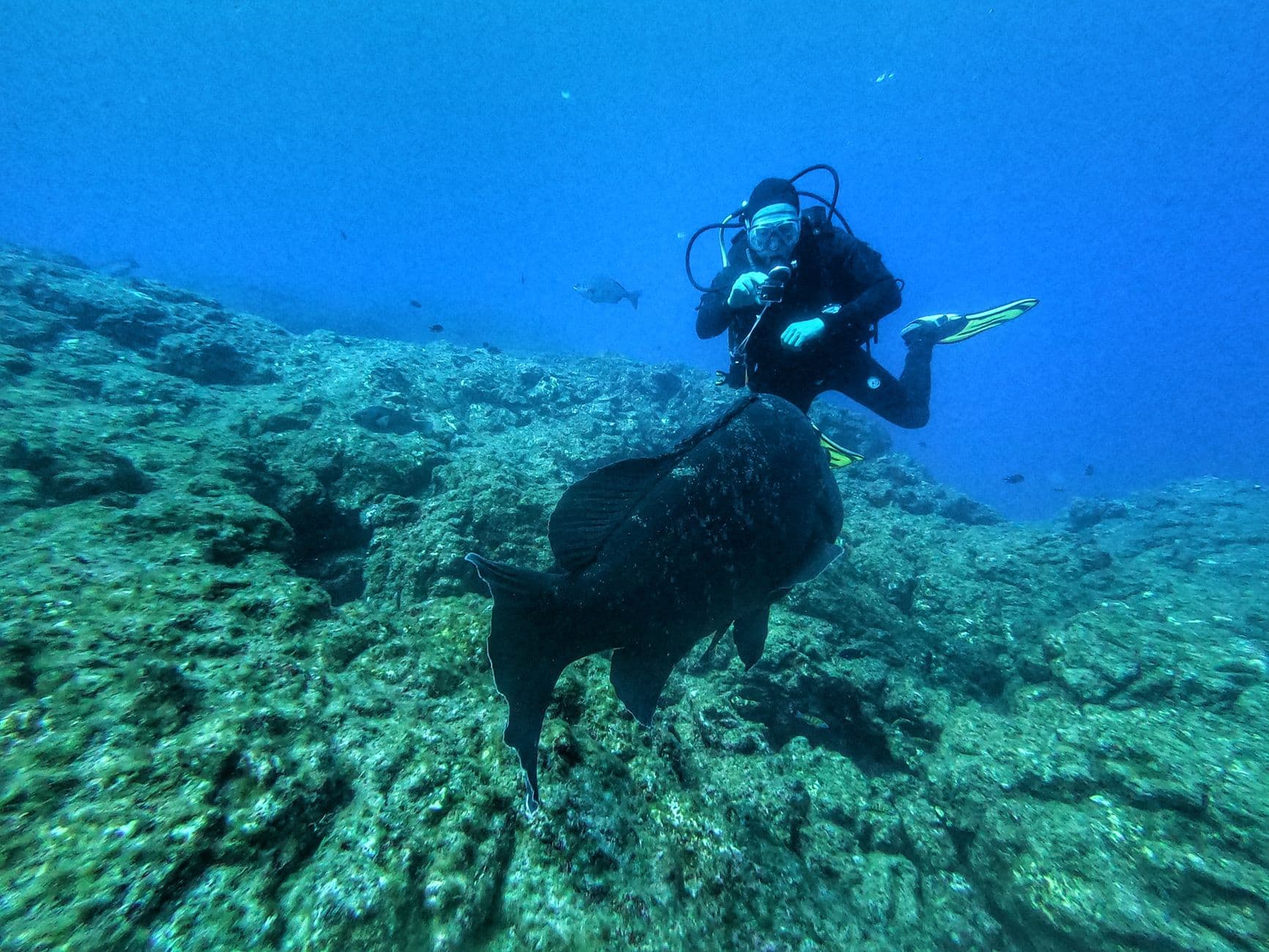
Azores Diving: The Ultimate Guide to Europe's Pelagic Capital
The Azores are where the Atlantic Ocean reveals its secrets.
This Portuguese autonomous archipelago sits 1,500 kilometers (930 miles) west of Lisbon, dead center of the mid-Atlantic, and it has become the closest place in the world for European divers to encounter giant mobula rays, blue sharks, mako sharks, and oceanic manta rays in their natural habitat. The water here doesn't gradually deepen — it drops off from a shallow shelf directly into abyssal plains over 2,000 meters deep, and that dramatic topography is what makes Azores diving so extraordinary.
The nine volcanic islands of the Azores create an underwater landscape that looks like another planet. Underwater calderas, lava tubes, submerged sea stacks, canyons, and seamounts rising from 1,500+ meters — the geological drama is matched only by the marine life that thrives in these waters. Thirty percent of Azores waters are designated as a Marine Protected Area, the largest in Europe, and half of that is a fully protected no-take zone. That means the wildlife you encounter here has a real chance to ignore you and behave exactly as it would in the deep ocean.
What Makes the Azores Unique
Princess Alice Bank: The Crown Jewel
The single reason most divers come to the Azores is Princess Alice Bank — a submerged seamount rising 1,500 meters from the abyssal plain to just 32 meters below the surface, located about 45 nautical miles southwest of Pico Island. On the right dive, this underwater mountain summons between 500 and 1,000+ giant mobula rays (Mobula tarapacana) on a single dive. It is, by any measure, the most concentrated ray aggregation in the world. Barracuda swim in dense cylinders overhead. Blue marlin cruise the depths. And the mobulas — some spanning over 4 meters wing-to-wing — circle you slowly, taking no notice of the diver hovering in the blue.
Blue-Water Shark Diving
The Dollabarat Seamount near Pico is one of the densest concentrations of blue sharks in the Atlantic. Divers go here specifically for pelagic encounters — blue sharks, mako sharks, sailfish, and giant marlin. This is advanced diving with strong currents, open-ocean conditions, and full-day boat expeditions from Horta. The reward is swimming in blue-water environments where there is no bottom, no reef, and no shore in sight — just the deep blue and the animals that live in it.
The Submerged Caldera
Vila Franca do Campo on São Miguel is a submerged volcanic caldera — and it's the only one of its kind in Europe you can dive inside. The caldera rim is at 12–30 m, and inside the sheltered lagoon the water sits at 8–18 m. Harbor fish, barracuda, groupers, and sea bass are common, and dolphin encounters happen regularly, especially in summer. The water is calm inside, making it accessible to beginners, while the reef wall is a compelling feature for all levels.
Underwater Landmarks
The Azores pack extraordinary landmarks into a small area. The Ilhéus das Formigas marine reserve sits 30 minutes by boat from Vila Franca and features an actual underwater lighthouse at 20 meters depth — a preserved structure that sits on the seabed and draws dense marine life. Faial Island has the Museu Subaquático de Horta, an open-air underwater sculpture garden where marine biologists have been observing coralline algae encrusting the sculptures since installation. And on Terceira, a WWII decommissioned ship graveyard sits scattered on the seabed, making it one of the few wreck-diving opportunities in the archipelago.
Who the Azores Is For
The Azores is not a casual destination. It is the most rewarding diving in Europe for divers who want:
- Big animal encounters — mobula rays, manta rays, blue sharks, mako sharks, tuna, billfish, whale sharks (occasional), dolphins, and 20+ species of whales
- Blue-water diving — open-ocean dives where the ocean is 2,000+ meters deep a few hundred meters from the boat
- Volcanic topography — lava tubes, arches, canyons, sea stacks, caves, tunnels, and submerged calderas
- Conservation-diving — diving in the largest marine protected area in Europe with genuinely thriving ecosystems
The Azores is ideal for Open Water divers who want beginner-accessible shore and coastal sites like Vila Franca and the caldera interior. It is the best destination in Europe for advanced divers seeking pelagic seamount diving with the big animals that open-ocean blues attract. It is less suited for divers looking for shallow coral gardens or tropical reef diving — the Azores experience is about dramatic topography, clear water, and pelagic wildlife.
The Seven Dive Shops
Diving in the Azores is well-organized. There are seven verified dive shops across the archipelago, concentrated on São Miguel (three shops in Ponta Delgada and Vila Franca), Pico (two shops in Horta and Madalena), and Faial (one eco-operator in Horta). Prices from CW Azores on Pico — the most transparent operator — run €55 for a single coastal dive, €200 for a four-dive package, and €250 for a full-day Princess Alice Bank expedition with two tanks.
You'll want to spend time across at least two islands to get the full Azores experience. São Miguel gives you the iconic caldera dives and beginner-friendly sites. Pico is your base for Princess Alice Bank, Dollabarat, and the best pelagic diving. Faial offers the underwater museum and a marine-biologist-run dive operation. Terceira brings wreck diving. Santa Maria provides the warmest waters of the archipelago.
Practical Overview
The Azores sit in the Atlantic/Azores timezone (UTC-1, no daylight saving). Euro (€) is the currency. English is widely spoken in dive shops and tourist areas, though Portuguese is the official language. The nearest major airports are João Paulo II (PDL) on São Miguel with direct connections from Lisbon (2.5 hours) and seasonal direct flights from Boston and Toronto.
Bottom Line
The Azores is the closest place in the world — and Europe's undisputed best — for pelagic diving. If you want to swim alongside 1,000 mobula rays on a single dive, see blue sharks at depth, or dive inside a submerged volcanic caldera, the Azores delivers. The diving is accessible from Lisbon via short flight, the dive infrastructure is mature, and the conservation protections mean the wildlife is genuinely wild. It is, simply, one of the best diving experiences in Europe.