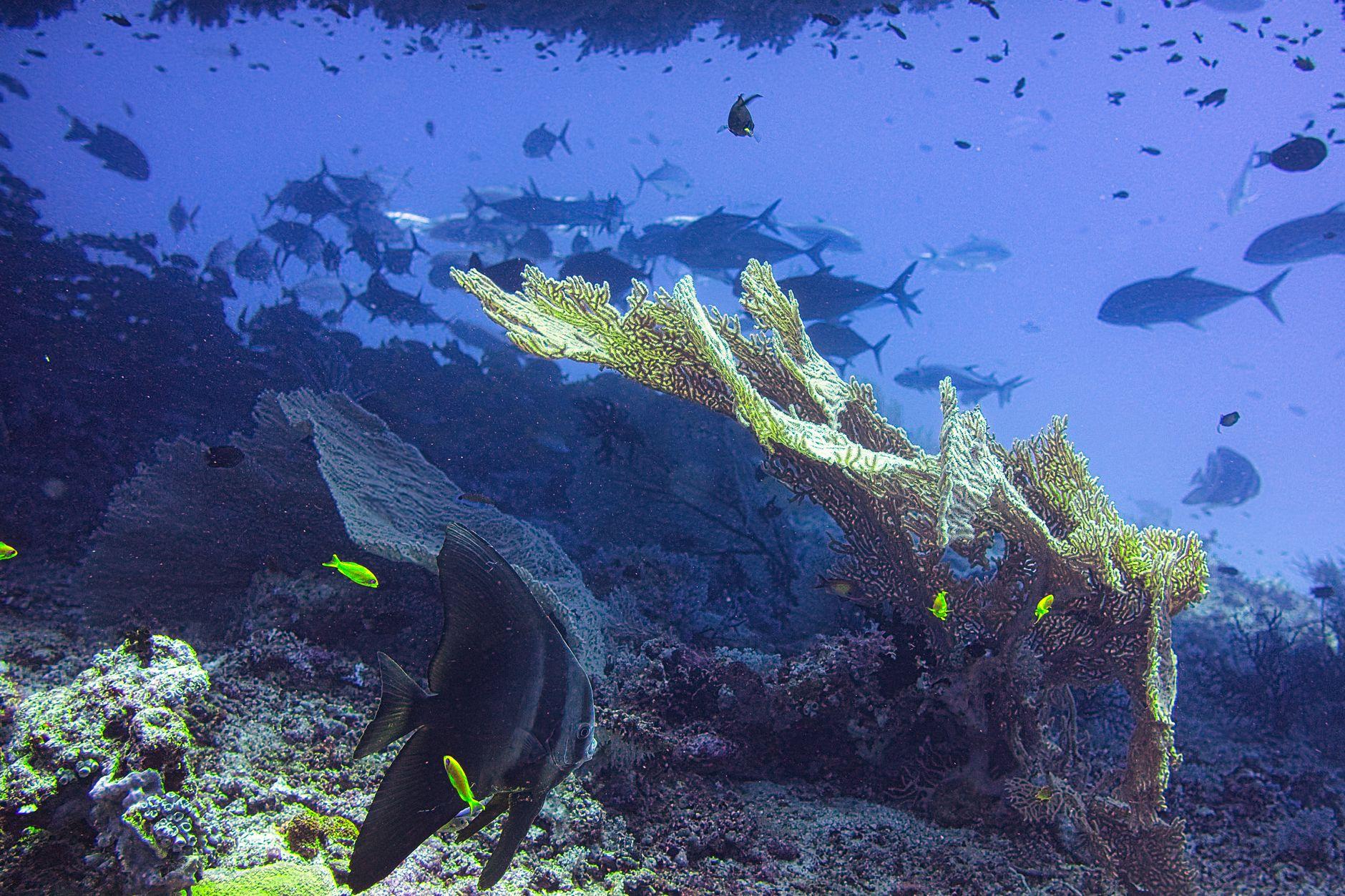
Top 10 Dive Sites at Aliwal Shoal
Aliwal Shoal compresses a remarkable range of diving into one offshore system: shark caves, current-swept edges, shallow sand gullies, macro-rich ledges, two historic wrecks and specialist blue-water drifts. Rankings are useful for planning, but conditions decide which site is truly best on a given morning. A safe shallow reef in manageable current beats a famous wreck forced into the wrong sea state.
The list below uses documented public site descriptions and conservative depth ranges. Individual GPS coordinates are not widely published, so operators choose drop points according to current. Every dive is boat-accessed from Umkomaas and includes the physical demands of a RIB surf launch.
1. Cathedral
Depth: 19–27 m | Level: Advanced | Best window: Winter raggies; reef life year-round
A broad arch and cavern-like opening make Cathedral the shoal’s most dramatic structural dive. The sandy floor and current-facing walls create opportunities for ragged-tooth sharks, rays, morays and schools of reef fish. Maintain buoyancy around the arch and avoid entering enclosed spaces beyond training.
Ask the operator how current changes the planned route, descent point and pickup. The same named site can feel very different from one day to the next.
2. Raggies Cave
Depth: to 18 m | Level: Open Water to advanced | Best window: June–October
The site is named for the winter aggregation. Divers usually remain outside the overhang and let ragged-tooth sharks choose their route. Shallow depth can provide long observation time, but crowding, surge and current still require disciplined positioning.
Ask the operator how current changes the planned route, descent point and pickup. The same named site can feel very different from one day to the next.
3. MV Produce
Depth: to 32 m | Level: Advanced | Best window: Year-round; raggies in winter
This 1974 cargo wreck is heavily encrusted and famous for potato bass, morays and schooling fish. Its depth compresses no-decompression time, while current can complicate descent and pickup. Treat penetration as a separate trained activity, not an automatic part of the dive.
Ask the operator how current changes the planned route, descent point and pickup. The same named site can feel very different from one day to the next.
4. Outside Edge
Depth: to 27 m | Level: Advanced in current | Best window: Warm-season pelagics
The exposed edge is where divers look away from the reef for tiger, bull, blacktip or occasional hammerhead sharks. Game fish and eagle rays also use the current line. The payoff is blue-water possibility; the cost is variable drift speed and visibility.
Ask the operator how current changes the planned route, descent point and pickup. The same named site can feel very different from one day to the next.
5. Inside Edge
Depth: to 22 m | Level: Open Water in benign seas | Best window: Year-round macro and reef life
Inside Edge shows that Aliwal is more than sharks. Search for octopus, cuttlefish, scorpionfish, lionfish, cowfish, nudibranchs and morays along ledges and rubble. Slow movement and a torch reveal more than chasing the group’s fastest swimmer.
Ask the operator how current changes the planned route, descent point and pickup. The same named site can feel very different from one day to the next.
6. SS Nebo
Depth: to 27 m | Level: Advanced recommended | Best window: Year-round
The older of Aliwal’s classic wrecks sank in 1884 with railway materials. Partly collapsed remains, boiler and propeller features support eels and baitfish. It is shallower than MV Produce but remains a serious ocean wreck when visibility or current deteriorates.
Ask the operator how current changes the planned route, descent point and pickup. The same named site can feel very different from one day to the next.
7. Channel Cave / Chunnel
Depth: 11–12 m | Level: Open Water in suitable conditions | Best window: Winter raggies
A shallow channel and cave-like reef opening often holds small schooling fish and resting raggies. Its depth makes it accessible, not automatically easy: surge, current, close groups and overhead temptation must all be managed.
Ask the operator how current changes the planned route, descent point and pickup. The same named site can feel very different from one day to the next.
8. Eelskins
Depth: to 18 m | Level: Open Water | Best window: Year-round
Clusters of reef, sandy gullies and swim-through-like structure create a relaxed exploratory profile on good days. Morays, nudibranchs, reef fish and rays reward close observation. It is a useful alternative when deeper objectives are unsuitable.
Ask the operator how current changes the planned route, descent point and pickup. The same named site can feel very different from one day to the next.
9. North and South Sands
Depth: to 14 m | Level: Open Water | Best window: Year-round
These shallow sand-and-reef interfaces offer easier depth profiles and chances for sand-associated sharks, rays, dolphins and reef fish. They can suit newer divers under direct guidance, though the surf launch and open-ocean pickup remain part of the experience.
Ask the operator how current changes the planned route, descent point and pickup. The same named site can feel very different from one day to the next.
10. Shark Alley / Baited Drift
Depth: midwater | Level: Experienced divers | Best window: November–March
This is an operator-selected blue-water route rather than a fixed reef coordinate. Blacktip sharks are regular targets, with tiger, bull and dusky sharks possible. Join only a reputable specialist operator and follow formation, depth and exit instructions exactly.
Ask the operator how current changes the planned route, descent point and pickup. The same named site can feel very different from one day to the next.
Quick Comparison
| Site | Depth | Best for | Typical level |
|---|---|---|---|
| Cathedral | 19–27 m | Structure and winter raggies | Advanced |
| Raggies Cave | to 18 m | Calm shark observation | OW–Advanced |
| MV Produce | to 32 m | Wreck and potato bass | Advanced |
| Outside Edge | to 27 m | Blue-water pelagics | Advanced |
| Inside Edge | to 22 m | Macro and reef life | OW in benign seas |
| SS Nebo | to 27 m | Historic wreck | Advanced |
| Channel Cave | 11–12 m | Shallow raggie site | OW in benign seas |
| Eelskins | to 18 m | Gullies, morays and reef | Open Water |
| North/South Sands | to 14 m | Easier profiles | Open Water |
| Shark Alley drift | Midwater | Specialist shark encounter | Experienced |
How to Choose
Choose Cathedral, Raggies Cave or Channel Cave for the winter shark story. Choose MV Produce or SS Nebo if wreck history is the priority and your recent depth experience is strong. Choose Inside Edge and Eelskins when you want slower reef observation, photography and a break from staring into blue water. Choose Outside Edge or a specialist drift only when the operator is satisfied with current, visibility and group control.
Plan variety rather than a rigid checklist. A good four- to six-day trip might combine two structural reefs, one wreck, one shallow site, one macro-oriented edge and one specialist shark dive. Weather buffers matter because a wreck may be unavailable on the exact day you hoped to dive it.
Planning an Aliwal Shoal Dive Week
Base yourself in Umkomaas, the working coastal town used by local dive operators. King Shaka International Airport is the usual gateway, followed by roughly one to one and a half hours by road depending on traffic and pickup point. A four- to six-day diving window is sensible because surf, current and visibility can change quickly. Building a buffer day into the schedule gives an operator room to move a wreck dive, shark drift or exposed reef objective to the safest weather window.
Every day begins with operator judgment. The skipper considers the surf at the Umkomaas launch, offshore wind, current direction and the experience of the group. Divers help launch the RIB, secure cylinders and loose equipment, and enter by backward roll. A negative entry may be requested when current is moving across the shoal. Listen closely to the briefing, descend with the team, carry a visible surface marker buoy, and agree on lost-buddy and separation procedures before leaving shore.
Aliwal is inside a marine protected area. Confirm the current permit process with your operator and follow no-touch, no-chase and no-feeding rules. On shark dives, stay in the formation defined by the guide, avoid rapid surface movements, and never treat a close animal as permission to approach it. On reef and wreck dives, keep fins away from soft corals and avoid placing hands on ledges where scorpionfish, lionfish or morays may be concealed.
Equipment and Safety
A 5 mm full suit is a useful baseline. Cold-sensitive divers should bring a 7 mm suit or hooded vest for winter, deep wreck profiles and repeated dives. Pack an SMB and reel, audible signaling device, cutting tool, dive computer and a torch for overhangs and wreck openings. Gloves are not an invitation to touch the reef. Keep camera equipment compact enough to manage during a surf launch and hand it up when the crew instructs you to do so.
The nearest hyperbaric support is not in Umkomaas; research points toward Durban, roughly 50 km north. Verify current chamber availability and emergency numbers directly with the operator before diving, carry suitable dive insurance, and leave enough surface interval before flying. Operators carry oxygen and first aid, but that does not shorten the road transfer. Conservative profiles, hydration, controlled ascents and honest reporting of fatigue are especially important at a destination where current and boat handling add workload.
Respecting the Sites
Ragged-tooth sharks need space around their resting routes. Stay outside cave mouths, avoid blocking exits and let each animal set the distance. On blue-water drifts, remain in the instructed formation. On wrecks, do not grab living growth or enter openings without training. Across the MPA, excellent buoyancy is the most useful conservation tool a visiting diver brings.
Aliwal's best site is ultimately the one that matches the day's sea and your actual ability. Trusting that judgment creates better encounters, safer profiles and a reason to return for the sites the ocean kept closed the first time.